return to home  
Join   |  Gift   |  Member Login   |  Library Login
BookBrowse Mobile
twitter Bookmark and Share mail to a friend Email
   Reading Guides

The Devil in the White City by Erik Larson: Questions, plus a reading group guide, with links to reviews, excerpt, author biography at BookBrowse.com.

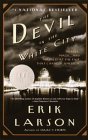
The Devil in the White City

The Devil in the White City
Murder, Magic, and Madness at the Fair That Changed America
by Erik Larson
Hardcover: Feb 2003,
447 pages.
Paperback: Feb 2004,
464 pages.

Publication information
Author Information
Critics' Opinion:   
Readers' Rating:  
About BookBrowse Rankings
Buy This Book

Reading Guide Questions

 Printer Friendly Guide

Please be aware that this discussion guide may contain spoilers!

About This Book

In The Devil in the White City, Erik Larson takes readers into a richly complex moment in American history, a moment that would draw together the best and worst of the Gilded Age, the grandeur and triumph of the human imagination, and the poverty, violence, and depravity that surrounded it.

The book's two most powerful figures, the great architect Daniel Burnham and the psychopathic killer, Henry H. Holmes, in many ways embody the opposing forces of the age. Burnham was responsible for building the White City, overcoming a series of crushing professional obstacles and personal tragedies to make the Fair the magical, awe-inspiring event that it was. He brought together some of the greatest architects of the day—Charles McKim, George Post, Richard Hunt, Frederick Law Olmsted, and others—convinced them of the importance of the Fair, and somehow got them to work together to achieve what many considered to be an impossible project in an astonishingly brief amount of time. Simultaneously, in the shadow of the White City, Henry H. Holmes set up his own World's Fair Hotel to take advantage of naive young single women arriving in Chicago from surrounding small towns. Using his mesmerizing charm and an uncanny ability to fend off creditors and police, Holmes bent his victims to his will and committed a series of murders as cold-blooded as any in American history.

But The Devil in the White City is about more than just two men. It is about America on the threshold of the twentieth century—a time of widespread violence, fantastic wealth, growing labor unrest, and financial panic; a time when Buffalo Bill could take a bow to Susan B. Anthony; and a time when men and women as diverse as Jane Addams, Theodore Dreiser, Thomas Edison, Samuel Gompers, and Frank Lloyd Wright—could all gaze in wonder at the magnificence of the White City.


Reading Guide

  1. In the note "Evils Imminent," Erik Larson writes "Beneath the gore and smoke and loam, this book is about the evanescence of life, and why some men choose to fill their brief allotment of time engaging the impossible, others in the manufacture of sorrow" [xi]. What does the book reveal about "the ineluctable conflict between good and evil"? What is the essential difference between men like Daniel Burnham and Henry H. Holmes? Are they alike in any way?

  2. At the end of The Devil in the White City, in Notes and Sources, Larson writes "The thing that entranced me about Chicago in the Gilded Age was the city's willingness to take on the impossible in the name of civic honor, a concept so removed from the modern psyche that two wise readers of early drafts of this book wondered why Chicago was so avid to win the world's fair in the first place" [p. 393]. What motives, in addition to "civic honor," drove Chicago to build the Fair? In what ways might the desire to "out-Eiffel Eiffel" and to show New York that Chicago was more than a meat-packing backwater be seen as problematic?

  3. The White City is repeatedly referred to as a dream. The young poet Edgar Lee Masters called the Court of Honor "an inexhaustible dream of beauty" [p. 252]; Dora Root wrote "I think I should never willingly cease drifting in that dreamland" [p. 253]; Theodore Dreiser said he had been swept "into a dream from which I did not recover for months" [p. 306]; and columnist Teresa Dean found it "cruel . . . to let us dream and drift through heaven for six months, and then to take it out of our lives" [p. 335]. What accounts for the dreamlike quality of the White City? What are the positive and negative aspects of this dream?

  4. In what ways does the Chicago World's Fair of 1893 change America? What lasting inventions and ideas did it introduce into American culture? What important figures were critically influenced by the Fair?

  5. At the end of the book, Larson suggests that "Exactly what motivated Holmes may never be known" [p. 395]. What possible motives are exposed in The Devil in the White City? Why is it important to try to understand the motives of a person like Holmes?

  6. After the Fair ended, Ray Stannard Baker noted "What a human downfall after the magnificence and prodigality of the World's Fair which has so recently closed its doors! Heights of splendor, pride, exaltation in one month: depths of wretchedness, suffering, hunger, cold, in the next" [p. 334]. What is the relationship between the opulence and grandeur of the Fair and the poverty and degradation that surrounded it? In what ways does the Fair bring into focus the extreme contrasts of the Gilded Age? What narrative techniques does Larson use to create suspense in the book? How does he end sections and chapters of the book in a manner that makes' the reader anxious to find out what happens next?

  7. Larson writes, "The juxtaposition of pride and unfathomed evil struck me as offering powerful insights into the nature of men and their ambitions" [p. 393]. What such insights does the book offer? What more recent stories of pride, ambition, and evil parallel those described in The Devil in the White City?

  8. What does The Devil in the White City add to our knowledge about Frederick Law Olmsted and Daniel Burnham? What are the most admirable traits of these two men? What are their most important aesthetic principles?

  9. In his speech before his wheel took on its first passengers, George Ferris "happily assured the audience that the man condemned for having ‘wheels in his head' had gotten them out of his head and into the heart of the Midway Plaisance" [p. 279]. In what way is the entire Fair an example of the power of human ingenuity, of the ability to realize the dreams of imagination?

  10. How was Holmes able to exert such power over his victims? What weaknesses did he prey upon? Why wasn't he caught earlier? In what ways does his story "illustrate the end of the century" [p. 370] as the Chicago Times-Herald wrote?

  11. What satisfaction can be derived from a nonfiction book like The Devil in the White City that cannot be found in novels? In what ways is the book like a novel?

  12. In describing the collapse of the roof of Manufacturers and Liberal Arts Building, Larson writes "In a great blur of snow and silvery glass the building's roof—that marvel of late nineteenth-century hubris, enclosing the greatest volume of unobstructed space in history—collapsed to the floor below" [p. 196–97]. Was the entire Fair, in its extravagant size and cost, an exhibition of arrogance? Do such creative acts automatically engender a darker, destructive parallel? Can Holmes be seen as the natural darker side of the Fair's glory?

  13. What is the total picture of late nineteenth-century America that emerges from The Devil in the White City? How is that time both like and unlike contemporary America? What are the most significant differences? In what ways does that time mirror the present?


Suggested Reading
John Berendt, Midnight in the Garden of Good and Evil; E. L. Doctorow, World's Fair; Theodore Dreiser, Sister Carrie; Eric W. Hickey, Serial Murderers and Their Victims; Jon Krakauer, Into Thin Air; Upton Sinclair, The Jungle; Mark Twain, The Gilded Age; Edith Wharton, The House of Mirth.

Copyright Vintage Publishing.


Unless otherwise stated, this discussion guide is reprinted with the permission of Vintage. Any page references refer to a USA edition of the book, usually the trade paperback version, and may vary in other editions.

Become a Member
The Leftovers
Editor's Choice
  •  May 24 
  •  May 22 
  •  May 20 
Luminarium
Alex Shakar
Luminarium Jacket Do you feel... Your life is without purpose? Your days are without meaning? There's something about existence you're just not getting?
Lehrter Station
David Downing
Lehrter Station Jacket WWII has ended… But the danger has just begun for a spy caught between political superpowers.
All Woman and Springtime
Brandon W. Jones
All Woman and Springtime Jacket This spellbinding debut, reminiscent of Memoirs of a Geisha, depicts, with chilling accuracy, life behind North Korea's iron curtain.
Birdseye
Mark Kurlansky
Birdseye Jacket The first biography of Clarence Birdseye, the eccentric genius inventor whose fast-freezing process revolutionized the food industry and American agriculture.
A Land More Kind Than Home
Wiley Cash
A Land More Kind Than Home Jacket A mesmerizing literary thriller about the bond between two brothers and the evil they face in a small western North Carolina town.
Click Here
   Most Recent Blog Entries
Why "Fifty Shades of Grey" Is So Successful
Summer 2012: Movies Based on Books
Following the Thread - Great Book Design
rss  RSS   rss  subscribe
The Butterfly Cabinet
  Latest BookBrowse News
BookExpo America will broadcast live author appearances for the first time (May 24 2012)
For the first time, BookExpo America is making author appearances at the show available for viewing online live or on demand, via Livestream. It is... Full Story
rss RSS feed More...
BookBrowse Poll
Q: Have you bought a book in any of these stores in the last 3 months?
Walmart
Costco
Sam's Club
Any other warehouse store
Any other bricks & mortar location that isn't a bookstore
None of these
Select Any That Apply
Search: Title or Author
Free Newsletters

Online Book Club
More about
Next to Love
Join the discussion!

BookBrowse Showcase
visit showcase now!
Advertise Here

First Impressions
Members Recommend:
Afterwards
by Rosamund Lupton
4.5 Stars
Lots of Candles, Plenty of Cake
by Anna Quindlen
4.5 Stars
The Secrets of Mary Bowser
by Lois Leveen
Five Stars
A Lady Cyclist's Guide to Kashgar
by Suzanne Joinson
Four Stars
A Simple Murder
by Eleanor Kuhns
Four Stars
The Voluntourist
by Ken Budd
3.5 Stars
more...


Win This Book!
Beneath The Shadows

Beneath the Shadows jacket

A thrilling gothic debut - publishing June 5

Enter To Win Now!

wordplay
Solve this clue:
"S T Pass I T N"

and be entered
to win....
frame top
New Author
Interviews
Isabel Allende
Alice Hoffman
Richard Ford
Mark Seal
frame bottom
HOME Submissions | Advertising | Libraries | Media Inquiries | Reviewers | Contact Us