Write your own review!
beentheredonethat
(01/26/11)
eh..unfinished.
I was disappointed in how quickly Barbara retreated! Seemed she didn't try too very hard to explore all possibilities...kinda fell into a stereotypical mindset & setting and then pulled out. thrift stores are a treasure trove of necessities - one trip, she would have supplied herself with kitchen utensils and work clothes to meet her needs for pennies on the dollar. She could of hit the day labor agencies for the in between wait days (and cash in hand at the end of each day). How about taking a room at the local 'y' or in a private home? Answer some ads for a roommate! Hit the food pantries! Maybe a night in her car would of got the creative/fear juices flowing...geeez, did she even stay into the 2nd month? Aside from her half baked attempt, I did LOL several times, but was left filling in the blanks. something she could of done with a little more effort, with a sincere application of herself to the project at hand.
RM
(07/01/10)
Classism, racism, and herr Ehrenreich
Though my title is harsh, it doesn't compare to the subtle racist and classist innuendo peppering this book. For someone who is prone to Marxist rhetoric, I found it ironic that Ehrenreich fell back on her more comfortable lifestyle in times of need. I think this book could have much better been written by someone who truly has lived the life she is able to pop in and out of. Her book is an exercise in modern day black face. It is entertainment that seemingly mimics reality, but is actually a condescending show of Ehrenreich's privilege, written for those who feel a need to pat themselves on the back for their concern and found understanding of America's working poor.
Editor's note: Blackface is the term used to describe the theatrical makeup used in the United States in minstrel shows and vaudeville, which became associated with certain archetypes of American racism.
Robert Holloway
(05/20/09)
Nickel and Dimed
The book is good,but it fails to state how other low wage workers feel about their jobs. Besides in the end when she quits all the jobs, her so called friends don't even care when she leaves. So working in low wage America isn't necessarily bad. There are plenty of Americans who enjoy working their low wage jobs that may offer many benefits such as Health Care, and Retirement Benefits.
Christian Jeans
(01/05/09)
Not very good
I thought Ehrenreich was so so condescending going into this that she never got the full experience. She forgot that these are peoples real lives, she didn't spend enough time to see how it is over a long period of time. She also went into areas where the poverty level was not that bad Key West?, Maine?, how about trying to go into Chicago or New York to make a living. The book had an obvious bias and she even mentioned that she was prone to marxist rants which is blatantly saying she supports socialism. I felt like she set her self up to fail and from the beginning she did not try her hardest. There were some good points though and it did expose the harsh life the some American live just to survive.
Vanessa
(02/14/08)
Reality Check
This book is guaranteed to be ignored or rated low by anyone that is made uncomfortable by the plight of the working poor. It is much easier to believe that people are poor and living in the street because they are lazy or like it. This is reality. Unfortunately, the people who can make the difference either refuse to acknowledge there is a problem or use the excuse that they can not help everyone. This excuse allows them to justify doing nothing.
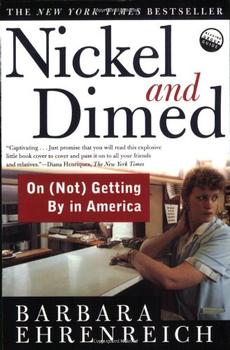
After the 1996 welfare reform Barbara began questioning how millions of women were living, and often raising families, on $6 to $7 an hour. With a scientific determination Barbara chooses to step out of the security of her privileged social class to experience the lifestyle of the less fortunate. The resulting ethnography evolves from an investigative journalist paradigm as Barbara discovers the reality of survival in Key West, Florida; Portland, Main; and Minneapolis, Minnesota, on poverty level employment.
Barbara’s experiences were spread out over a two year period between the spring of 1998 and the summer of 2000. She acknowledges that she could not survive for over a month in any one situation. However, the reader never knows for sure the reason for or the length of time between each attempt. In an interest of social does use each individual experience to expose the irrational idealistic concepts that: Any job will lead to self improvement and the ability to defeat poverty.
tmg619
(08/28/07)
bad
I did not like this book at all, the way it was written made the book boring and pointless to read, a lot of people know its hard to work low wage so do we have to write about it some people may have liked this book and thats ok.
Lisa
(04/10/05)
Book Shouts a Message that Needs to be Heard
This book is excellent and should be required reading for all highschool students as a good idea of where one may end up without a college education. I applaud Barbara for her guts to go do the job of actually living the life of the working poor. What better way to truly understand and report, loud and clear, the true nitty-gritty" circumstances of those without advantages or knowledge of how to get beyond the low wage rut.
Her humor is marvelous and helps get a message across of just how ridiculous the beauracracies can be. She is laughing in disbelief at what employers can get away with and what low income workers must deal with simply for the sake of survival.
How refreshing to read something honest as opposed to many supposed motivating and "feel good" articles, we find these days, on how to work more, try harder, reach that impossilbe dream, which more often than not for many people is exactly that: impossible and just a dream.
Kathy
(01/22/05)
This book's impact is significant because the author lived among the working poor, taking low-wage jobs, finding whatever housing she could afford on such wages, and living paycheck to paycheck. The author, as a reporter, could have simply interviewed some of these workers, but that would not have captured firsthand the difficulty of surviving on minimum wage. No, it's not a perfect book. The author goes on rants at times that seem endless, but her story brought the issues of the working poor to the attention of many Americans who had no idea what it was like to do back-breaking, degrading work and still not be able to make ends meet. I was glad to see that this book was being used as a teaching aid in high schools and universities.