Write your own review!
Julie B. (Menomonee Falls, WI)
(03/27/12)
Interesting but not a typical Christopher Moore
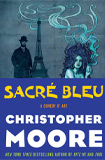
I was so excited to read the newest Christopher Moore. I have read almost all of his books and found them to be laugh-out-loud funny. Not so with this book. It was certainly amusing, but not what I expected from Moore. It was, however a very original story about real artists in a very unreal situation. I would recommend it for the story and the illustrations of beautiful paintings.
Michael F. (Providence, RI)
(03/26/12)
Bravo!
What a find! Sacré Bleu is a highly-entertaining and smartly-written romp through the late 19th Century art scene in Montmartre and beyond. The book is infused with sharp wit and is cleverly spiced with well-researched historical characters and details. The result is a funny, sexy story that grabs the reader immediately and holds on throughout the wild ride that follows. Filled with likeable characters and highly imaginative plot turns, Sacré Bleu is a thoroughly-satisfying read. I, for one, will never look at Toulouse- Lautrec the same way again. Merci Christopher Moore!
Stan W. (Columbus, OH)
(03/14/12)
A Comedy of Arts
In typical Christopher Moore fashion, the author has written yet another book that proposes a unique "take" on a particular subject matter, in this case, art history. The story centers on a mysterious letter written by Van Gogh just before his death and sent to Toulouse-Lautrec. While the book is not his best work, in my opinion, it does evoke a few laugh-out-loud moments. If you like Sacré Bleu, then I would recommend you read my personal favorites by iMoore, Fluke/i and iA Dirty Job/i.
Teresa M. (Naples, FL)
(03/13/12)
a good read
I chose this book because I love the Impressionists, find this period of time fascinating and am always interested in learning more about both. And this book does not disappoint. Although clearly the author did a great amount of research, it is a fictional and irreverent art history lesson set in fin de siecle France. I was completely entertained by the author's characters, both real and imagined, and will recommend this book to my friends who love art, Paris and good reads.
Sara S. (Murfreesboro, TN)
(03/10/12)
Blue
Christopher Moore ceases to fail at creating a novel that is both intriguing, smart, and without delay - hilarious. Sacre Bleu is another one of his better works. The novel is both witty and smart while taking you on a journey through history and art. I definitely recommend anyone to read this or any other work by Christopher Moore.
Mary G. (Purcellville, VA)
(03/08/12)
Sacre Bleu is a fun read
I am a huge fan of Christopher Moore so I was excited to be selected to review his latest book, Sacre Bleu. While not as laugh out loud funny as some of his other works, Sacre Bleu is still highly original and entertaining. It is probably the quirkiest art history you will ever read.
Pam (MA)
(03/08/12)
Sacre Blue
Sacre Bleu is comic historical fiction about the post impressionist painters of the late 19th century. Toulouse Lautrec is one of the main characters. Fiction about art and artists is one of my favorite types but this book took me awhile to get into because of its totally irreverent approach to its subject matter. Once I got over the author’s sophomoric potty-mouth writing style, I enjoyed the book a lot. The author captured the angst of artistic life and had an interesting take on the artist’s muse. I particularly enjoyed the inclusion of the works of art referred to in the story. As I read the book, I felt I was reading a comic book or graphic novel. The most similar book that I know is Secret Lives of Great Artists by Elizabeth Lunday which is a graphic book.
Karen M. (Great Falls, VA)
(03/01/12)
Very good storyteller
I have always wanted to read a Christopher Moore book. His reviews are nearly always positive. His work is considered witty, humorous and a bit of a satire. I thought we might have a current day Oscar Wilde on our hands. So, it was with great enthusiasm I asked for an ARC from Bookbrowse in order to read his latest "masterpiece" (says the book jacket), Sacré Bleu.
Christopher Moore can tell a great story. One that you don't want to put down. He can write funny dialogue; in this case, the banter between Henri Toulous-Lautrec and Lucien Lessard is first-rate. The central conceit of the book surrounds a supernatural phenomenon that is causing all the painters of the time -- van Gogh, Monet, Renoir, Pissaro and Cezanne to paint their finest work using the color
"sacré bleu." This color comes from a mysterious Colorman and an equally curious but enchanting woman who poses for these artists. These men feverishly create masterworks during months of infatuation with their models accompanied by loss of time, no memory of painting these works, and unbelievable sex. The Roman Catholic Church wants this particular shade of blue to be used exclusively for the painting of the Virgin Mary's clothes. Thus the name, translated from French, as "the sacred blue." Obviously, it's inspiring other unforgettable and racy uses for the painters of Paris who feel compelled to use it.
Of course, Moore can't ignore the joke in the title, for "sacré bleu" is considered a curse or more importantly, a profanity, in french. Loosely translated, it is the exclamation "My God." Wikipedia will tell you it's rarely used in French-speaking countries, but the word was taught to me in my high school French III class in 1970's America. Profanity is a surprise player in this book. I am caught up in the story, and then one of the characters says "shag," or "bugger,"not terms found in late 18th century France, and it derails me. It takes me out of the experience and lands me right back in the present day. Why would Moore do it? It felt as if he is an adolescent saying naughty words just to shock and/or mess with the readers' heads. Perhaps he doesn't want you to take the subject matter and the characters too seriously. I suppose if you love movies or TV shows where there is a lot of burping and farting, then it's funny. But I wonder why would he insert English cuss words into the great French painters' mouths? Maybe I missed the memo that told me that these words are considered funny outside of England.
With the above caveat, I would recommend this book to anyone who would love to read a mystery with a supernatural twist set in the late 1800s in Paris. There is even a bit of time travel, always a plus. Famous artists are creating very recognizable works of art and Moore puts you in the room with the painters. We find out about the masters' sisters, brothers, mothers, fathers, lovers, and wives. I have read several books about this time of tremendous creativity combined with perhaps a little debauchery a la Moulin Rouge, and I found Moore's twisted fantasy to still be informative and fun. It's clear that Moore did his research and shares his knowledge in a delightful and engrossing narrative. I finished it in a day, and I intend to immediately check out all of Moore's other work. If the subject matter is of interest, I'll buy and read the book. And now that I know his characters may have a case of Tourette's Syndrome, I'm prepared.