Write your own review!
Sally
A Wealth of Knowledge
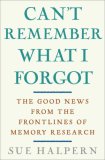
Halprin's book, "I Can't Remember" What I Forgot, is a darn good read. She takes the reader through an adventure of the brain, as a one-woman detective who is seeking to find and understand the culprit for memory loss and Alzheimer's. She is willing to be a guinea pig for this investigation, volunteering for memory studies, including those studies that are dubbed 'quackery' by medical circles. Halprin condenses a vast subject and is successful in narrowing it down to 245 pages, covering neuroscience, brain morphology, procedures, and pharmaceuticals. Her narrative also includes many heart-felt stories of doctors and patients who are working with and experiencing memory defects.
Halprin's journey can be read and understood by any layman and will contribute a wealth of knowledge to the reader. It is witty, informative, and fun reading. I recommend this book for anyone who is interested in learning more about memory and Alzheimer's.
Sandra
Calming the fear
Alzheimer's is something most 'boomers' have a concern about. Author Sue Halpern has written a book about her odyssey of what makes a normal brain. She used herself as guinea pig. Her journey helps the reader to understand some of the complexities of the brain and the research going on in the field regarding memory loss and most particularly Alzheimer's Disease. This book is highly readable even with some of the technological jargon. I highly recommend it to all, especially all of us 'boomers'. I learned a lot. The title alone made me want to read this book.
Marion
Hopeful news about Alzeimer's
This is a well written, well researched account of the most recent advances in memory research. Halpern herself underwent many of the psychological tests and neurological procedures by new, cutting-edge machines. There are no definitive answers to the causes of Alzheimer's Disease, but there have been encouraging advances.
Katherine
A thought provoking read......
I found this book to be well written except for a few tortuous run-on sentences. The writer brought her readers along with her on her journey through Alzheimer's research. The fact the she allowed herself to become a subject of many of the research protocols made the narrative more interesting and real.
As a psychologist who has done some work in the field I was left wondering if the book could be entirely understood by all who might like to read it, as there was a tendency to use medical terminology that is not in common usage. Although disappointing, I find it unfair to fault the author for not revealing a definitive cure for Alzheimer's. What she did do was to give us all a bit of hope.
Lynda
The Good News is...... maybe
As a registered nurse who now primarily works with brain-injured adults, I chose this book in the hope of a better understanding of the great mystery that is the human brain.
In the middle of reading this surprising readable tome (surprising, considering the subject matter), I realized that much of the research detailed in this book is already "old news" to most researchers in the neurological community. Yet, for the general public, the information obtained can be hopeful.
Rather than another "How to" volume`on preserving brain power, this book reveals some of the ways that doctors are probing our brains in order to save them.
While a little prior understanding of medical terminology is helpful, Ms.Halpern has aimed at the middle ground, mostly hitting the mark, between researchers and the families searching for answers.
Mark
In search of lost memory
From middle age on, the term “senior moment” carries the hope that a forgotten name is just the slow slide into mild fuzziness and not the first sign of Alzheimer ’s disease. Sue Halpern’s book “Can’t Remember What I Forgot: the Good News from the Front Lines of Memory Research” fits within David Quammen’s “Go Forth and Observe with a Probing Mind” lineage of science writing. Halpern visits laboratories and interviews researchers working on Alzheimer’s disease and memory. However, Halpern allows her own probing mind to be probed, taking us along while she subjects herself to brain scans and memory tests. A therapy to prevent or mitigate Alzheimer’s seems always “five years away.” Promising drugs that work on cells in a dish (or for mice) often don’t work in people (or cause unacceptable collateral damage). Some self-help may be helpful; aerobic exercise and eating colorful fruits and vegetables seem more therapeutic than crossword puzzles and pills. The Good News of the book title is that scientists seem close to crossing the border from correlation to causation and finding simplicity at the molecular heart of memory loss.
Irene
I forgot!
This book is much to deep for me. I need several more years of education to understand it. Most of the time I had to reread a few pages to get back on track. I have some educated children and I will pass this book to them. They then can explain it to me.
Anne
What was that again?
I feel so glad to find out that I am not alone. Memory has always been a fascination, and just because it is an interesting subject, but rather because I suffer from it- suffer from not remembering where my keys are, suffering from not remembering appointments I wrote down in my planner because I forgot to look at the planner, suffering from the fear of "If my memory is this bad now, what's it going to be like when I get older?" I'll have to make a strong memory to not forget about this book. But in the meantime, while I can think of it, it's nice to know that I am not alone in this forgetful state.