Write your own review!
Eileen C. (Arlington, TX)
History and food.
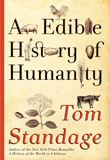
Excellent book by the author of the "History of the World in Six Glasses". Unlike the previous book there is not a timeline followed in this book, there are historical topics and food. The reader experiences how the cultivation of wild foods changed to food traits more favorable for human cultivation, instead of traits that might have lead to greater spread of foods. Revealed is how specialized societies developed from changes from a hunter/gatherer to agricultural society. How searching for new foods expanded knowledge of the world, and how foods from the new world led to better farming and the industrial revolution. How the ability to supply food to troops changed wars is covered as is the question of how the growing world can be fed today.
I recommend this book as an enlightening view of how foods have contributed to history and the world as we know it.
Kathy P. (Saratoga, CA)
Accessible and Insightful
Standage convincingly transforms colorful side notes from old world history texts -- spice trade routes, the domestication of grain -- into the dominant, driving forces that shaped human civilization. Lifelong learners will enjoy perusing these well-researched pages. He illuminates credible premises in entertaining, informative ways -- such as how Britain's food supply logistics helped the American Revolution to succeed, or how the existence of the potato made Britain's Industrial Revolution possible. Even well-honed trivia buffs will find new conversational highlights and factual gemstones here. This book could easily serve as a college textbook or reference resource.
Claire M. (Hilton Head, SC)
Food through the Ages...
Without great thought most of us have perhaps thought that history has influenced food but the opposite is true - food has written history. Who would be thinking farming was an alien activity 10,000 years ago? The mutations of corn, rice, wheat and other grains over the millennia, from a grass into a so called cereal, which can only be grown by man is illustrative of the current food supply. Standage’s book is a very interesting story of how we have gotten to where we are through the domestication of grain and livestock. And here I stand; an opponent of genetic engineering who has not understood the precedents!
What this book also shows us is that we should follow the food, not the money in order to understand the growth of societies. Today we take food for granted in a country dominated by agribusiness - cheap food for cheap health. Though many of us may want to eat and think local it behooves us to understand the inter dependence of global agribusiness and populations which have led us to these desires. Thomas Malthus, wars, famines, Norman Borlaug, synthesizing ammonia, and feeding huge populations - all of these many people and events are shown by Standage to have brought us to what we eat now. I’m delighted to have learned what I have, to understand the interrelationships, the history of food and civilizations in reading this very interesting book.
dee
Froma
A Feast for Readers
Standage is at his best telling a story, whether it be Napoleon’s strategy, the invention of canned food, or the Berlin airlift. The book is weakest in the early chapters where, of necessity, Standage weaves many strands together, jumping around geographically and temporally, tracking the move from hunter/gatherer to agriculturally based societies. The stories of Stalin’s and Mao’s famines are completely gripping; the analysis of the relationship between dictatorship and famine is compelling; the story of the green revolution, fascinating. If you think you might enjoy this book, read it. You will.
Pat
An Edible History of Humanity
History buffs rejoice! Tom Standage has written an erudite and entertaining view of world history through the lense of food choices and agriculture.
He interspaces the tale of history with thoroughly understandable explanations of plant adaptation, sociology and military tactics. Standage is a wonderful storyteller who makes history come alive in a clear and concise writing style. Fans of Mark Kurlansky will definitely enjoy this book.
Kelly P. (Monterey, TN)
An enjoyable book
Overall, I found An Edible History of Humanity to be an enjoyable and informative book. The author traces the impact of food on human civilization by addressing such topics as global trade, political policy, warfare, and scientific development. While there are not many stunning new revelations, the book does entertain and inform the reader. The information is presented in a logical manner, the writing is crisp, the examples are appropriate, and most importantly the author avoids the dreaded “information dump” that plagues too many histories.
Mark O. (Wenatchee, WA)
Food and the Turning Points of History
Standage writes on “… the intersections between food history and world history, to ask a simple question: which foods have done most to shape the modern world, and how?” So, this book is coarse-grain history, telling us about the sprouting of civilizations from the domestication of wheat, barley, rice, corn, and potatoes. We “follow the food” as trade (especially in spices) cross-fertilizes the cultures of continents. “Give us this day our daily bread” makes logistics as important as munitions in waging war and give tyrants an almost irresistible means of coercion. Perhaps the best fodder for reading groups is the generous view of the green revolution and industrial agriculture, provoking discussion of food that is at least local, if not slow.
I suspect that readers of books on history naturally form two groups: those driven by narrative and those for whom history is visual and illustrations are essential. I especially missed having enough readable maps showing past peoples and the connecting arrows that signify camel routes and voyages in small wooden ships. This was remedied by having “The Times Atlas of World History” close at hand.*
Food is the everything of our lives, from food stamps to the commodity prices of the corn that makes the tortillas in the barrios to the omega-3-containing salmon that might save our hearts. “An Edible History of Humanity” could be a good short course in a curriculum of books about food.
*Editor's note, Mark was reviewing an advanced reader's copy (ARC) of An Edible History of Humanity, oftentimes maps and other illustrations are not included in the ARC but are available in the finished version.
Kevin
An Edible History of Humanity
The author puts forward his views that all large transformations in history were caused, enabled or influenced by food. The change as humans left hunter-gatherer societies and become agrarian societies allowed people to have the ability to stay in one place, to own personal items (because they did not have to carry them), to grow into various class distinctions, to eventually allow those in control to have others get food for them. The author argues that food (or the lack thereof) was the main reason for wars to occur.
A very interesting history. I was not expecting much but enjoyed the book. I don't think I will ever look at corn in the same way again.