Summary | Excerpt | Reading Guide | Reviews | Beyond the book | Read-Alikes | Genres & Themes | Author Bio
Critics' Opinion:
Readers' Opinion:
First Published:
Aug 2009, 352 pages
Paperback:
Jul 2010, 352 pages
 Book Reviewed by:
Donna Chavez
Buy This Book
In Tropper's latest opus the fictional Foxman family pushes the limits of their - or anyone's - idea of dysfunction, proof positive that authors who are going to portray a dysfunctional family shouldn't skimp on the drama. Because by going all out, Tropper is giving readers a rockin' good read - with benefits.
Be warned: you will laugh. You may not always be proud of why you're laughing, but unless you're a paragon of virtue who can resist all urges to indulge in a little schadenfreude, you will laugh. After all, it's not everyday that a man walks into his own bedroom to find his wife in bed with his boss. Nor is it common for family members to emerge from a religious rite - particularly a funereal rite - with cuts, bruises and a dislocated shoulder. Laughter aside, however, there is plenty to ponder as protagonist Judd Foxman returns to his childhood home to mourn the death of the family patriarch.
Subsequent to learning that his father has died, Judd finds out that non-practicing Jew and sporting goods storeowner Morton Foxman's last request was for his family to sit shiva, a formal mourning period that requires the family to remain together in the family home for seven days. This would not be a problem for most people. But for Judd, his brothers Paul and Phillip and their sister Wendy - whose personal and familial issues would put Dostoevsky's most complicated characters to shame - it is tantamount to impossible.
Even before three generations gather under the Foxman roof – the observance includes spouses and their children – the fun begins. Prodigal son Phillip, "the Paul McCartney of our family: better looking than the rest of us, always facing a different direction in pictures, and occasionally rumored to be dead," shows up at the funeral and throws himself on the coffin in a fit of spectacularly theatrical grief. This after he apologizes for being late to Rabbi Grodner, inadvertently calling the boyhood friend by his junior high school nickname, "Boner."
Not surprisingly, the Foxman family shiva spirals downhill from there. Partially because, according to Judd, Mort was so emotionally aloof and his wife so inappropriately blunt in her speech that their children lacked even the sketchiest model for polite, socially acceptable dialogue. However, it is from these domestic disasters that the aforementioned benefits spring like flowers from a dung heap. Myriad tragicomic plot twists and personal confessions lobbed grenade-like into the family's core ignite familial interaction and sprout insights into the human condition. Such as this gem: "At some point you lose sight of your actual parents; you just see a basketful of history and unresolved issues." Yes, beneath and around Tropper's wicked sense of humor there is a universal substructure of wisdom that is applicable to all families and blood relationships. Read it and weep… and laugh.
 This review was originally published in The BookBrowse Review in October 2009, and has been updated for the
August 2010 edition.
Click here to go to this issue.
This review was originally published in The BookBrowse Review in October 2009, and has been updated for the
August 2010 edition.
Click here to go to this issue.

If you liked This Is Where I Leave You, try these:
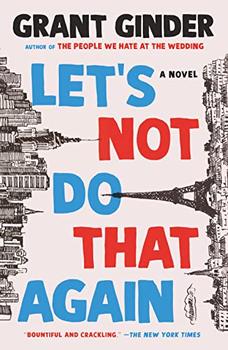
by Grant Ginder
Published 2023
From Grant Ginder, the author of The People We Hate at the Wedding, comes Let's Not Do That Again a poignant, funny, and slyly beguiling novel which proves that, like democracy, family is a messy and fragile thing - perfect for fans of Veep's biting humor, the family drama of Succession, and the joys of Kevin Wilson's Nothing to See Here.

by Jonathan Franzen
Published 2022
Jonathan Franzen's gift for wedding depth and vividness of character with breadth of social vision has never been more dazzlingly evident than in Crossroads.



The House on Biscayne Bay
by Chanel Cleeton
As death stalks a gothic mansion in Miami, the lives of two women intertwine as the past and present collide.
The Flower Sisters
by Michelle Collins Anderson
From the new Fannie Flagg of the Ozarks, a richly-woven story of family, forgiveness, and reinvention.

The Funeral Cryer by Wenyan Lu
Debut novelist Wenyan Lu brings us this witty yet profound story about one woman's midlife reawakening in contemporary rural China.
Your guide toexceptional books
BookBrowse seeks out and recommends the best in contemporary fiction and nonfiction—books that not only engage and entertain but also deepen our understanding of ourselves and the world around us.