
-
Your next favorite book
is waiting.
Summary | Excerpt | Reviews | Beyond the book | Read-Alikes | Genres & Themes | Author Bio
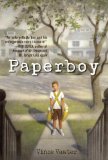
 Book Reviewed by:
The narrator of Paperboy, by Vince Vawter, avoids telling us his name until the final pages of the novel. He does not withhold his name because he's in hiding, or because he's being coy. It is simply because it is too difficult for him to say, due to a stuttering affliction. Throughout this story set in 1959 Memphis, he refers to himself only as Little Man, a nickname given to him by Mam, the live-in housekeeper in his white household.
He has an important story to tell, one he's still making sense of. He's been through a summer of growth and change. He's seen new things and gained insights and understanding of the world around him. Little Man needs to type out his story, for, as he explains, "I need to see the words on paper to make sure everything happened the way my brain remembers it. I trust words on paper a lot more than words in the air." Written in short blocks of text, devoid of commas and excess punctuation, the text mimics Little Man's way of speaking. He is a careful narrator, one who has to focus precisely on what he wants to say.
Little Man is an excellent baseball player, with a powerful arm for pitching. When he busts his best friend's lip with a hard throw, he feels guilty and as a kind of penance, offers to cover Art's paper route while he's gone for the summer. He doesn't anticipate any trouble navigating the route and is looking forward to throwing the papers, but Little Man knows collecting money at the end of the week is going to challenge his ability to communicate clearly.
Readers will feel Little Man's burden as he makes his way through the neighborhood. He's bright and curious and would love to interact more fully with the world, but every encounter requires strategic planning. Every time he opens his mouth, he must plan how to express himself while avoiding the words that give him extra trouble. One of the speaking strategies he's been taught is a trick he calls "Gentle Air." This requires him to "sneak up" on a word by making a hissing noise first.
Throughout the book Little Man's words are interspersed with "s-s-s-s." For instance, when talking to Mam early on in the story, he says, "s-s-s-s-Do you ever have a s-s-s-s feeling that something bad is s-s-s-s-going to happen?" He's willing to try this "hissing" trick because, "When you're eleven years old it's better to be called a snake than a retard." It's an interesting choice by the author to use this signal as opposed to the perhaps more expected mirroring of what his stutter might actually sound like. It is somewhat distracting and slows the story down, but that's the point. His stutter slows him down and distracts others from hearing what he has to say.
Mam has warned Little Man to stay away from the local junkman, Ara T, but inevitably their paths do cross. Throughout the story, Ara T shuffles and wanders through the background, ultimately revealing an ominous darker side of the world that Little Man had not known. Besides a growing awareness of the strife looming in the background between Mam and Ara T, Little Man's encounters with his white customers also contribute to his maturing and awakening. Although these interactions are quiet moments, they ultimately help Little Man make sense of the surprising truths he discovers.
Although alluded to from the first page of the book, a sudden act of violence stands out in shocking contrast to the steady and quiet tone of the rest of this book. But that's often how acts of violence are. Perhaps we cannot—and should not—be prepared for something so dark and sinister appearing from the shadows.
There are layers of appeal to this story. Younger, less experienced readers may find a growing awareness along with Little Man as he slowly realizes the inequities of his world; while older readers may be quicker to see the prejudice that looms in the background, not quite in Little Man's line of vision yet. He had not previously considered the disparate situation between the privileged life of his white family with that of the "colored junkmen who push their carts around," or, even with his beloved Mam, who he trusts more than his own mother.
Although Paperboy is appropriate for readers age ten and up, I think this novel will appeal to many adult readers looking for a reminder of the moment when one begins to see the world through a wider lens.
 This review was originally published in The BookBrowse Review in June 2013, and has been updated for the
January 2015 edition.
Click here to go to this issue.
This review was originally published in The BookBrowse Review in June 2013, and has been updated for the
January 2015 edition.
Click here to go to this issue.

If you liked Paperboy, try these:
by Nathan Filer
Published 2014
What begins as the story of a lost boy turns into a story of a brave man yearning to understand what happened that night, in the years since, and to his very person.
by Jack Gantos
Published 2013
A sly, sharp-edged narrative about a small western Pennsylvania town and a dead-funny depiction of growing up in a slightly off-kilter place where the past is present, the present is confusing, and the future is completely up in the air.
The Curious Incident of the Dog in the Night-Time
by Mark Haddon
Published 2004
'Haddon's portrayal of an emotionally dissociated mind is a superb achievement. He is a wise and bleakly funny writer with rare gifts of empathy.'




Information is the currency of democracy
Click Here to find out who said this, as well as discovering other famous literary quotes!

Can you name the title?
Test your book knowledge with our daily trivia challenge!
Your guide toexceptional books
BookBrowse seeks out and recommends the best in contemporary fiction and nonfiction—books that not only engage and entertain but also deepen our understanding of ourselves and the world around us.
