
-
Your next favorite book
is waiting.
Summary | Excerpt | Reviews | Beyond the book | Read-Alikes | Genres & Themes | Author Bio
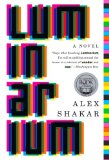
A Novel
by Alex Shakar Book Reviewed by:
Luminarium may not be for every reader, but if you like to feel the intelligence of the author behind a story that addresses contemporary subjects, this one is for you. Alex Shakar's first novel, The Savage Girl, got glowing reviews and made it onto some "best of" lists, but I found the characters calculating, brittle and soulless. In Luminarium, the author clearly went looking for some spiritual underpinnings, as does his main character, and was successful in his quest.
Fred Brounian, the seeker in the story, is a twin. He and George grew up with yearnings for a better world and successfully created one virtually. Meanwhile the real world got worse: the attack on the World Trade Center, the resulting fear of terrorism and wars, and the rise of the military in American life. In fact, Fred, George and a third brother Sam suffered their own attack when Urth, their successful virtual-world company, was gobbled up by Armation, whose government contracts involved creating virtual worlds for military training. During this descent from utopia to total war, George fell fatally ill and now lies in a coma. He is being kept alive at a financial cost that is bankrupting Fred.
A modern man, fairly atheistic, who is intelligent and has always put his faith in technology and science, hits rock bottom and turns to religion is a bit of a cliché. But Alex Shakar doesn't do clichés except to turn them inside out by means of humor and irony. So when Fred signs up for a neurological study and puts on the "God helmet" while Mira, his researcher and guide, alludes to "faith without ignorance," he and the reader are in for some wild rides straddling the boundaries between science and religion.
An impressive degree of complexity makes reading Luminarium compelling. Fred falls in love with Mira, a woman full of mystery and contradictions. Concurrently he is receiving emails and texts from his comatose twin and while rationally he knows they have to be bogus, the chance that George is actually reaching out to him on some inexplicable spiritual plane propels him into researching religions ancient and modern and comparing his findings to the quantum physics he has always pursued in his spare time.
All of this is conveyed in some of the most consummate prose I have read. Fred's out of body adventures, brought on by the "God helmet" electrodes, are explained to him in terms of the targeted stimulation of various lobes in his brain. But descriptions of the ways Fred experiences feeling one with the universe, being overwhelmed by love for strangers and so forth, are comparable to those found in the books of Carlos Castaneda (which, starting with The Teachings of Don Juan in 1968, deal with a young man's training by a Mexican shaman leading him to spiritual power and an ability to see a deeper reality than what is apparent to the senses.) Fred must walk the streets of New York City while in these altered states, adding a bit of humor to the process. Though Fred's search for meaning in the midst of the chaos and anxiety of his current life leaves him mostly confused, Shakar's skills as a writer keep the reader from getting lost.
By the end of the story, most of the mysteries in the lives of Fred and his brothers are solved, and questions are answered. True to life, though, is a final chapter that opens a whole new set of possibilities for the future of Fred. I personally dream of a future where science and religion meet. Whatever your beliefs or dreams, Luminarium will challenge you and make you think about where our world is going. In our current state of rapid technological advance, Alex Shakar posits that we still need spiritual answers, that family and love matter, but loss and misunderstandings confront us at every turn. It is a wonder how he made such potentially weighty ideas so entertaining.
 This review was originally published in The BookBrowse Review in September 2011, and has been updated for the
May 2012 edition.
Click here to go to this issue.
This review was originally published in The BookBrowse Review in September 2011, and has been updated for the
May 2012 edition.
Click here to go to this issue.

If you liked Luminarium, try these:
The Revised Fundamentals of Caregiving
by Jonathan Evison
Published 2013
Bursting with energy, this big-hearted, soulful, and inspired novel ponders life's terrible surprises and the heart's uncanny capacity to mend and become whole again.
by Hari Kunzru
Published 2013
Viscerally gripping and intellectually engaging, Gods Without Men is, above all, a heartfelt exploration of the search for pattern and meaning in a chaotic universe.
by Robert Hellenga
Published 2011
A novel packed with wit, substance, and emotional depth, Snakewoman of Little Egypt delivers Robert Hellenga at the top of his form.







It is among the commonplaces of education that we often first cut off the living root and then try to replace its ...
Click Here to find out who said this, as well as discovering other famous literary quotes!

Can you name the title?
Test your book knowledge with our daily trivia challenge!
Your guide toexceptional books
BookBrowse seeks out and recommends the best in contemporary fiction and nonfiction—books that not only engage and entertain but also deepen our understanding of ourselves and the world around us.
