
-
Your next favorite book
is waiting.
Summary | Excerpt | Reviews | Beyond the book | Read-Alikes | Genres & Themes | Author Bio
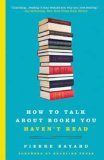
 Book Reviewed by:
By all rights, I shouldn’t have to read this book. After all,
Pierre Bayard begins with an epigraph from Oscar Wilde: "I never read a book I
must review; it prejudices you so." But I did read it, swiftly, ferociously, and
with a pen in hand. Many times I underlined a sentence I admired, such as this
one: "He who pokes his nose into a book is abandoning true cultivation, and
perhaps even reading itself." But just as often, I underlined in fierce
disagreement. This book isn’t, finally, about books, but about book
conversation, and I had a particularly lively one with it.
Bayard takes the deliberately perverse stance that non-reading
is an activity that should be defended and even taught. His argument begins by
noting the conundrum which pinions the educated reader: on the one hand, our
universities inculcate in us the value of exhaustively knowing a formidable body
of classic literature; on the other hand, to read exhaustively is so impossible
that, as Bayard phrases it, "reading is first and foremost non-reading." Even
when we are reading a book, we are not reading all the other books in the
universe, and even when we are reading a book, we are reading only the sentence
in front of us, all the others disappearing into the receding horizon of our
faulty memories. Everyone, from the casual reader to the literature professor,
shares this experience of reading, yet we all must disavow it. Thus our
attitudes toward reading are plagued with guilt, feelings of inadequacy, and
anxious lies about how much we’ve actually read.
With a wave of his hand, Bayard absolves us of such guilt. He
punctures the highbrow notion of perfect comprehension and retention, and
instead substitutes a whole catalog of ways we non-read books: we skim them, we
read about them in reviews such as this one, we read them and then forget them.
All of these methods, he argues, qualify us to discuss the books we've non-read
because they allow us to understand books as part of a collective library.
"Culture," he writes, "is above all a matter of orientation. Being
cultivated is a matter of not having read any book in particular, but of being
able to find your bearings within books as a system." Bayard burnishes his
manifesto with a rogues' gallery of non-readers in classic literature, from the
librarian in Robert Musil's The Man Without Qualities who excels at his
job by virtue of not having read a single book, to Montaigne, who is so profound
a non-reader of his own books that he cannot recognize them when they are quoted
in his presence.
Yet as even a non-reader of Bayard's book will have intuited,
Bayard’s argument is très disingenuous. How could he take us on so
debonair a tour of classic literature without having read some of it? And what
about the nonsocial pleasures of reading? Many readers characterize their
experience of novels as absorbing, when the rest of the world melts away
and they are enveloped by the pages in front of them. This, it strikes me, is
the opposite of the university model of reading, not Bayard's non-reading.
Indeed, Bayard's own book is so felicitous it gives the lie to his theory: I
inhaled it and have been talking about it to other people ever since I closed
the cover.
Perhaps it is possible to speak worthily about books you
haven't read, but in order to do so, you must at least have thoroughly devoured
some other ones—you must be a reader. The wonderfully self-defeating irony of
How to Talk about Books You Haven't Read is that it made me want to
disappear into any one of the books Bayard mentions that I haven't already read.
I could talk to you about them—Bayard has equipped me to do so. But I don't want
to. I’d rather read than talk.
 This review was originally published in The BookBrowse Review in November 2007, and has been updated for the
October 2009 edition.
Click here to go to this issue.
This review was originally published in The BookBrowse Review in November 2007, and has been updated for the
October 2009 edition.
Click here to go to this issue.

If you liked How to Talk About Books You Haven't Read, try these:
by Scarlett Thomas
Published 2011
Smart, entrancing, and boiling over with Thomas's trademark big ideas, Our Tragic Universe is a book about how relationships are created and destroyed, how we can rewrite our futures (if not our histories), and how stories just might save our lives.
by Elif Batuman
Published 2010
The true but unlikely stories of lives devoted — Absurdly! Melancholically! Beautifully! — to the Russian classics.
by Gabriel Zaid
Published 2003
'An appealing, meditative collection of thoughts and observations on the book industry and the state of literature in the early 21st century. Book lovers of all stripes will enjoy this light piece of cultural criticism' -- Publishers Weekly



The moment we persuade a child, any child, to cross that threshold into a library, we've changed their lives ...
Click Here to find out who said this, as well as discovering other famous literary quotes!

Can you name the title?
Test your book knowledge with our daily trivia challenge!
Your guide toexceptional books
BookBrowse seeks out and recommends the best in contemporary fiction and nonfiction—books that not only engage and entertain but also deepen our understanding of ourselves and the world around us.
