
-
Your next favorite book
is waiting.
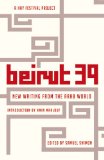
New Writing from the Arab World
by Samuel Shimon Book Reviewed by:
Certain anthologies – especially those which seek the "best" writing of a time, place, genre or generation – invite debate about the hubris involved in the task and about the criteria which determines a writer's inclusion or exclusion. Beirut 39 does not claim such ambitions, nor is it meant to represent contemporary Arabic literature. To quote its editor, Samuel Shimon, the book is "…only a first step to discovering the extraordinary talents" of the men and women whose short stories, novel excerpts, and poems appear in translation from Arabic and French, and in one case, in its original English.
This remarkably humble approach may seem prescient in retrospect as other reviewers have remarked on the anthology's unevenness, and several entries bear mixed results. One of these is "The Path to Madness", which features a trio of narrators and their views on the topic in question. This promising study on distorted perceptions as well as on the malleability of "truth" is conveyed through unreliable narrators, a familiar approach to fictionalizing madness, but it is unclear why one neighbor's fabrication of a persona and lifestyle should impact other residents. The story remains as more of a curious, passing incident. Another story, "from the novel The Scent of Cinnamon", portrays infidelity by drawing on the dynamic of a husband's betrayal with a servant, but does not provide deeper reflections of such an emotionally complex situation. These are, however, among a handful of weaker exceptions; and, although it could be said that Beirut 39 is more noteworthy for its vision than for its individual components, this should not discourage readers ready to explore new settings.
Pragmatically alphabetized by the authors' first names, the entries spark with serendipities. Readers are implicitly asked to draw connections. Many selections explore themes of tribal expectations, sexuality, and violence from multiple points of view; or refer to oral tradition by having characters narrate a story within a story. Settings range from an apartment building in Gaza to the hometown of the man who is believed to have been the twentieth 9/11 terrorist. Realistic scenes juxtapose with scenes informed by folklore or more fantastic realms, including an otherworldy visitation in "Suicide 20, or The Hakimi Maqama." Poems include prose poems as well as lineated verse.
The more evocative entries include "from the novel The Last Hanging Poem," a stark assessment of a man who is concerned by the mysterious pranks occuring in his town, and who later becomes a participant. His decision leads to uncomfortable commentary on the callous side of spectatorship. "from Bedouins on the Edge" employs an abandoned car as the point of departure for communal speculation. As villagers wonder what could have caused the accident, they become "virtuosos in their retellings." Their pastime dissolves when baser instincts arise and the car is ransacked for parts. The premise is simple, allowing characters to indirectly and effectively reveal prejudice as well as desire.
Of the poetry selections, "from the poem 'The Geology of the I' in the Book of J" stands out as one that might particularly interest an Anglophone readership. With its apparent homage towards Walt Whitman's declaration "…I am large, I contain multitudes," the speaker in the poem builds a list of declarations that form an autobiography in verse. As the poem progresses, the force of repetition lets details accrue in meaning.
The best of these works frequently underscore darker moments, running the gamut from a bombing and a book-burning to schoolyard bullying, but do so without criticizing the characters nor the conditions of the societies which shaped them. Read together, a sense of restlessness -- of migrations from village to city, from childhood to adulthood, from living with hesitation to gradually accepting fate -- emerges. These stories dig at human fallibilites with imaginative risks.
 This review is from the August 4, 2010 issue of BookBrowse Recommends.
Click here to go to this issue.
This review is from the August 4, 2010 issue of BookBrowse Recommends.
Click here to go to this issue.
 Beirut 39 derives its title from 'Beirut39', a group of thirty-nine writers of Arab heritage who were all born in or after 1970. The countries of origin represented in the anthology include Palestine, Saudia Arabia, Syria, Oman, Jordan, Sudan, Libya, Lebanon, and Egypt, among others.
These writers met for workshops, readings, and discussions as part of the Hay Festival, a week-long literary event held in early summer in Haye-on-Wye, a town in the west of England widely known for its bookshops. Once called the "Woodstock of the mind" by Former President Clinton, the festival began in 1988 and is currently sponsored by the British newspaper, The Guardian.
Drawing nearly 80,000 visitors each year, the Hay Festival has also inspired sister festivals in Segovia, Alhambra, Cartagena, Zacatecas, Maldives and Nairobi, as well as related events, the most recent of which is the Brecon Jazz festival in August of 2010. The Hay initiatives seek to foster a sense of international community and a spirit of discovery, featuring prominent and emerging literary figures. In their respective ways, they seek to highlight "multiculturalism and social commitment" and to serve as a "platform for readers, writers, listeners and thinkers".
Interesting Links:
The Hay Festivals' website.
The website of the town of Hay on Wye.
Image: Some of the Beirut 39. Click for a full display of images linked to brief bios.
This review is from the August 4, 2010 issue of BookBrowse Recommends.
Click here to go to this issue.
Your guide toexceptional books
BookBrowse seeks out and recommends the best in contemporary fiction and nonfiction—books that not only engage and entertain but also deepen our understanding of ourselves and the world around us.
