
-
Your next favorite book
is waiting.
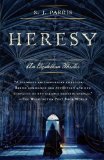
 Book Reviewed by:
Fans of historical mysteries will be thrilled to discover this first installment in a new series. 25 out of 26 BookBrowse readers rated Heresy 4 or 5 stars. Here's what they had to say:
I thoroughly enjoyed this book from the beginning to the end. Right away I was captivated by the characters, the historical setting and the unfolding mysteries. The best historical fiction always makes me want more - more information about the time period and more about the characters. This book did all that. I repeatedly found myself doing online research to find out more about events of this time period and the main character - a complicated and fascinating man. I was generally aware of the persecution of Catholics in England, but I did not fully appreciate the extent of the killing in the name of religion until I picked up this book. The more I read, the faster I read - rushing to get to the answers. I hope this author writes more books in this historical period, especially if they involve Giordano Bruno and Sophia (Dolena W).
What I love about this book is the writer's style. She keeps things interesting and gives just enough detail without weighing the story down with too much prose, as so many writers of historical fiction are wont to do. Her characters are well-developed and she does a good job of splitting time between the plot and a fascinating period of history (Chris G).
Enticing and layered, this is a great choice for book clubs! It brought up questions about politics and religion, love and betrayal, and right and wrong. I kept thinking about how this book relates to today and how people are still fighting about religion. Reading Heresy made me interested in researching more about Giordano Bruno - a complex man who finally met his end at the hands of the Inquisition (Mary R).
A few readers acknowledge some flaws:
The book started out interestingly enough, but got stuck with repetitive scenarios mid-way through. I liked the descriptions of life during that time period but felt the book would have benefited from stronger editing (Susan P). The story dragged in a few places where it became a little too scholarly, but it was mostly fast paced and entertaining (Cheryl D). Throughout, the author's writing is very good, although I think she spent more time on plot rather than on her characters. My understanding is that this is the first of a planned series, and hopefully the author will flesh out the ongoing characters a bit more (Nancy O).
The bottom line:
I loved this book! I was pulled into the story immediately and fascinated with all the twists and turns as well as the historical detail. It's intricately plotted, but avoids becoming cumbersome with details (Jean T). The characters are very well-developed, the story is exciting, and the mystery is a winner (Donna N)! I highly recommend this book to fans of historical fiction and mysteries as well as those interested in English history (Chris G).
 This review was originally published in March 2010, and has been updated for the
February 2011 paperback release.
Click here to go to this issue.
This review was originally published in March 2010, and has been updated for the
February 2011 paperback release.
Click here to go to this issue.
 Giordano Bruno (1548-1600) was an Italian Dominican priest, philosopher, mathematician and astronomer. After studying for several years in Naples, he entered the Order of St. Dominic at the age of 15, and was ordained priest in 1572. He was known for his belief in the infinite nature of the universe, identifying the Earth's sun as just one of an infinite number of stars and heavenly bodies, and asserting that God had no particular relation to Earth over any other part of the universe. He was charged with heresy in 1576 for his views and outspoken criticism of theological doctrines.
From then on he wandered from country to country, facing persecution in each place until he was finally delivered to the Inquisition in 1592. The numerous charges against him included blasphemy, immoral conduct, and heresy. He refused to recant, and was burned at the stake on the Campo del Fiori in Rome, Feb. 17, 1600.
Giordano Bruno (1548-1600) was an Italian Dominican priest, philosopher, mathematician and astronomer. After studying for several years in Naples, he entered the Order of St. Dominic at the age of 15, and was ordained priest in 1572. He was known for his belief in the infinite nature of the universe, identifying the Earth's sun as just one of an infinite number of stars and heavenly bodies, and asserting that God had no particular relation to Earth over any other part of the universe. He was charged with heresy in 1576 for his views and outspoken criticism of theological doctrines.
From then on he wandered from country to country, facing persecution in each place until he was finally delivered to the Inquisition in 1592. The numerous charges against him included blasphemy, immoral conduct, and heresy. He refused to recant, and was burned at the stake on the Campo del Fiori in Rome, Feb. 17, 1600.
Read about S.J.. Parris's research for Heresy
This review was originally published in March 2010, and has been updated for the
February 2011 paperback release.
Click here to go to this issue.
Your guide toexceptional books
BookBrowse seeks out and recommends the best in contemporary fiction and nonfiction—books that not only engage and entertain but also deepen our understanding of ourselves and the world around us.
