
-
Your next favorite book
is waiting.
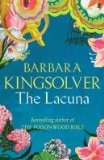
A Novel
by Barbara Kingsolver Book Reviewed by:
I have read every novel by Barbara Kingsolver and I love them all, even the less favorably reviewed Animal Dreams and Prodigal Summer. Her writing is literary, lyrical and relevant - but that's not the reason for my deep affection. It's because she is a woman of heart and mind who is unafraid of using her mind to reveal her heart.
For almost 200 pages into The Lacuna, I was worried. Some critics have said that the book starts off slowly, but actually it's just hard to tell where the story is going, and I thought perhaps Kingsolver had lost her touch, as some writers do. Suddenly, within the next forty pages, I was hooked, convinced, and entirely seduced, and it only got better from there on.
While I had early doubts about the story, the voice had me from the start. I think voice is Kingsolver's strongest suit. From the quirky, rebellious Taylor Greer of The Bean Trees to the four unique voices of the sisters in The Poisonwood Bible, she proves herself a literary ventriloquist. The Lacuna is narrated by two main voices. Harrison Shepherd's story is told through his journals. Since he began keeping them as a lonely thirteen-year-old boy and wrote his last installment decades later, his voice and style grow from a young David Copperfield type to a disillusioned man but never lose their tone of bewilderment. The voice of Violet Brown, Harrison's loyal secretary, is the epitome of that southern wisdom from the hills - part of Kingsolver's own heritage.
 Through Harrison's ability to recreate conversations in his journals, we also hear from Frida Kahlo (arguably, Mexico's most famous female painter) who probably gives Harrison the most mothering he ever had. (Imagine having Frida Kahlo for a mother!) Most surprising of all is Leon Trotsky, known as Lev in this story, with his impassioned sense of history, the working class and the true meaning of communism.
Any fan of Barbara Kingsolver would enjoy this book, as would fans of early-to-mid 20th century historical fiction. One critic complained of preachiness, which I have noticed is a word often aimed at women who speak up. I disagree and instead found in The Lacuna one of the more sensitive fictional accounts of the McCarthy era. In fact, as Harrison Shepherd finds himself targeted by the FBI and HUAC, his ordeal represents the intimate, troubling effects of those times on a single individual and brings the political into the personal.
The title of this novel is also its continuous imagery. A lacuna is a blank gap, a missing part (in a piece of writing or music, in bone or cartilage), a hole, a vacancy. Harrison Shepherd is haunted by lacunae. He discovers them, he is tortured by them, and ultimately it appears he is saved by one. His story moved me to laughter, outrage, anxiety, but mostly to tears. It is overall a very sad tale. When I closed the book, I simply could not move.
 This review was originally published in November 2009, and has been updated for the
August 2010 paperback release.
Click here to go to this issue.
This review was originally published in November 2009, and has been updated for the
August 2010 paperback release.
Click here to go to this issue.
Kingsolver's fictional protagonist, Harrison Shepherd, spends much of his life brushing up against the lives of real people, including the Mexican artists Frida Kahlo and Diego Rivera who played host to Leon Trotsky in the 1930s. Undoubtedly, you know of Trotsky, Bolshevik revolutionary and Marxist theorist, but did you know that he spent the last years of his life exiled in Mexico?
The story of his exile starts with the death of Vladimir Lenin in 1924. Although Lenin had appointed Joseph Stalin General Secretary of the Soviet Communist Party he had grown distrustful of him and had come to favor Trotsky as his successor, and had even written a letter to that effect. However, on Lenin's death, Stalin manouvered quickly to consolidate his power and Trotsky found himself on the back foot. Trotsky continued to battle for leadership as the de facto leader of the Left Opposition, a faction within the Communist Party, until he was expelled from the Party in 1927 and exiled from Russia two years later. Even though Trotsky opposed Stalin, he did not find a welcome in most European countries whose governments feared that he would become a rallying point for local communists. He was offered brief periods of asylum in Turkey, France and Norway; then, in 1936, Diego Rivera, a founder of the Mexican Communist Party and supporter of Trotsky's views, used his influence to help Trotsky gain permanent asylum in Mexico.

Leon Trotsky and his wife, Natalia Sedova, lived in the Coyoacán area of Mexico City, first in Frida Kahlo's childhood home and then in the home of her husband, artist Diego Rivera. They then moved to their own home nearby, following a split with Rivera over ideological differences and rumors of Trotsky's affair with Kahlo. Their house was protected by guards behind high stone walls and steel doors scarred by bullet holes from an assassination attempt in 1940, headed by the painter Joseph Siqueiros.
While in exile Trotsky wrote and published My Life; The History of the Russian Revolution; and The Revolution Betrayed, all of which have been translated into English and are available in English paperback editions today.
On August 20, 1940, Trotsky was attacked in his home by Ramón Mercader, who sunk an Alpine climbing ax into his skull. Trotsky fought back and was taken to the hospital, but died the next day. Mercader, aka Jacques Mornard, was a Spanish communist later revealed to be a Soviet agent, suspected of acting on orders from Joseph Stalin.
"Life is not an easy matter ... You cannot live through it without falling into frustration and cynicism unless you have before you a great idea which raises you above personal misery, above weakness, above all kinds of perfidy and baseness."
- Leon Trotsky
This review was originally published in November 2009, and has been updated for the
August 2010 paperback release.
Click here to go to this issue.
Your guide toexceptional books
BookBrowse seeks out and recommends the best in contemporary fiction and nonfiction—books that not only engage and entertain but also deepen our understanding of ourselves and the world around us.
