
-
Your next favorite book
is waiting.
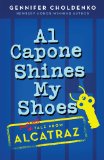
 Book Reviewed by:
Al Capone Shines My Shoes is the sequel to Choldenko's celebrated Al Capone Does My Shirts. Twelve-year old Moose Flanagan continues his account of life on the Rock and the conflicts and crises that beset the isolated community of cons, guards, mothers and kids who call it home. Moose's voice - so true, so funny, so boyish, so irreverant - will make you want to stand up and applaud Choldenko's bravura encore:
Alcatraz Island is shaped like a wedding cake with three tiers and lots of paths and stairs and switchbacks that lead from one level to the next. The parade ground where we play baseball… makes a pretty good field except for the wind. I can't tell you how irritating it is to hit a good ball and have the wind make it a foul.
…Piper flies down the steep switchback on her roller skates, her long hair streaming behind her, her dress flowing back so you can see the outline of her - okay, never mind what you can see.
The romantic and scary island, the soothing and beautiful rhythm of baseball, and the too-delicious Piper (who smells of talc and root beer) are just a few of the powerful forces at work on Moose as he struggles to remain unruffled and do right by his friends, his parents, and his autistic older sister, Natalie. But there is real turbulence under Moose's affable surface, and beneath the prison there are dark and dusty passageways where the children hide to confess their fears or eavesdrop on their parents confessing theirs. The cons live the most public and regulated lives - assembling on the hour to be counted - but as they live and work under the scrutiny of the guards there are dangerous machinations and upsetting communications hidden inside their slightest movements or gestures. The many layers-within-layers of the wedding cake are just one of Choldenko's many triumphs here.
The story opens as Moose finds himself caught between two mysterious and volatile forces, Al Capone and his sister Natalie. Capone is the rock star of the prison population, infamous, charismatic, rich and powerful; Natalie is isolated, deeply vulnerable, emotionally reactive and precariously rigid. Capone, who remains unseen for most of the novel, communicates with Moose via notes tucked into his laundry. Natalie - away attending a special boarding school in San Francisco that Moose and his family know offers her a last chance to learn to control the whirlpool of feeling that threatens to drown her - is always a felt presence to Moose: Is she safe? Is she suffering? Is she happy?
In the first book Capone secretly used his pull to help Natalie find a place at the special school, and the sequel opens with his demand for payback from Moose. Moose's anxiety about what Capone will require, and the need for secrecy (to protect his father), carry the reader along and provide genuine suspense. But Choldenko's greatest achievement is the creation of the inner worlds of her characters: all complicated, turbulent, alive, surprising, sweet and deep.
 This review is from the October 21, 2009 issue of BookBrowse Recommends.
Click here to go to this issue.
This review is from the October 21, 2009 issue of BookBrowse Recommends.
Click here to go to this issue.
Alcatraz and Al Capone
Alcatraz, the setting of Choldenko's novel, is as vivid and interesting as her characters. She got to know its layout, the way the sun looks on the sea around it, its birds and its weather while working there for a year as a docent.
Most famous as the site of a federal prison, Alcatraz Island was first a military fortress, home to the first lighthouse on the Pacific Coast in the mid 1850's, and a military prison for prisoners of the Civil and Spanish American Wars. After the 1906 San Francisco earthquake, hundreds of civilian prisoners were transferred to Alcatraz. By the 1920's the three-story prison was nearly at full capacity. Ownership shifted from the Army to the Department of Justice in 1934, and work began to outfit the prison with maximum-security enhancements. In 1963, the prison was shut down due to structural deterioration and excessive operational costs. The island remained essentially abandoned until 1969 when a large group of about 100 Native Americans from numerous tribes occupied the island for the next 18 months in what would become the longest prolonged occupation of a federal facility by Native Americans to this very day. The occupation fueled the rise of modern Native American activism, and brought Indian rights issues to the attention of the federal government and American public.
In 1972, Alcatraz was declared a National Park, and is today considered an ecological preserve and bird sanctuary. For more history visit alcatrazhistory.com.
 Al Capone is the mysterious and charismatic figure at the center of the novel - secured and hidden deep inside the prison, the island's kids feel his powerful presence, and his influence extends across the water into San Francisco.
America's most famous gangster, Capone was born in 1899 in Brooklyn. A gang member, bartender and bouncer, he earned the nickname "Scarface" after being attacked by the brother of a female patron whom he'd offended. In Chicago, Capone moved from bootlegging to gambling, prostitution, horse racing, nightclubs and distilleries and is said to have earned $100,000,000 a year. Capone is famous for organizing the St. Valentine's Day Massacre during which his hit men dressed as policemen and fooled their victims into dropping their guns. Although Capone was violent and volatile, he was known to be loyal and at times generous. Capone opened the first soup kitchens after the stock market crash of 1929. Capone was indicted for tax evasion in 1931 and went to prison in Atlanta, where he soon controlled the guards and converted his cell into a luxurious apartment. He was transferred to Alcatraz in 1934, where he was, as Choldenko describes him, a cooperative prisoner. He was transferred again in 1938 to Terminal Island Prison, to serve out the remainder of his sentence, and was released in 1939. He died in his Palm Beach Mansion in 1947 from complications of syphilis.
This review is from the October 21, 2009 issue of BookBrowse Recommends.
Click here to go to this issue.
Your guide toexceptional books
BookBrowse seeks out and recommends the best in contemporary fiction and nonfiction—books that not only engage and entertain but also deepen our understanding of ourselves and the world around us.
