
-
Your next favorite book
is waiting.
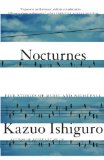
Five Stories of Music and Nightfall
by Kazuo Ishiguro Book Reviewed by:
Like many of Kazuo Ishiguro's widely-acclaimed novels, Nocturnes charts the nature of shifting relationships, the passage of time, real and perceived failures, the consequences of deferred dreams, feelings of estrangement, and the quiet but destructive erosion that occurs when truth is denied for too long, yet it does so with more attenuated gestures and less reflection.
In "Crooner" and "Nocturne" a singer and a saxophone player attempt to revitalize their careers by changing their lives. Though we may expect a certain degree of typecasting, these characters never entirely move beyond our preconceptions of Hollywood "has-beens" to become empathetic figures, nor do they push towards the extreme edge of the grotesquely satirical, as Gloria Swanson does in the role of Norma Desmond (Sunset Boulevard, 1950). While plots about careers in decline could be made more resonant by either a sense of revelation or an acerbic wit, Ishiguro offers neither. The stories remain closer to the anecdotal, as the narrators recall incidents and conversations. Criticisms about a system that sometimes appears to reward attractive personas more than talented ones is also familiar. Despite such lapses, the author raises insightful and often probing questions regarding the tendency to draw distinctions between art and entertainment, the lengths some will go to achieve a goal, and the problem of deciding when "selling out" is a necessary strategy and when it means that a vision has been compromised, if not abandoned. These questions, among others, linger throughout the subsequent stories, though they remain mostly unanswered.
"Cellists" explores how the desire for musical virtuosity leads one woman to lie, while "Malvern Hills" features a young guitarist and songwriter whose talent is matched by his ego. The woman believes she has not "unwrapped" her talent for playing the cello because no teacher could ever understand her; the man attributes his lack of participation in a band to the "utterly rotten" and "extremely shallow and inauthentic" perspective held by the London crowd. Both characters treat music as an endeavor that only the privileged could appreciate. Their bravado is tempered by an appealing vulnerability, making their stories the strongest in the collection.
Music figures less prominently in "Come Rain or Come Shine." Neither an accomplished nor an aspiring artist, the narrator is a middle-aged aficionado of nostalgic music. He has been invited to the home of his married friends, but soon discovers that the invitation was an orchestrated attempt to have him serve as a foil for the husband rather than a sign of goodwill. What could have had potential as a multi-layered portrait of fragile friendships bound more by habit than by a deep-seated respect becomes a simpler effort to find comedy in the midst of pain. Much of the story unravels when the narrator attempts to cover a faux-pas by casting blame; the effect is less humorous than intended. One of the more intriguing aspects of the story remains unexplored, but reiterates the belief that music is exclusive. When the husband advises the narrator to refrain from bringing up the subject, we're left to wonder why the knowledge of somewhat obscure albums or someone else's tastes could be regarded as threatening.
Though the characters are occasionally burdened by selfish motivations or repetitive scenarios, the struggles they experience highlight the uses of music as a balm, an idea that is found in each of these stories. Ishiguro reminds us that songs can easily become conveyances for memory, momentary forms of escape, or backgrounds for climactic moments. Fans of his novels may enjoy the change of pace offered by this debut, but newer readers may prefer to begin with his previous works, which better exemplify his talents.
 This review was originally published in November 2009, and has been updated for the
September 2010 paperback release.
Click here to go to this issue.
This review was originally published in November 2009, and has been updated for the
September 2010 paperback release.
Click here to go to this issue.
 Born in Nagasaki, Japan on November 8, 1954, Kazuo Ishiguro moved to Britain in 1960 at the age of five when his father began research at the National Institute of Oceanography. His family had not expected to stay, but ended up making Britain their home. He was educated at a grammar school for boys in Surrey, and later read English and Philosophy at the University of Kent, Canterbury, during which time he was also employed as a community worker in Glasgow (1976). After graduating, he worked as a residential social worker in London and studied Creative Writing at the University of East Anglia, where he met his early mentor, Angela Carter.
Ishiguro is the author of three stories published in Introductions 7: Stories by New Writers (1981), and the novels A Pale View of Hills (1982), winner of the Winifred Holtby Memorial Prize; An Artist of the Floating World (1986), winner of the 1986 Whitbread Book of the Year award, the Primio Scanno, and a Booker Prize nominee; and The Remains of the Day (1989), winner of the Booker Prize in 1989 and the basis for the 1993 film featuring Anthony Hopkins and Emma Thompson.
He is also the author of the novels The Unconsoled (1995); When We Were Orphans (2000), which was shortlisted for the Booker Prize; Never Let Me Go (2005), which was shortlisted for the Booker Prize and provides the inspiration for the 2010 film of the same name starring Keira Knightley; and the short-story collection Nocturnes: Five Stories of Music and Nightfall (2009).
In addition, he has written two screenplays for Channel 4 Television, A Profile of Arthur J. Mason, broadcast in 1984, and The Gourmet, broadcast in 1986, as well as the screenplay for the 2003 film The Saddest Music in the World, a melodrama set in the 1930s starring Isabella Rossellini. His work has been translated into approximately 40 languages.
The recipient of an Order of the British Empire for Services to Literature (1995) and the French Chevalier de l'Ordre des Arts et des Lettres (1998), he is also a Fellow of the Royal Society of Literature. Granta Magazine nominated him as one of the 20 "Best of Young British Writers" (1983).
Ishiguro has also worked as a singer-songwriter, playing in clubs and sending demo tapes to producers. In a 2005 interview with The Guardian, he remarks, "I went through my purple-prose phase in my songwriting" and that the process served as an "apprenticeship" for his fiction. For the first time in nearly 30 years, he returned to his previous vocation to write the lyrics for jazz singer Stacey Kent's 2007 album Breakfast On the Morning Tram.
He lives in London with his wife and daughter.
Listen to a 2009 interview with Ishiguro
This review was originally published in November 2009, and has been updated for the
September 2010 paperback release.
Click here to go to this issue.
Your guide toexceptional books
BookBrowse seeks out and recommends the best in contemporary fiction and nonfiction—books that not only engage and entertain but also deepen our understanding of ourselves and the world around us.
