
-
Your next favorite book
is waiting.
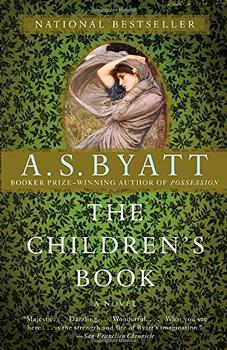
A Novel
by A.S. Byatt Book Reviewed by:
When I first plunged into The Children's Book, what struck me was how real the characters were. Olive Wellwood and her circle of friends and family didn't feel like characters, they felt like people. From just a few sentences, I felt like I knew these children who were wandering through the South Kensington Museum in London, looking for adventure. As I continued to read, I was impressed with how A. S. Byatt succeeded in making the innovations of the late 19th century, like electric lighting and automobiles, seem rare and magical without being trite.
The expansive scope of this novel, and the attention to detail in so many areas - theater, pottery, fairy tales, anarchy, socialism and many others - is impressively handled and rarely does the history interfere with the storytelling. The historical characters (Oscar Wilde, Kaiser Wilhelm II, Emma Goldman, Queen Victoria, Auguste Rodin) are used in such a way that knowing the history can increase the reader's understanding, but is not necessary to follow the fictional characters and storyline. We visit the Exposition Universelle of 1900 in Paris with several of the characters, each with a different area of interest, so we discover how ornate and impressive it was without ever having heard of it before.
While this is clearly a historical novel, it does not read like one until the end - when World War I is close at hand. The historical connections are never far away, but most of that history is conveyed directly through the lived experiences of the characters. One daughter is a suffragette, another trains to be a doctor. One nephew flirts with the Anarchists. Young women get pregnant out of wedlock, and poor folks die from hazardous working conditions. None of these occurrences are statistics, they are real situations portrayed with the nuance and ambiguity of lived experience. The younger generation gets the most attention, with the adults serving mostly to make their lives difficult and complicated.
I thoroughly enjoyed the novel until the advent of World War I. While I'm sure that is partly because it is hard to watch characters you love go through tragedy, I think the author spends a lot less time on the inner lives of the characters once the children become adults. I am sure this is deliberate on Byatt's part - these happy lives (while far from perfect) become increasingly dark. I felt like the first half of the novel was much more character-driven, whereas the last quarter was mostly plot. That plot was certainly well-written and exciting, but not as fulfilling. I was disappointed that the ending didn't come with a little more of the clarity and understanding I had enjoyed so much in the first part of the book.
There is a point in the novel where an author - free-loving nudist Herbert Methley - gives a lecture and says that "It was not possible in a novel to describe most of the world as it really was." It is obvious that Byatt is trying to refute that statement with this novel. She attempts to portray life during this difficult period as it truly was, and for this generation there were few happy endings.
 This review was originally published in October 2009, and has been updated for the
August 2010 paperback release.
Click here to go to this issue.
This review was originally published in October 2009, and has been updated for the
August 2010 paperback release.
Click here to go to this issue.
One of the main characters in The Children's Book is Phillip Warren, apprentice to eccentric master of ceramics Benedict Fludd. While Fludd is a fictional creation, the kind of pottery being made in his house is in a style that came to be known, in the early 20th century, as Studio Pottery - that is to say pottery made by artists working alone or in small groups, producing unique items or small quantities of similar items.
In the wake of the industrialization of pottery in the previous centuries, those who created unique items from earthen- and stone-ware struggled to have their work accepted as art. Some of the leaders of the Studio Pottery tradition were William Staite Murray, Bernard Leach and Michael Cardew. Were Phillip Warren a real person, he would have been making his pots at the same time as Murray, the earliest of the studio potters.
 William Staite Murray was born in London in 1881, and had his own pottery there in the 1920s. He patented a gas-fired kiln design that made it easier to heat his work consistently. By 1925 he was teaching at the Royal College of Art, where he influenced the next generation of studio potters.
 Bernard Leach was born in Hong Kong to English parents, learned pottery in Japan and was successful there before moving to England in 1920. Leach was a central figure in the craft community in England for more than 50 years.
 Michael Cardew was born in 1901. He gained a scholarship to read Classics at Oxford but was already focused on pottery and thus graduated with a third class degree. He was apprenticed to Leach, and was a student of Staite Murray's. He spent much of his middle years in Africa building and managing potteries.
This review was originally published in October 2009, and has been updated for the
August 2010 paperback release.
Click here to go to this issue.
Your guide toexceptional books
BookBrowse seeks out and recommends the best in contemporary fiction and nonfiction—books that not only engage and entertain but also deepen our understanding of ourselves and the world around us.
