
-
Your next favorite book
is waiting.
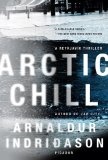
A Thriller
by Arnaldur Indridason Book Reviewed by:
I do my traveling by armchair these days and I've come to believe that you can become very familiar with another culture through its crime fiction. There's something so universal about police, detectives, and amateur sleuths that immediately eases you into a foreign world. In his fifth U.S. publication, Iceland's Arnaldur Indridason returns with a stand-alone Inspector Erlendur novel that reveals the shadow side of a newly multicultural Reykjavik (Iceland's capital city).
Iceland is not much on the minds of most Americans, even after its recent financial meltdown. It's a place Sunee, the mother of the murdered child in Arctic Chill, had never even heard of in her native Thailand until she was wooed by an Icelandic man. Now he's moved on and she's living in an apartment in Reykjavik with their son, Elias, and Niran, her older son she never told the man about. She doesn't speak or understand much Icelandic, but she wants to stay, works hard, and attempts to keep parts of her native culture alive in a place that is cold to her in most ways. And now Elias is dead.
It falls to Inspector Erlendur and his team, Sigurdur Oli and Elinborg (these are all first names - see sidebar), to determine what happened. Since Iceland's immigrant population has been rapidly growing and since Elias is dark-skinned, the idea that this may have been a racially motivated crime has to be considered. And there are, sadly, no shortage of suspects, including some of Elias's teachers.
Erlendur is a wonderfully melancholic character. He has never recovered from the death of his younger brother, who disappeared in the same blizzard Erlendur was rescued from, and is obsessed with Iceland's large body of literature on the subject of people who have disappeared. He and the younger Sigurdur Oli have little in common:
The two men were poles apart in their thinking. While Erlendur sat at home reading old Icelandic folklore or fiction, Sigurdur Oli would sit in front of the television watching American cop shows with a bowl of popcorn in his lap and a bottle of coke on the table. When he joined the force he modelled himself on such programmes. He was not alone in thinking that a job with the police could sharpen one's image. Recruits still occasionally turned up for work dressed like American TV cops, in jeans and back-to-front baseball caps.
But, along with Elinborg, they are excellent cops, horrified by the murder of Elias and what it might mean about their country. When Sunee hides Niran and won't tell them where he is, Erlendur realizes "'We can't begin to understand what it's really like for immigrants in this country… It's bound to be tough and I think it's very hard for us to put ourselves in their shoes. Racism may not be an everyday occurrence here but we know that not everyone's happy with the way society is going.'"
The crime's resolution is stunning and unexpected, but also completely believable. This is not much comfort to Erlendur, who bitterly chastises himself for not seeing the forest for the trees. "He had forgotten the caution designed to protect him from blundering when he did not know the terrain. Arrogance had led him astray. He had overlooked other obvious possibilities; something that should not have happened to him."
Arctic Chill is unique among Idridason's Erlendur books: the previous four all revolve around crimes connected to the past. This one combines the best aspects of Indridason's earlier books with a new and compelling awareness of Iceland now. I expect even better things with his next book which I hope will take on the recent economic collapse in his country.
 This review was originally published in October 2009, and has been updated for the
September 2010 paperback release.
Click here to go to this issue.
This review was originally published in October 2009, and has been updated for the
September 2010 paperback release.
Click here to go to this issue.
Located midway between North America and mainland Europe (map), Iceland is the same distance from New York as New York is to Los Angeles. The island is the same size as the state of Ohio, with 11% of its surface covered in glaciers. Much of the country is an other-worldly moonscape of ancient lava flows covered in moss, and tall, treeless mountains. More than half of Iceland's 300,000 residents live in the capital city, Reykjavik (pronounced RAKE-ya-vick); but with more than 100,000 waterfalls, countless hot springs, numerous fjords, and green valleys, Iceland's uninhabitable parts are popular destinations for native and tourist explorers.

Icelandic Names
Only about 10% of Icelanders have surnames; the rest use patronyms, which is to say that a person's last name is formed from the first name of his or her father. Children are given their father's first name plus "son" when they are boys and the father's first name plus "dottir" for girls. Women do not change their names when they marry and, obviously, children will have different "last names" from their parents. This may sound confusing, but most Icelanders, who are descended from the Vikings (with some early blending of Celtic blood), can trace their family lines back to the 13th century, so it works for them.
Those who use surnames had to have acquired them prior to 1925 when the law began requiring the use of patronymics. In some families, matronymics are used, meaning that the children are given the mother's name. Some families even choose to use both, as in the case of the former mayor of Reykjavík, Dagur Bergþóruson Eggertsson. Icelanders almost always use first names to refer to one another – people even refer to the president as Olafur, and never Mr. Grimsson! As for first names - previously unused names must be approved by the Icelandic Naming Committee - the two criteria that a name must meet are that it can be spelled using the Icelandic alphabet and that it can be declined according to standard grammatical rules.
Language & Literacy in Iceland
Icelanders speak Icelandic, believed to be little changed from what was spoken by the original Norse settlers; the alphabet has two letters unique to it: the character "eth": Ðð and the runic letter "thorn": Þþ . Most Icelanders, especially the younger generations, also speak fluent English, and many speak several other languages, including Danish, German, and Spanish. Iceland has a high standard of education, with the highest literacy rate in the world, effectively 100%, and more books, periodicals, and newspapers published per capita than anywhere else.
This review was originally published in October 2009, and has been updated for the
September 2010 paperback release.
Click here to go to this issue.
Your guide toexceptional books
BookBrowse seeks out and recommends the best in contemporary fiction and nonfiction—books that not only engage and entertain but also deepen our understanding of ourselves and the world around us.
