
-
Your next favorite book
is waiting.
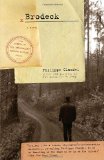
A Novel
by Phillipe Claudel Book Reviewed by:
In the final passage of Steinbeck's The Grapes of Wrath, a man narrowly escapes starvation by feeding at the breast of a woman whose infant child has died. It is a punishingly beautiful combination of despair and hope with few peers in contemporary fiction. Brodeck, the prescient new novel by French author Phillipe Claudel, culminates in an equally moving but far darker scene that will haunt readers even as the book enchants them.
The story is set in a small mountain village where Brodeck lives with his wife, a young daughter and an old gypsy who rescued Brodeck as a child from the charred shtetl we see only in his hazy memories. The two make a ramshackle caravan, we presume through the mountains of the east, until they arrive in a remote hamlet somewhere in western Germany or perhaps eastern France. It is a place that centuries of cultural and linguistic blending have left uncomfortably outside grand narratives of nationhood.
Brodeck the man is an obscure bureaucrat of the periphery who brings to mind a hollowed-out version of Steinbeck's preacher Casey, able to see through men's artifice to their deepest motives, but with his innate moral sense obliterated by unspeakable violence. The book begins with his cards in plain view: The truth can gash you so deeply that you can't live with the wounds any longer, and for most of us, what we want to do is live. And this is why the novel stands out as a story of genocide. Rather than seeking to rescue some exalted meaning from the wreckage of history, Claudel shows us people who want nothing more than to live as they become hopelessly lost in a web of inhumanity.
The drama revolves around an outsider who comes to visit the village, and to the utter astonishment of the burghers takes up residence at the inn. The Anderer, or the other, as Brodeck calls this stranger, walks the village streets with a sketchbook in hand, smiling pleasantly at everyone he passes. In the book's opening scene we learn that this stranger has managed to stir up the passions of the townsfolk to such a fevered pitch that he ended up a victim of mob justice. Arriving on the scene after the execution is complete, Brodeck is pressed into service by the still homicidal mob as official chronicler of the stranger's arrival, his transgressions and the rationale for his punishment.
What could the visitor have done to bring such wrath upon himself? That is the topic of Brodeck's other manuscript; not the one he's been forced to write to save his skin, but the one he keeps in a pouch pressed against his wife's body as she sleeps. This other, hidden manuscript is the only text Claudel shows the reader, dispensing with multiple voices or framing devices. It is a brilliant narrative strategy, perhaps the book's most striking feature. At every moment, we go only as deep as Brodeck's memory can take us. Contradictory explanations, speculation, bilious rage, all wash over the reader as Brodeck wades through the story of his life to reveal the simple motivation behind this act of violence.
Not that Brodeck is himself the guilty party. One can't claim that any particular person was more responsible than another for the Anderer's death. The indelible stain of that guilt will mar the whole village, that is if they cannot banish it from their minds. But then, this stranger did something so unpardonably audacious he could never have hoped to escape with his life: he held up a mirror to every man woman and child in the village, and in it they saw reflected the acts of cowardice they had committed and tried so hard to forget. Not only by his presence, but by his art, the Anderer forced them all to remember what they had done to save their own skins. It is a dehumanizing shame great enough to fill an entire century, one that leaves no one, not even Brodeck, unscathed.
Brodeck's readers will not escape unharmed either. The depiction of the concentration camp is particularly harrowing, in part because it draws from the historical record, though it is never graphically violent. Claudel's book is a reckoning with acts of animal insanity, and naturally some readers will find it difficult. I think, however, that most readers will approach it as I did, knowing that history hides terrible scars, and concentrating most on the difficult task of making sense of the present in light of the past. Viewed in this way, the book is a deep and wide ocean of a story, with transcendent crests and despairing troughs. Get up your courage before you set sail.
 This review was originally published in August 2009, and has been updated for the
July 2010 paperback release.
Click here to go to this issue.
This review was originally published in August 2009, and has been updated for the
July 2010 paperback release.
Click here to go to this issue.
 While Philppe Claudel makes no explicit references to any historical event, a number of them clearly influenced his novel. A particularly poignant example comes when Brodeck is forced to flee the city where he attends university because nationalist thugs respond to a popular protest by smashing store fronts and savagely beating anyone who looks like they don't belong. There is an obvious parallel to the infamous events of Kristallnacht, a touchstone in the progression toward the Nazi murder of the Jews.
When Hitler occupied the chancellorship of Germany in 1933, he did so as head of a National Socialist party that shared anti-communist and anti-Semitic rhetoric with a number of other political movements in Europe. The difference between the Nazis and their counterparts would ultimately be that the former remained wedded to an inherently violent ethno-national world view as they rose to dizzying heights of power. As this fatal combination of fundamentalism and military might carried them toward epochal acts of genocide, the foot soldiers of Nazism would leave countless markers, one of the most well known of these being Kristallnacht.
 Jews had been a target of repression since the early days of the Nazi regime, along with the mentally and physically infirm, political dissidents, gays, and "gypsies". On November 9, 1938 German leaders issued orders that "actions" were to be taken against the Jews across the territories that then made up the Reich. These actions included burning and destroying synagogues and local businesses, in some cases leaving the streets blanketed with glass (thus the name Kristallnacht – "Night of broken glass"). Thousands of Jews were also rounded up and shipped to concentration camps, in what marked a decisive move toward the so-called "final solution."

This review was originally published in August 2009, and has been updated for the
July 2010 paperback release.
Click here to go to this issue.
Your guide toexceptional books
BookBrowse seeks out and recommends the best in contemporary fiction and nonfiction—books that not only engage and entertain but also deepen our understanding of ourselves and the world around us.
