
-
Your next favorite book
is waiting.
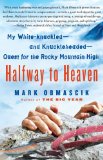
My White-knuckled - and Knuckleheaded - Quest for the Rocky Mountain High
by Mark Obmascik Book Reviewed by:
Halfway to Heaven is a different kind of mountain climbing book. Unlike
Into Thin Air or Touching the Void, which feature
well-trained individuals obsessed with the sport, Halfway to Heaven
relates the exploits of forty-four year old "everyman" and novice climber, Mark Obmascik. The result is an entertaining look at a challenging activity from a
viewpoint to which many of us can relate. This is a book for the weekend
warrior, for all of us who watch mountaineering movies from the safety of our
couches, and for those who dream of attempting feats of athleticism - maybe
tomorrow.
There will be inevitable comparisons between Halfway to Heaven and
Bill Bryson's
A Walk in the Woods, and for the most part, they're apt.
Both feature middle-age men tackling nature in ways one wouldn't think possible
for those in less than peak physical condition. Both authors also see the humor
in what they're attempting, and are able to convey it to their readers. Unlike
much of Bryson's book, though, Obmascik's writing isn't as laugh-out-loud funny;
his style is to drop the occasional one-liner into his narrative, more likely
resulting in a sympathetic smile or chuckle than a belly-laugh.
"On the way up the mountain I had donned crampons for the first time, mostly to practice with my new gear, but also for safety. Besides, they let me climb like Spider-Man. Slopes that Matt had to hop and peck and squirm around, I just sauntered straight up. The twelve sharp steel teeth strapped onto each hiking boot may as well have been superglue; they stuck to anything, and I beamed like a boy with his newest, favoritest Christmas toy. I felt safe. I felt strong. I even felt a little bit of an even rarer commodity – confidence."
Halfway to Heaven is also more compelling than Walk in the Woods.
For one thing, mountaineering is a dangerous sport. Obmascik unquestionably
risks injury or death every time he steps on the mountain. Humor aside, there
are definitely sections of the narrative where his fear is evident.
Adding interest to Halfway to Heaven is his depiction of the other
people with whom he climbs. His wife's insistence that he never climb alone led
him to ask, beg and bribe relatives and friends (some of whom he hadn't seen in
decades) to join him. When that still left too many unattended climbs, he turned
to friends of friends, and, ultimately, to strangers. Obmascik not only
describes these people and their climbing abilities, but gives his readers some
insight into what motivates them to undertake such a demanding sport. Finally,
he depicts the mountains themselves as individuals. Each has its own
unique character, making each climb different and unpredictable.

 This review was originally published in May 2009, and has been updated for the
May 2010 paperback release.
Click here to go to this issue.
This review was originally published in May 2009, and has been updated for the
May 2010 paperback release.
Click here to go to this issue.
Mountain climbing, or mountaineering, is the sport of attaining or attempting
to attain high points in mountainous regions, mainly for the pleasure of the
climb. Before the 18th century, climbing for sport was rare. Humans
did ascend high peaks, but generally only out of necessity or for religious
reasons (many ancient religions such as the Mayans and Greeks built mountaintop
shrines, and it is believed that pilgrims have been journeying to the foot of
Mount Kailash in Tibet since well before recorded history).
The birth of contemporary mountain climbing came in 1760, when Horace Benedict de Saussure offered prize money for the first summit of Mont Blanc, the tallest peak in Europe (no attempt was successful until 1786). The first summit of the
Matterhorn came in 1865. The activity became increasingly popular, with mountaineers looking for ever greater challenges, culminating in the summit of Mount Everest,
the highest mountain in the world, on May 29, 1953. The invention of better,
lighter climbing gear over the decades has enabled more and more people to
participate in the sport. It is no longer just for the elite climber; thousands of "regular people" summit mountains every year.
In addition to the typical gear most people would take on a backpack trip,
mountaineering requires some specialized equipment:
Even with the appropriate gear, mountaineering is a dangerous sport. Lower air pressure and lack of oxygen can lead to severe headaches, nausea and lethargy, collectively known as altitude sickness. The afflicted individual may eventually acclimatize, but altitude sickness can lead to high altitude cerebral or
pulmonary edema (an edema is a swelling caused by fluid trapped in the body's
tissues), either of which can be fatal. In addition there are a whole raft of other
potential conditions that can afflict climbers, from snow blindness to what is politely known as high altitude flatus expulsion, which is caused by the differential between the lowering external pressure and the relatively high pressure within the body.
Despite the many different ways to achieve injury or death on a mountain, the most common cause of injury is, as you would expect, falling.
Useful Links
This review was originally published in May 2009, and has been updated for the
May 2010 paperback release.
Click here to go to this issue.
Your guide toexceptional books
BookBrowse seeks out and recommends the best in contemporary fiction and nonfiction—books that not only engage and entertain but also deepen our understanding of ourselves and the world around us.
