
-
Your next favorite book
is waiting.
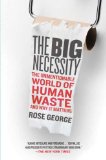
The Unmentionable World of Human Waste and Why It Matters
by Rose George Book Reviewed by:
Rose George has a growing history of covering off-beat topics, such as
writing about Saddam Hussein's birthday party and exploring the Alternative
World Cup. Tackling the topic of human bodily waste is quite risky, and while
George admits to being on the receiving end of many jokes, she effectively
presents the topic as a serious public health issue supported by a riveting
barrage of information.
At one end of the waste disposal spectrum are the luxurious
Washlet toilets she
finds throughout Japan - the bottom of the line model has a built-in bidet
system, a heated seat, and a control panel; while higher-end products monitor
blood pressure and play music. Since 1980, TOTO, an esteemed Japanese toilet
manufacturer, has sold 20 million Washlets to Japan's population of 160 million.
So commonplace in Japan are these toilets that census figures have revealed more
Japanese households owning a Washlet than possessing a computer.
In diametric opposition to this pristine scenario is the rampant open defecation
which is practiced throughout much of India. According to the author, 200,000
tons (155,000 truckloads) of human feces are left untreated in India every day.
Men, women and children squat on their haunches to defecate beside train tracks,
outside urban public toilets, and on roads outside villages, resulting in the
spread of worms, salmonella, cholera, giardia, and many more infections.
Throughout her travels the author interviews many interesting individuals who
are devoted to the cause of sanitation in areas such as these. One such is Joe
Madiath, who runs Gram Vikas (Village Development). Gram Vikas created a
cycle of success in the village of
Samiapalli by targeting the women. In return
for the residents agreeing to build bathrooms up to roof level for privacy (Madiath's slogan is "building dignity through toilets") he promised to
bring water to the village so that the women would no longer have to laboriously
fetch water from faraway pumps. In turn, the building of latrines sparked
the construction of stronger cyclone-proof homes, the beginning of women working
outside the home, and higher attendance rates of healthier children at
school. Samiapalli's success has now been repeated in over 100 villages across
the Indian state of Orissa. Through this example and others, the author convincingly argues that
improved sanitation with toilets affects a society in many unimagined positive
ways.
Anthropologists should be having a field day with bathrooms, according to the
author. "A place where all sorts of human needs and habits intersect: fear,
disgust, conversation, grooming, sex." In short, she boldly maintains, "To be
uninterested in the public toilet is to be uninterested in life." After
following the author's investigative escapades of the London sewers and checking
out toilets connected to biogas digesters in China, readers will be left
wondering about hygiene in other parts of the world and the resulting societal
effects. What is happening with human bodily excrement in Egypt? In Venezuela?
The topic becomes increasingly relevant the smaller our global world becomes,
and here's hoping that Rose George keeps it right in front of us.
Interesting Links
 This review was originally published in November 2008, and has been updated for the
July 2009 paperback release.
Click here to go to this issue.
This review was originally published in November 2008, and has been updated for the
July 2009 paperback release.
Click here to go to this issue.
In The Big Necessity Rose George introduces readers to biogas digesters in rural China. Biogas digesters (often shortened to biodigesters) are permanent structures, usually constructed of cement, in which waste (human, animal and agricultural leftovers) decompose in the lower section causing the micro-organisms to release methane that is collected in the upper section.
There’s evidence that biogas was used to heat bath water in Assyria around 10 BC. The first modern-day biodigester was built in a leper colony in Bombay India in 1859. China began using biogas technology back in the late nineteenth century. By the end of 2005 there were about 17 million digesters, predominantly in rural areas, with about 50 million Chinese reaping the benefits. By 2020 biogas could potentially supply energy to one quarter of Chinese rural households. The reactors are commonly built in tandem with new pigsties, with toilets draining directly into them. In China, a biodigester can be built in about a week for about $80.

The benefits and uses for biogas technology are numerous. It can be tapped into
immediately for cooking, as well as for the generation of heat and electricity. An efficient digester can supply 60% of a rural family's energy requirements. Biogas methane can even be harnessed as vehicle fuel. Further, it can be used to heat greenhouses, boosting photosynthesis as well as increasing silkworm egg hatching. The liquids and solids remaining in the digester act as extremely rich
crop fertilizer. Finally, the digestion process greatly reduces disease transmission, since waste is no longer stored in open festering pits.
In addition to the many practical benefits to farmers, harnessing biogas is environmentally responsible. Methane is a key 'greenhouse' gas, second only to
carbon dioxide in its effect on global warming.
Reports from the Institute of Science in Society
and Canada's Office of Urban Agriculture offer further details on Chinese biogas digesters, as well as some interesting photographs and diagrams.
Biodigesters are becoming commonplace in virtually every developing country from India to Guatamala; and the developed world is slowly picking up speed, led by Sweden which is said to be 20 years ahead of countries such as the USA and UK.
This review was originally published in November 2008, and has been updated for the
July 2009 paperback release.
Click here to go to this issue.
Your guide toexceptional books
BookBrowse seeks out and recommends the best in contemporary fiction and nonfiction—books that not only engage and entertain but also deepen our understanding of ourselves and the world around us.
