
-
Your next favorite book
is waiting.
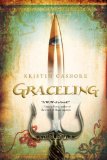
 Book Reviewed by:
I lost a night of sleep and a day of work to this book. Usually drawn to
decidedly toothier fare, I was ready for a little treat. I was not prepared for
an all-encompassing vortex of storytelling that would render all of my other
responsibilities utterly unimportant. Both a gripping adventure tale and a
moving portrait of a tempestuous, beautifully flawed young woman coming of age,
Graceling marks the debut of a truly gifted writer.
Every so often in The Seven Kingdoms, a child is born with mismatched eyes.
These children are Graced, or gifted, with an extreme skill, and are sent into
the service of the king as their Grace develops. Some are Graced with
mind-reading, cooking, or dancing, but Graceling's heroine, Katsa, is Graced
with fighting. She can clear a room of 20 armed men in minutes, with her bare
hands. She's ten times faster and stronger than any soldier, her aim with bows, swords and knives
deadly accurate. Placed in the service of her uncle, King Randa, she has no
choice but to do his bidding as he dispatches her to carry out painful
punishment against those who have failed to follow his orders. An orphan who
knows no other world, Katsa lives within Randa's walls journeying only on her
violent missions, her social skills stunted, having trained with single-minded
determination since childhood, isolated from and feared by all others. As she
grows up she begins to question her missions, becoming frightened and sickened
by her own violence. She starts to rebel, refusing to kill her victims, meting
mercy wherever she can, and forms an underground network of citizens of The
Seven Kingdoms that carries out secret plans against the corruption and evil
throughout the land.
On one of her secret missions, Katsa almost meets her match in another Graceling,
a handsomely mysterious young man named Po who seems to share her Grace for
combat. He's still no physical match for Katsa, but his challenge to her reaches
far beyond brute strength and skill, stirring battles within her that force her
to question her true nature. In a fantastic twist on the classic coming-of-age
novel, Katsa struggles with her developing self-awareness and her growing
friendship with Po, wrestling with her Grace and its implications, wondering
"When a monster stopped behaving like a monster, did it stop being a monster?
Did it become something else?" Just what that "something else" is underscores
the rest of this terrifically captivating novel, as Katsa and Po embark on an
elaborate, heart-stopping mission to save The Seven Kingdoms. They also begin an
equally pulse-quickening romance, but Katsa's feminist convictions keep it far
from a knight-in-shining-armor fairy tale. She prizes her independence, wishes
to remain her own protector and defender, and refuses to yield her power to a
husband or her independence to children. In a medieval world where girls her age
are courting marriage, Katsa's notions are anathema to everyone except Po. Their
romance is at once innocent and strikingly mature, impassioned and thoughtful,
in the emotional realm of adults, but sparked with the electricity of a first
teenage love. The adventure and the romance intertwine seamlessly, and the
action is heightened by the deeply developed emotional and intellectual
undertones.
As I closed the cover and reluctantly emerged from Kristin Cashore's narrative
grasp, I already felt starved for more, and I'm relieved to know that she's hard
at work on both a prequel and a sequel. I can't help but remark that Ms.
Cashore's Grace is keenly evident in this remarkable debut novel, and I can't
wait to see where she takes her characters next. The prequel, Fire published last week. It has one cross-over character with Graceling, a small boy with strange two-colored eyes who comes from no-one-knows-where, and who has a peculiar ability that Graceling readers will find familiar and disturbing.
 This review was originally published in November 2008, and has been updated for the
September 2009 paperback release.
Click here to go to this issue.
This review was originally published in November 2008, and has been updated for the
September 2009 paperback release.
Click here to go to this issue.
Though Graceling is certainly set in a magical history, the time
period seems distinctly medieval, based on the descriptions of clothing,
weapons, buildings, and the general atmosphere. A descriptive passage towards
the end of Graceling made me wonder about the science and craft of
stained-glass-making in medieval times. Wielding the magical powers of The World Wide Web, I was startled to find news of a recent study that suggests that
medieval stained glass windows painted with real gold actually purify the air
when sunlight shines through them.
 Zhu Huai Yong, along with a group of researchers at Queensland University of Technology's School of Physical and Chemical Sciences, found that many church windows across Europe were decorated with paint containing gold nanoparticles (very basically: really tiny particles) of various sizes. A reaction caused by the activity of electrons in the particles energized by the sun increases the nanoparticles' magnetic field strength by up to 100 times, enough to break up
pollutant particles in the air.
Zhu Huai Yong, along with a group of researchers at Queensland University of Technology's School of Physical and Chemical Sciences, found that many church windows across Europe were decorated with paint containing gold nanoparticles (very basically: really tiny particles) of various sizes. A reaction caused by the activity of electrons in the particles energized by the sun increases the nanoparticles' magnetic field strength by up to 100 times, enough to break up
pollutant particles in the air.
Zhu remarked that "For centuries people appreciated only the beautiful works of
art, and long life of the colours, but little did they realize that these works of art are also, in modern language, photocatalytic air purifiers with nanostructured gold catalysts." The sun acts as the catalyst in this case, creating a solar-powered technology that may now be used to drive drive chemical reactions. Now, how's that for magic?
The University's press release on the topic has been widely reported in
mainstream and specialized media including at
nanitenews.com; and the same website also reported on other
potential medical breakthroughs utilizing gold nanoparticles.
Examples of medieval stained glass windows:
This review was originally published in November 2008, and has been updated for the
September 2009 paperback release.
Click here to go to this issue.
Your guide toexceptional books
BookBrowse seeks out and recommends the best in contemporary fiction and nonfiction—books that not only engage and entertain but also deepen our understanding of ourselves and the world around us.
