
-
Your next favorite book
is waiting.
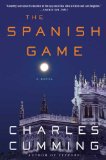
A Novel
by Charles Cumming Book Reviewed by:
In essence, The Spanish Game is a novel in two parts. The first, longer section serves to set the scene and introduce us to the protagonist, Alec Millius. Cumming's considerable literary talent is most evident here. He describes modern-day Spain in loving, exacting detail that transports the reader in a way only top-notch writing can. He is equally exacting in the creation and description of his characters:
"Mikel Arenaza, politician and friend of terror, is a lively, engaging man – I could tell as much by his manner on the phone – but the full extent of his ebullient self-confidence becomes apparent only upon meeting him. We arrange to have a drink in the old town of San Sebastian, not in an herriko taberna – the type of down-at-heel pub favored by the radical, left-wing nationalist abertzale – but in an upmarket bar where waves of tapas and uncooked mushrooms and peppers cover every conceivable surface, two barmen and a young female chef working frantically in sight of the customers…Arenaza arrives late, picking me out of the crowd within an instant of walking through the door, at least six feet of heavy good looks pulling off a charming smile beneath an unbrushed explosion of wild black hair."
Perhaps, though, Cumming's most remarkable
achievement is the fine balance he achieves in his depiction of
Millius, a deeply flawed character with so much baggage that in a
lesser author's hands he'd be completely unlikable. He's excessively
paranoid, a womanizer, an alcoholic, and generally of questionable
morality. Cumming deftly shows the vulnerability that lurks
underneath Millius's damaged persona - both his loneliness and his
desire to return to the fold of the espionage community are
palpable, and the reader develops the utmost sympathy for him.
Adding to the character's appeal is that he's not perfect; he makes
mistakes and fails as often as he succeeds. The Spanish Game
is the sequel to Cumming's earlier work,
A Spy by Nature (which was released in paperback in the USA
in November 2008). While this second entry stands reasonably well on
its own, one cannot escape the feeling that one would understand
Millius better having read the first book.
The second part of the The Spanish Game consists of non-stop
action and one shocking plot twist after another. The reader is
swept up right along with Millius in the confusion. At this point,
the plot becomes completely unpredictable and, like Millius, the
reader never knows whom to trust or what will happen next. The
tension stays high right up to the end of the book, keeping readers
in a state of anxiety to, quite literally, the last page of the
novel.
The Spanish Game does have idiosyncrasies that may lessen its
appeal for some readers. Cumming's attention to the set-up in the
first half may frustrate readers looking for an action-adventure
novel; and when the action does take off, it's very sudden; there's
no build-up of tension as the book shifts gears. In addition, the
history of the Basque separatists is complex, and at times the way
Cumming chooses to relate it comes off as clumsy -- too forced and
too much like an encyclopedia entry. Finally, the ending is a bit
open-ended (this is the second volume in a planned trilogy) and may
leave readers who like tidy conclusions unsatisfied. Nevertheless,
this is an exceptionally well-written addition to the genre, and
deserves the praise it has garnered in both the USA and UK, where it was
first published. Readers who appreciate quality spy fiction
will want to put this one high on their list.
 This review was originally published in November 2008, and has been updated for the
November 2009 paperback release.
Click here to go to this issue.
This review was originally published in November 2008, and has been updated for the
November 2009 paperback release.
Click here to go to this issue.
Like many spy thrillers, The Spanish Game is awash in an alphabet soup of acronyms. Below is a brief translation for the uninitiated.
MI5: "Military Intelligence, Section 5." Formed in 1909, MI5is a UK counter-intelligence and security agency which concentrates its efforts mainly on security issues within the UK (approximately equivalent to the FBI). For more about the Military Intelligence Units & MI5 see the sidebar to At Risk by Stella Rimmington.
SIS: "Secret Intelligence Service" (sometimes incorrectly known as MI6). Formed in 1909 as the Secret Service Bureau, the SIS is the UK's external intelligence-gathering agency (approximately equivalent to the CIA). During World War II, SIS adopted the name MI6 as a 'flag of convenience', becoming one of 17 wartime military intelligence units. The name MI6 fell out of official use years ago but much of the media still refers to the SIS as such. For more about the SIS, see the sidebar to Cumming's first book A Spy by Nature.
GCHQ: – "Government Communications Headquarters." The
GCHQ provides information security to MI5 & SIS. It's responsible for the interception, decryption and interpretation of communications. It was formed in 1919 as the Government Code and Cypher School.
CIA: "Central Intelligence Agency." The CIA is a civilian branch of the US government formed in 1947 to collect and analyze information about foreign governments, corporations and citizens. For more about the CIA see
Legacy of Ashes.
ETA: "Euskadi Ta Askatasuna" (Basque for "Basque Homeland and Freedom"). The ETA is an illegal, armed Basque separatist organization founded in 1959. Its goals are sovereignty and self-determination for the Basque Country in Spain. Its ideology is primarily Socialist. It is considered a terrorist organization by the European Union. For more about the ETA see the sidebar to House of the Deaf.
Batasuna: ("Unity" in Basque) – aka Herri Batasuna ("Unity of the People") and Euskal Herritarrok ("We Basque Citizens"). Batasuna is a nationalist political organization, considered the political arm of the ETA. Like the ETA, it is illegal and considered a terrorist organization due to its financial support of the ETA. Its main activities include organizing strikes and rallies in support of Basque independence.
Guardia Civil: The Spanish Civil Guard. This organization is primarily the Spanish police force, although it also provides military and counter-terrorism support.
CNI: "Centro Nacional de Inteligencia." Formed in 2002, the CNI is the Spanish intelligence agency responsible for both internal and external intelligence gathering.
CESID: "Centro Superior de Información de la Defensa." The predecessor of the CNI, active from 1977 – 2002.
GAL: "Grupos Antiterroristas de Liberación" ("Antiterrorist Liberation Groups"). The GAL was a series of death squads illegally set up by officials of the Spanish Government to fight the ETA. It operated mainly in the Basque Country from 1983 – 1987. Responsible for at least 27 killings, its actions are referred to as "La guerra sucia" ("the dirty war").
BVE: "Batallon Vasco Espanol" ("Basque Spanish Battalion"). The BVE was a Spanish right-wing paramilitary group active in the north Basque Country, 1975 – 1981, which employed violence against Basque nationalist and separatist groups. It was replaced by the GAL.
This review was originally published in November 2008, and has been updated for the
November 2009 paperback release.
Click here to go to this issue.
Your guide toexceptional books
BookBrowse seeks out and recommends the best in contemporary fiction and nonfiction—books that not only engage and entertain but also deepen our understanding of ourselves and the world around us.
