
-
Your next favorite book
is waiting.
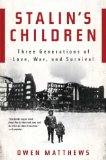
Three Generations of Love, War, and Survival
by Owen Matthews Book Reviewed by:
 The quote featured on the jacket regarding Matthews' inspiration for
Stalin's Children is extremely appropriate and neatly summarizes the
book's intent. Matthews succeeds admirably in his goal of describing his
family's journey from Russia to England and back again, in the process
crafting a fascinating history that reads more like a novel than a work of
non-fiction.
The quote featured on the jacket regarding Matthews' inspiration for
Stalin's Children is extremely appropriate and neatly summarizes the
book's intent. Matthews succeeds admirably in his goal of describing his
family's journey from Russia to England and back again, in the process
crafting a fascinating history that reads more like a novel than a work of
non-fiction.
The book chronicles the lives of Matthews' Russian grandparents, aunt,
mother, and Welsh father (as well as delving briefly into his own) who were
all directly effected by one or more of the multiple political upheavals
that characterized much of Russia's 20th century history. Victims of
Stalin's Purge and later Communist crackdowns, most of the family somehow
managed to survive. Matthews, a one-time war correspondent for Newsweek,
relates his family's experiences with a reporter's eye for description and
detail, completely drawing his readers into his family's saga.
The narrative comes across as surprisingly objective, particularly when
Matthews discusses his male relatives. He says of his grandfather's
execution during the Great Purge:
Bibikov himself would have perfectly understood, with his rational mind, as he stood in a cellar or faced a prison wall in his last moments, the logic of his executioners. And perhaps – why not? – he might, if he had met different people in his early days in the Party, found different patrons, have become an executioner himself. Did he not explain away the famine which his Party had brought to the Ukraine as a necessary purging of enemy elements? Did he not consider himself one of the Revolution's chosen, ruled by a higher morality? Bibikov was no innocent, caught by an evil and alien force beyond his comprehension. On the contrary, he was a propagandist, a fanatic of the new morality – the morality which now demanded his life, however pointlessly, for the greater good.
Additionally, Matthews provides a dispassionate account of his
emotionally distant relationship with his father Mervyn, blaming neither his
father nor himself for the rift. Few authors are able to achieve this sense
of balanced reporting while still making a book interesting, particularly
when discussing so intimate a subject. Matthews, however, manages to do just
that.
 The information in Stalin's Children comes from numerous
conversations with Matthews' surviving Russian relatives, an enormous amount
of research, and the letters written between his mother and father during
their six-year separation. Much of the work, too, is based on Matthews' own
observations made during his visits to the country, as well as personal
knowledge gleaned during the years he lived in Moscow. He attempts to show
parallels between his life and that of his father's, bouncing back and forth
between the two eras. This is perhaps the only weak part of the book.
Readers may find themselves so wrapped up in the father's tale that the
switch to the son's is an interruption. Matthews relates more of his own
life later in the book, including a particularly harrowing account of
reporting from the war in Chechnya. Unfortunately, while it's apparent from
his press clippings that Matthews has lived a fairly adventurous life, most
of his experiences aren't recorded in Stalin's Children.
The information in Stalin's Children comes from numerous
conversations with Matthews' surviving Russian relatives, an enormous amount
of research, and the letters written between his mother and father during
their six-year separation. Much of the work, too, is based on Matthews' own
observations made during his visits to the country, as well as personal
knowledge gleaned during the years he lived in Moscow. He attempts to show
parallels between his life and that of his father's, bouncing back and forth
between the two eras. This is perhaps the only weak part of the book.
Readers may find themselves so wrapped up in the father's tale that the
switch to the son's is an interruption. Matthews relates more of his own
life later in the book, including a particularly harrowing account of
reporting from the war in Chechnya. Unfortunately, while it's apparent from
his press clippings that Matthews has lived a fairly adventurous life, most
of his experiences aren't recorded in Stalin's Children.
Overall, Stalin's Children is a well-written biography about
resilient people living in a tense, and dangerous, political climate.
Non-fiction readers will want to put this one high on their list.
 This review was originally published in October 2008, and has been updated for the
September 2009 paperback release.
Click here to go to this issue.
This review was originally published in October 2008, and has been updated for the
September 2009 paperback release.
Click here to go to this issue.
The history of Russia and the Soviet Union during the first half of the 20th
century is complex to say the least, characterized by near-constant turmoil. The autocratic
reign of the Tsars came to an end in 1917, sparked by economic hardship
instigated by Russia's involvement in World War I, rapid urban growth, and
the rise of the middle class. Various political parties emerged to vie for
leadership in the ensuing vacuum, with the Bolshevik Party led by Vladimir
Lenin ultimately prevailing. Lenin's death in 1924 led to a power struggle
which left party leadership in the hands of Joseph Stalin.
Stalin's policy of aggressive industrialization led to workers leaving the
farms for employment at the new factories. The result was fewer agricultural
workers producing food, and more industrial workers who needed to be fed. In
addition, the peasants resisted collectivization, destroying assets and
hiding food stores to keep them from being appropriated. Food shortages
resulted. Although scholars attribute the ensuing famine to Stalin's
policies, Stalin blamed the "kulaks" (rich peasant landowners), accusing
them of hoarding grain. He began a campaign of retribution with the goal of
eliminating the kulaks as a class. Anyone accused of being a kulak, kulak
helper or, later, even an ex-kulak, was to be shot, sent to a gulag (labor
camp), or deported to remote and inhospitable parts of the country.
Thousands of deaths were reported, with over a million peasants sentenced to
hard labor at the gulags.
The political situation remained unstable throughout the early 1930s, partly due to the chronic food
shortages. Party loyalties became split between Stalin and Sergei Kirov, a
popular party leader in Leningrad. When Kirov was assassinated in 1934,
Stalin declared the shooting part of a larger conspiracy led by Leon Trotsky
(another rival for power). He instituted a series of purges, beginning with
the arrest and execution of sixteen high-ranking party officials accused of
being conspirators. The purge spread to include anyone who had supported
Trotsky, and then to anyone considered an "enemy of the state." Many
military leaders were convicted of treason. No segment of society was left
untouched.
 Nikolai Yezhov, a Stalin loyalist, was made the head of the NKVD (Soviet
secret police and precursor to the KGB) and put in charge of the continuing
purge of anyone who did not support Stalin's policies. Under Yezhov, the
process became increasingly arbitrary. People were arrested and tortured for
merely being suspected of anti-revolutionary thinking. Neighbors would
inform on each other in the hopes of appearing to be a good citizens and
thereby avoiding arrest themselves. An accusation of being an "enemy of the
people" would start a cycle of public persecution and abuse, often ending in
interrogation, torture and execution. Relatives of the accused were assumed
guilty of the same offenses and summarily deported. Historians estimate that
about 700,000 people were shot in 1937-1938, most of them ordinary peasants
and workers. An estimated five million people were deported to the gulags,
thousands of whom died there of starvation, disease, exposure and overwork.
Nikolai Yezhov, a Stalin loyalist, was made the head of the NKVD (Soviet
secret police and precursor to the KGB) and put in charge of the continuing
purge of anyone who did not support Stalin's policies. Under Yezhov, the
process became increasingly arbitrary. People were arrested and tortured for
merely being suspected of anti-revolutionary thinking. Neighbors would
inform on each other in the hopes of appearing to be a good citizens and
thereby avoiding arrest themselves. An accusation of being an "enemy of the
people" would start a cycle of public persecution and abuse, often ending in
interrogation, torture and execution. Relatives of the accused were assumed
guilty of the same offenses and summarily deported. Historians estimate that
about 700,000 people were shot in 1937-1938, most of them ordinary peasants
and workers. An estimated five million people were deported to the gulags,
thousands of whom died there of starvation, disease, exposure and overwork.
By late 1938 the purge had achieved its purpose: Stalin's unchallenged rule
of the USSR. 90% of the army's senior leadership had been killed, and 130
members of the 139-member Central Committee had been arrested.
Of the NKVD's 809 high officials - the people responsible for carrying out the purge - only 43 (5%) lived through it, falling victim to an ever increasing paranoia they themselves instigated. The mass arrests
ceased, and Stalin had Yezhov arrested for "overzealousness" in an attempt
to deflect blame from himself. Yezhov was later among the executed.
This review was originally published in October 2008, and has been updated for the
September 2009 paperback release.
Click here to go to this issue.
Your guide toexceptional books
BookBrowse seeks out and recommends the best in contemporary fiction and nonfiction—books that not only engage and entertain but also deepen our understanding of ourselves and the world around us.
