
-
Your next favorite book
is waiting.
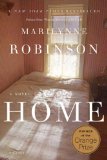
A Novel
by Marilynne Robinson Book Reviewed by:
I simply could not get Gilead out of my head
after I read it. Neither, apparently, could
Marilynne Robinson, so she wrote it all over again
from another character's perspective, even replaying
some of the same scenes from a different corner of
the room.
The story at the heart of both books is Jack
Boughton's return to Gilead, Iowa, after twenty
painful years of self-exile, and the way his
presence deeply unsettles two families, his own and
that of his father's best friend, John Ames. Jack
sinned mightily in his youth when he took up and
then discarded a poor young girl in Gilead, leaving
her to care for the child that resulted from their
union, and it is almost as if Jack decided out of a
certain twisted integrity to live the rest of his
life in fealty to the dissipation he demonstrated at
such an early age. He walks out on his family and
leaves them, twisting on the spear of their love for
him, to wonder if he is even still alive, until the
day he simply walks back through the door.
Gilead is told from Ames's perspective,
unfolding as a series of letters the aged reverend
writes to his young son, and is thus completely
confined to Ames' first-person narration and the
idiosyncrasies of his spiritual yearnings. Home,
by contrast, is told in free indirect speech, the
narrator forever hovering within the mind of Glory,
Jack's sister, who has also just slinked back to
Gilead after a failed relationship. This shift in
narrative strategy allows Robinson to open up the
story, elaborate on the dialogue in scenes that
Reverend Ames only sketchily recorded for his son,
and shade in her characters. We learn little that is
new about the two families in this second go-round,
but we inhabit, exquisitely, their smallest recesses
of feeling.
Home is not a place of refuge and restoration for
Glory and Jack. It is the place to which they limp
when they are utterly defeated by the bustling outer
world. It is, for Jack in particular, a place in
which to keep alive the hope for redemption, though
he doesn't share his minister father's beliefs. Home
is the place to recapture what he never had. Jack
tells Glory, "I've thought about this place so many
times. When I was a kid I used to wish I lived here.
I used to wish I could just walk in the door like
the rest of you did and, you know, sit down at the
table and do my homework or something." Robinson
writes, "Oh, it was the loneliness that none of them
could ever forget, that wry distance, as if there
were injury for him in the fact that all of them
were native to their life as he never could be."
Home is excellent, even if at times too
preoccupied and repetitious, at detailing Jack's
almost congenital estrangement from his family and
their unwavering and agonized loyalty to him.
Even in disgrace, Jack projects an irresistible
charm, and I couldn't help but bleed for him as he
repeatedly attempts to make peace with his dying
father only to enflame old wounds. But to focus on
Jack's tortured soul, as so many reviewers have
done, is to duplicate an injury that Robinson
condemns within the novel—that of overlooking and
taking for granted the state of Glory's soul. It is
she who comes to know Jack better than anyone in the
family, and it is her emotional wisdom that saves
him day after day. Because Robinson narrates the
action from within Glory's perspective, it is
perhaps most accurate to say that Home is the
story not of a prodigal son but of a sister's
loving, faltering attempt to bring the prodigal son
back into the family.
Marilynne Robinson simply cannot write a bad or
frivolous sentence, and it is the always engrossing,
always stately progress of her language that drives
the novel in the absence of a strong plot. You
needn't be religious to appreciate the grave beauty
of Robinson's beliefs. Just listen to the way her
description of a tree grows and takes flight when it
becomes animated by her particular spiritual
sensuality:
"And there was an old oak tree in front of the house, much older than the neighborhood or the town, which made rubble of the pavement at its foot and flung its imponderable branches out over the road and across the yard, branches whose girths were greater than the trunk of any ordinary tree. There was a torsion in its body that made it look like a giant dervish to them. Their father said if they could see as God can, in geological time, they would see it leap out of the ground and turn in the sun and spread its arms and bask in the joys of being an oak tree in Iowa."
Gilead has so overtaken my mind that I find I cannot independently evaluate Home. If you only read one book by Marilynne Robinson, read Gilead. If you love Gilead, then the very instant you close its cover, open up the pages of Home.
 This review was originally published in September 2008, and has been updated for the
September 2009 paperback release.
Click here to go to this issue.
This review was originally published in September 2008, and has been updated for the
September 2009 paperback release.
Click here to go to this issue.
One of the crucial scenes in Home, a scene so important that it repeats and vastly expands on a scene from Gilead, occurs when John Ames and his wife Lila visit the Boughtons for dinner, and Jack discomfits them all by pressing Reverend Ames for his views on the doctrine of predestination. "Do you think some people are intentionally and irretrievably consigned to perdition?" he asks. He continues, "I've wondered from time to time if I might not be an instance of predestination. A sort of proof. If I may not experience predestination in my own person. That would be interesting, if the consequences were not so painful."
Reverend Ames, a Congregationalist, and Reverend Boughton, a Presbyterian, are both Calvinists, like Marilynne Robinson herself. Predestination, a principle tenet of Calvinism, refers to the belief that humankind is born into a state of original sin. Each person's decision to choose God is preceded by God's mercy and invitation to salvation; it is only by the sovereign grace of God that we are able to
recognize our fallen state and repent. Only some people are saved while others are condemned, but no one can know the state of another's soul. The Presbyterian Church* stresses that the doctrine of predestination be used to free believers
from the compulsion to judge others.
Marilynne Robinson's interpretation of Calvinist doctrine turns the question of morality into an aesthetic one. As she explains in an interview with Terry Gross on NPR's Fresh Air.
"If you think, why did God create the world, how does he love the world, what in the world, if you imagine him through the lens of Christ, what in the world breaks his heart, it seems to me it's the irreducible beauty and pathos of human beings and their capacity for love and their capacity for loyalty and all the rest that is simply beautiful, even though in many forms it is in error, it is possibly destructive, and so on….As Hamlet said, who would 'scape whipping? If we were judged on moral terms, we wouldn't perhaps be worth attracting the notice of God in the way that theology assumes that we do. That it's the beauty of us and not the goodness of us, finally."
*Presbyterianism, a form of Calvinism, is a family of Christian denominations within the Reformed branch of Protestant Western Christianity that includes Lutherans and Anglicans. The Protestant movement evolved in the 16th century, rejecting papal authority and many elements of the Roman Catholic doctrine such as the selling of pardons. Typically, Protestant churches believe that scripture is the only source of revealed truth and that salvation is the result of God's grace alone. Wikipedia has a helpful graph illustrating the main branches of Protestant Western Christianity. As you will see from this, Presbyterianism is an offshoot of Calvinism, but today there is a wide range of theological views within Presbyterianism so that one could count oneself Presbyterian without having to follow the tenets of Calvin.
This review was originally published in September 2008, and has been updated for the
September 2009 paperback release.
Click here to go to this issue.
Your guide toexceptional books
BookBrowse seeks out and recommends the best in contemporary fiction and nonfiction—books that not only engage and entertain but also deepen our understanding of ourselves and the world around us.
