
-
Your next favorite book
is waiting.
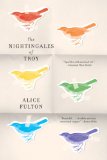
 Book Reviewed by:
Fans of Alice Fulton's poetry (bibliography) will find much to admire. A similar
lyricism, use of imagery, facts and curiosities abound, from Kitty painting
veins on her face with French chalk and Prussian blue* to the scent of vintage
perfumes. The details evoke a uniquely feminine culture. But for all the book's
poetic merits, it also stands on its own as a selection of stories spanning the
lives of seven memorable women.
Tempting as it is to read The Nightingales of Troy as a novel, it isn't
meant to be. There is no device like the four sides of the mahjong table in Amy
Tan's The Joy Luck Club, no pivotal family event, memory or point-of-view
linking everything together. The stories should not be read with the expectation
of perfect symmetry—some of the women's voices are heard only once, while
others, like Charlotte, become essential players in several stories. Rather than
relying on a single, over-arching narrative, the stories connect through their
themes.
Some stories can be read as companion pieces. "Queen Wintergreen" touches on
aging, as does "L'Air Du Temps". A nurse in the title story later becomes a
patient. One story features birth, another, death. The most powerful of these
pairings—"A Shadow Table" and "Centrally Isolated"—hammer one of the more
heartbreaking points home: "you could get hurt while serving others."
You'll find a range of women within these domestic spheres. Dorothy, a
mid-century woman, aspires to save towards a "Magic Chef range and Eureka vacuum
cleaner, a husband and kids". She's a contrast to Mamie, her mother, who is
portrayed as being a more level-headed, less conventional woman. In one scene,
Mamie, now "FULLY DELIGHTED" (a charming, peculiar
euphemism for being dilated) marches towards the bed where Kitty is sleeping.
"See here, Clara Lazarus," she says, "It's time to rise from the dead. I need
streetcar courtesy. I have to push this baby out." And she does, with every hope
that her daughter will lead a different life.
This combination of frailty and steeliness, of service and
independence, sainthood and aplomb, appears throughout the book. The differences
between the more subdued women and their more take-charge counterparts provide
rich material for social and psychological inquiries.
The expected, if familiar, outcome would have been to portray
women earlier in the century as repressed, and the most modern, educated woman
of them all, Ruth, as the liberated go-getter, but these women do not fit simple
preconceptions. Ruth has her self-doubts, and even indulges in a little
victimhood as she complains about the ruthlessness of her chosen profession. The
surprising fact that it isn't a linear progression rings more true. Mavericks
exist in any generation. It isn't always the current one that has the best to
offer.
The world presented here is a dark one, punctuated as it is with
madness, a drowning, hospitalization, unfulfilled desires, and an unhappy
marriage, but realism is never used for the sake of preventing nostalgia, and
never overwhelms. Moments of genuine humor are juxtaposed with seriousness.
Though you may find yourself wishing the characters would emerge unscarred,
happiness is not found in the avoidance of pain. It's found, wisely, in the
midst of it—through the loyalty of sisterhood and through the honoring of the
past as an ever-present force.
Alice Fulton's debut would appeal to any reader fascinated by
the evolution of women's roles throughout the past, or to those who enjoy
stories about love in its many guises. The stories succeed beautifully in
drawing the world inhabited by these "Nightingales of Troy", who, like Florence
Nightingale, minister to those around them.
*French chalk is a type of talc (hydrated magnesium silicate) used by tailors for marking cloth, by cleaners for removing grease from cloth, and as a dry lubricant in a number of applications including many bicycle repair kits. Prussian blue is a very dark blue, colorfast, non-toxic pigment, so named because it was first extensively used to dye the uniforms of the Prussian army. One of the first synthetic dyes, it was discovered accidentally in Berlin in 1704.
 This review was originally published in August 2008, and has been updated for the
July 2009 paperback release.
Click here to go to this issue.
This review was originally published in August 2008, and has been updated for the
July 2009 paperback release.
Click here to go to this issue.
 Alice Fulton is currently the Ann S. Bowers Professor of English at Cornell
University. Her most recent book of poems is Cascade Experiment:
Selected Poems. Her earlier collection, Felt was awarded the 2002
Rebekah Johnson Bobbitt National Prize for Poetry from the Library of Congress
and was selected by the Los Angeles Times as one of the Best Books of 2001 and
as a finalist for the Los Angeles Times Book Award. Her other books
include Sensual Math; Powers Of Congress; Palladium, winner
of the 1985 National Poetry Series and the 1987 Society of Midland Authors
Award; and Dance Script With Electric Ballerina, winner of The 1982
Associated Writing Programs Award. A collection of prose, Feeling as a
Foreign Language: The Good Strangeness of Poetry, was published in 1999.
Alice Fulton is currently the Ann S. Bowers Professor of English at Cornell
University. Her most recent book of poems is Cascade Experiment:
Selected Poems. Her earlier collection, Felt was awarded the 2002
Rebekah Johnson Bobbitt National Prize for Poetry from the Library of Congress
and was selected by the Los Angeles Times as one of the Best Books of 2001 and
as a finalist for the Los Angeles Times Book Award. Her other books
include Sensual Math; Powers Of Congress; Palladium, winner
of the 1985 National Poetry Series and the 1987 Society of Midland Authors
Award; and Dance Script With Electric Ballerina, winner of The 1982
Associated Writing Programs Award. A collection of prose, Feeling as a
Foreign Language: The Good Strangeness of Poetry, was published in 1999.
In an exclusive interview for BookBrowse, Karen Rigby chats with Ms Fulton
about her first collection of short stories, The Nightingales of Troy:
Karen: Your work seems carefully researched - there are so many interesting little
facts or factoids that lend a certain authority or authenticity to the stories
... How do
you encounter these tidbits? When you find one, does it serve as a seed for a
possible story, is it filed somewhere for reference? Does the information come
afterwards?
Alice: Yes, those details usually come after I've decided the larger aspects of the
story - who will be in it and at least a little about "the story problem." Once
I have a clue, I might begin researching the character - her interests,
profession, culture, religion, as well as the texture and language of the time
period.
The radium custodian is mentioned in the title story, which is set in in the
1930s. Old issues of the Journal of American Nursing were a great primary source
for that story. The magazine gave such a vivid sense of what it was like to be a
nurse during the Depression, before antibiotics. It was frightening. The Journal
also was full of ads for long gone medicines, and of course, case histories.
In "The Real Eleanor Rigby," fourteen-year-old Ruth is a Beatles fan and a fan
of Herman Melville. Her tendency to fetishize and collect led me to investigate
the classification of relics in the Catholic Church. Ruth appears again in "L'Air
Du Temps," much older and at a rather dark period of her life. In that story,
she seizes upon perfume as a form of therapy. She's also a scholar, and so she
looks into the history and composition of her favorite fragrances. While
building this aspect of Ruth's character, I read books - and blogs - about
perfume. It was fascinating. That's the pleasure and danger of research. It can
be so consuming that the story doesn't get written.
But it's the story and characters that lead to the research, not the other way
round. While working on a story, I fill notebooks with the idioms and details
that might be useful, and the story itself sends me off to investigate things
like relics or perfume.
Read the interview in full at BookBrowse.
Also of interest: An interview with Alice Fulton in the Irish Times.
This review was originally published in August 2008, and has been updated for the
July 2009 paperback release.
Click here to go to this issue.
Your guide toexceptional books
BookBrowse seeks out and recommends the best in contemporary fiction and nonfiction—books that not only engage and entertain but also deepen our understanding of ourselves and the world around us.
