
-
Your next favorite book
is waiting.
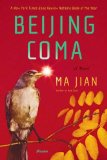
A Novel
by Ma Jian Book Reviewed by:
How can a novel about the massacre of hundreds of people narrated
by a man in a coma be beautiful, even life-affirming? Let me not mislead you;
this is a painful novel, filled with brutality and horror. It would be
impossible to read, were it not for the protagonist's voice, filled with the
light of vivid memories and the sweet ache of youth. Beijing Coma is 600
pages of fiction based on facts too awful to bear, but the way Ma Jian tells the
story makes the novel hard to put down, even when it's painful to read.
Comatose and dead to the world for ten years, Dai Wei has become little else
than a collection of memories. Trapped in the prison of his body, he dives into
the past and tries to make sense of his claustrophobic present. In the first
part of the book he focuses alternately on his father's persecution during the
Cultural Revolution and his own first loves, setting up a beautiful dialectic
that remains throughout the rest of the book. As the novel progresses into a
moment-by-moment account of the events in Tiananmen Square, Wei's infatuation
with the three women (girls, really) whom he fell in love with and lost is at
the heart of all of his memories. His focus is unwavering and his recall
impeccable, the details crystalline, physical, and unexpected. Even as he shouts
through a megaphone to thousands of hunger strikers in the square, he's
remembering Lulu, A-Mei, and Tian Yi; he's capturing the color of light through
a bead on one's necklace, of the way another holds a pen, of the pumpkin seed
caught in another's teeth.
Glimpses of the events in Tiananmen Square begin to increase in frequency until
they take over, slipping the reader into a minutely detailed recounting of the
six weeks Wei and his fellow university students spent in protest. These kids
are less hard-core revolutionaries expecting to die than young, naive,
impassioned hopefuls wrapped up in something that becomes much bigger than they
could have ever imagined, much more terrifying than they'd ever feared. Just a
week before they were struggling to finish their theses, get laid, make travel
plans for the summer -- but they're also students who stayed up through the
night to finish a forbidden copy of Freud's The Interpretation of Dreams,
who wore out a smuggled recording of a Beethoven concerto in just a week. Like
most 20-year-olds, their emotions are bursting at the seams and their passions
ride high as they face struggles both real and unimaginable. As protesters,
they're disorganized, their collective voice scattered and divided, their aims
unclear, and the in-fighting and power struggles among them threaten to destroy
their movement at every turn. As Wei remembers through the distance of years he
asks, "What was wrong with our generation? When the guns were pointing at our
heads, we were still wasting time squabbling among ourselves. We were courageous
but inexperienced, and had little understanding of Chinese history".
Wei's focus is physical, filled with scent memories, vivid details of the body, and intimate remembrances that become engrossing and addictive, and help create the light that illuminates this dark history.
As awful history continues to be made around him, he reveals the mind of a tender, careful observer, and a sharp analyst of Chinese oppression. As author Ma Jian remarks, "The act of remembering gives life its meaning. It is an act of defiance against tyranny and death."
Imagine a lone copy of the beautifully jacketed Beijing Coma - now banned in Ma Jian's home country - laying in the middle of the 100 acres that make up Tiananmen Square: A fitting monument, a powerful act of defiance and a work of art, against tyranny and death.
 This review was originally published in July 2008, and has been updated for the
June 2009 paperback release.
Click here to go to this issue.
This review was originally published in July 2008, and has been updated for the
June 2009 paperback release.
Click here to go to this issue.
Ma Jian on Beijing Coma
In April 1989, I left Hong Kong, where I'd been living in self-imposed exile
for two years, and caught a train back home to Beijing. Photographs of crowds
marching through the dusty streets of the capital had been plastered across the
world's newspapers. Chinese students had launched a movement for freedom and
democracy. I wanted to be part of it. At last, it seemed as though Communist
China was changing.
For six weeks, I joined the students on their marches, crashed out in their
cramped dormitories, shared their makeshift tents during their occupation of
Tiananmen Square. I watched them stage a mass hunger strike, dance to Simon and
Garfunkel, fall in love, engage in futile power struggles. I was ten years older
than most of them. Their passion and idealism impressed but also worried me.
Denied knowledge of their own history, they didn't know that in China political
protests always end in a bloodbath.
When the government quelled the protests with the Tiananmen Massacre on June
4th, I was 1000 kms away, in the coastal town where I was born. My brother had
run into a washing line while attempting to cross a road, smashed his head on a
concrete pavement and fallen into a coma. The news of the massacre reached me
while I was sitting beside him in hospital. I heard that hundreds, perhaps
thousands, of unarmed students and civilians had been gunned down and crushed by
army tanks. Had I remained in Beijing, I too might have been among the dead.
In a state of numb despair, I kept watch over my comatose brother, until, one
day, his eyes still closed, he moved his finger across a sheet of paper to write
the name of his first girlfriend. His memories had dragged him back to life.
By then, the Communist Party was busy unleashing a new economic miracle,
attempting to erase the memory of the Tiananmen Massacre from the minds of the
Chinese people, just as it had erased the deaths of an estimated 70 million
people killed during Chairman Mao's rule.
The Tiananmen tragedy was a defining moment in 20th Century history, but in China, no one
is allowed to discuss it. Remembering has become a crime. Today, the Chinese are
a people who ask no questions, and who have no past. They live as in a coma,
blinded by fear and newfound prosperity.
I wanted to write a book that would bear witness to recent history and help
reclaim a people's right to remember. Through my protagonist Dai Wei a student
lying in a coma after being shot in the Tiananmen Massacre I was able to write
about brutality and injustice, but also about the things that make life worth
living: love, hope, freedom, truth, and the quest for the sublime. Imprisoned in
his body for ten years, Dai Wei is forced to turn inwards and confront his past,
and in doing so becomes freer and more alive than the comatose crowds that
surround him. The act of remembering gives life its meaning. It is an act of
defiance against tyranny and death.
London, October 2007.
This review was originally published in July 2008, and has been updated for the
June 2009 paperback release.
Click here to go to this issue.
Your guide toexceptional books
BookBrowse seeks out and recommends the best in contemporary fiction and nonfiction—books that not only engage and entertain but also deepen our understanding of ourselves and the world around us.
