
-
Your next favorite book
is waiting.
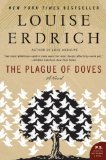
A Novel
by Louise Erdrich Book Reviewed by:
The jacket narrative of The Plague of Doves is rather
deceptive. Erdrich's latest offering isn't really a novel;
it's a collection of short stories loosely tied together
through the lynching mentioned in the book's description.
The core story serves as a touchstone, a place to connect
the diverse tales, but doesn't play a central part in the
characters' actions or development. Very little of the book
is about the brutal murders related in the book's one-page
introduction, focusing instead on relationships within and
between families.
Short story collections often suffer from unevenness in
quality from tale to tale. Such is not the case with The
Plague of Doves. All of the stories in this compilation
are engaging and exceptionally well-written, with a depth
rarely found in full-length novels, let alone the
abbreviated format of the short story. Erdrich is a master
story-teller. One of her strengths is her ability to shift
narrative style from chapter to chapter, depending on the
scene, event or character at the core of each tale. At times
her writing is lyrical, at others unembellished narration.
Some parts of this book are laugh-out-loud funny; she imbues
others with a sense of loss that resonates so deeply with
the reader that the events portrayed are completely
unforgettable. She vividly describes not only the sights of
the plains, but its tastes and smells as well:
"The wind came off the dense-grassed slough, smelling like wet hair, and the hot ditch grass reached for it, butter yellow, its life concentrated in its fiber mat, each stalk so dry it gave off a puff of smoke when snapped. Grasshoppers sprang from each step, tripped off my arms, legs, eyebrows. There was a small pile of stones halfway up the hill. Someone had cleared that hillside once to make an orchard that had fallen into ruin and was now only twisted silver branches and split trunks. I sat there and continued to watch the sky as, out of nowhere, great solid-looking clouds built hot stacks and cotton cones."
However, some of the stories, particularly
those in the middle third of the book, just don't seem to
fit. The reader struggles to find a way to relate them to
the broader outline of what is purported to be the heart of
the novel. In some cases the connection to the lynching is
so tenuous that it's difficult to understand why the tale
was included, sometimes consisting of nothing more than one
sentence mentioning a vague relationship to someone who took
part in the lynching nearly 100 years prior. In others,
characters from previous chapters behave so completely
contrary to the way they were portrayed earlier that the
later story doesn't seem to be about the same person. The
insertion of these tales feels unsettling and contrived.
While entertaining, they do nothing to resolve the central
mystery of the murder and subsequent lynching.
As short story collections go, Plague of Doves is
superb. As a novel, its lack of cohesion leaves something to
be desired. If the reader approaches the narrative expecting
short stories, they will not be disappointed, as this is
easily one of the best compilations to be published in a
long time. If, however, the reader is looking for a
well-written novel, he or she may find it more satisfaction
in one of Erdrich's earlier plot-driven works such as The
Painted Drum or The Master Butcher's Singing Club.
 This review was originally published in June 2008, and has been updated for the
May 2009 paperback release.
Click here to go to this issue.
This review was originally published in June 2008, and has been updated for the
May 2009 paperback release.
Click here to go to this issue.
Louis Riel
Many of the characters featured in The Plague of Doves
are
Metis. The Metis (historically known as the Bois
Brule) emerged in Canada in the mid-17th Century
as New World fur traders intermarried with Cree, Ojibwe,
Salteaux and Menominee natives. While mostly French, some of
the traders were English and Scots. Over time, the offspring
of these unions themselves interbred and had children of
their own, creating one of three Aboriginal peoples
recognized by the Canadian government.
The Metis homeland includes the Canadian provinces of
British Columbia, Alberta, Saskatchewan, Manitoba & Ontario,
as well as parts of the United States (Montana, North
Dakota, & NW Minnesota.). They speak Metis French or a mixed
language called Michif. Metis French is best preserved in
Canada, while Michif is more prevalent in the United States
(notably in the Turtle Mountain Indian Reservation of North
Dakota, where Michif is the official language).
Primarily fur traders and pioneers, the Metis acted as
translators between the First Nations and the Europeans in
Canada. They were well regarded as guides and trackers.
Louis Riel
One of the historical Metis mentioned in Plague of Doves
is the controversial Canadian folk-hero
Louis Riel. Riel was born in 1844 in the Red River
Settlement (now Manitoba) in Canada. After being educated in
both religion and law in Montreal, he returned to his
homeland in 1868. The provisional government he subsequently
established (1869-1870) ultimately negotiated the terms
under which the modern province of Manitoba entered the
Canadian Confederation, leading to Riel's recognition as
"The Father of Manitoba." Toward the end of this period,
referred to as the First Red River Rebellion, Riel ordered
the execution of Thomas Scott for "defying the authority of
the Provisional Government, of fighting with the guards and
insulting the President." As a result of this unpopular
decision, Riel was forced into exile to the United States.
While in the USA, Riel became convinced he was divinely
chosen as a leader and prophet of the Metis people, and
returned to Canada to represent Metis grievances
(particularly regarding land) to the Canadian government. He
led a resistance movement, which escalated into a military
confrontation in 1885 (the short-lived Second Red River
Rebellion). The rebellion ended with Riel's surrender. He
was tried under a charge of high treason, found guilty and
executed on November 16, 1885. The execution was widely
opposed and had long-lasting political ramifications.
On April 17, 2007, the Manitoba government enacted
legislation establishing
Louis Riel Day as the Third Monday in February. The
holiday was first celebrated on February 18, 2008.
This review was originally published in June 2008, and has been updated for the
May 2009 paperback release.
Click here to go to this issue.
Your guide toexceptional books
BookBrowse seeks out and recommends the best in contemporary fiction and nonfiction—books that not only engage and entertain but also deepen our understanding of ourselves and the world around us.
