
-
Your next favorite book
is waiting.
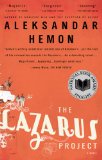
 Book Reviewed by:
The Lazarus Project creates a heavy, heartfelt wholeness
out of three different kinds of loss. First there is Vladimir Brik, a young
Bosnian-American whose only apparent difference from the author is his name (see
sidebar). He has lost his homeland, a loss made sharper by his guilt at having
escaped the ravages of war. In America, his new home, he feels forever tentative
and dissociated. "The one thing I remembered and missed from the before-the-war
Sarajevo," he says, "was a kind of unspoken belief that everyone could be
whatever they claimed they were—each life, however imaginary, could be validated
by its rightful, sovereign owner, from the inside."
He becomes almost morbidly fascinated by the true story of Lazarus Averbach, a
Jewish man who escaped the pogroms of Eastern Europe only to be shot dead by the
Chief of Police, mistaken for an anarchist a mere seven months into his pursuit
of the American dream. Hemon's narration moves backward into Averbach's short
life and forward into his sister Olga's grieving as she moves through the
crowded streets of Chicago's Jewish ghetto. "Every one of them is somebody's
brother or sister or child; all of them are alive; they know the good ways of
not dying."
Then there is Rora, another Bosnian immigrant who accompanies Brik on a journey
from Ukraine to Moldova and Bosnia to research Averbach's life. Unlike Brik,
Rora remained in Sarajevo during the war, surviving by hitching his fortune to a
Bosnian warlord and a corrupt American photojournalist. Rora tells his war
stories as they travel across the changed landscape. His life, so different from
Brik's experience of relative comfort, has turned him into a hardened mercenary,
yet Brik cannot help but admire his integrity: "I recognized him then; that is,
I finally comprehended what I had known but had never been able to formulate: he
had always been complete. He had finished the work of becoming himself, long
before any of us could even imagine such a feat was possible." As Brik
conducts his research, Rora takes pictures—emphasis on the word "take"—with
ruthless intensity. Each chapter in The Lazarus Project begins with a
photograph taken by Hemon's friend Velibor Bozovic or from the archives of the
Chicago Historical Society.
Brik's alienation from American culture sensitizes him to a more generalized,
existential strangeness under the surface of modern life, and it is in this
shadowy yet instantly recognizable terrain that Hemon finds his true subject:
I spotted a can in the corner whose red label read SADNESS. Was there so much of it they could can it and sell it? A bolt of pain went through my intestines before I realized that it was not SADNESS but SARDINES. It was too late for recovery, for sadness was now the dark matter in the universe of still objects around me: the salt and pepper shakers; the honey jar; the bag of sun-dried tomatoes; the blunt knife; a desiccated loaf of bread; the two coffee cups, waiting. My country's main exports are stolen cars and sadness.
Hemon has done a most difficult thing: he has written a deeply felt, almost
painfully tender novel that is also a precisely designed metafiction. I first
became absorbed in the keenly rendered moral universe of Lazarus and his sister
Olga, as Olga strives to prove her brother's posthumous innocence, and in Brik and
his wife Mary, as Brik strives to comprehend and connect with Mary's American
innocence. Only gradually did I realize that Hemon crafted the two stories to
echo one another. Characters from 1908 recur in 2008; for instance, Miller, the
newspaper man who reported Lazarus's death with such cavalier bigotry, becomes
Miller, the photographer who endangers Rora's life during the war. I won't say
any more on this subject, because thinking through those reverberations provides
a good deal of the pleasure of this novel.
These two different literary registers—realism and metafiction*—do not simply
coexist within the novel; they feed one another in Hemon's larger project of
describing America from without. American citizenship is, fundamentally, a
self-referential condition. Brik writes, "Moving through the crowd at the bus
station in Chernivtsi, I realized that my center had shifted—it used to be in my
stomach, but now it was in my breast pocket, where I kept my American passport
and a wad of cash. I pushed this bounty of American life through space; I was
presently assembled around it now and needed to protect it from the people
around me."
The resonance between Lazarus's historical story and Brik's present-day story
becomes more pronounced as the novel proceeds, making the ending inevitable,
predictable, and therefore satisfying in the way it completes the literary
pattern. Yet Hemon also means for us to criticize this very predictability and
to wonder if a sustained encounter with history might have altered it—if
literature with its flagrantly false patterning might be able to complete the
meaning of all-too-messy history.
At the time I first wrote this review in April 2008 I wrote, "It is simple to predict the fate of The Lazarus Project: it will
deservedly turn up on many 'best of 2008' lists." And indeed it did; in addition it was nominated for both the National Book Award and the National Book Critics Circle Award. Its characters have lingered in
my mind, but what sets the novel apart is the language that Hemon has imagined
into being for describing the reality just to the side of the one in plain view.
To dive into a Hemon novel is to feel, at least for the duration of its pages,
that we are all exiles from the country of the real.
 This review was originally published in May 2008, and has been updated for the
May 2009 paperback release.
Click here to go to this issue.
This review was originally published in May 2008, and has been updated for the
May 2009 paperback release.
Click here to go to this issue.
Aleksandar Hemon's extraordinary life story is more than simply fodder for
book publicists. It informs everything he has written, for his work is
restlessly autobiographical, infused with the urgency of thinking through his
life on paper.
In 1992, Hemon was a young Bosnian writer, just two years out of the
University of Sarajevo and about to publish his first book, a collection of
spare and modernist short stories. Then Sarajevo was surrounded by the Yugoslav
National Army and the Bosnian War broke out. Hemon's book was never published.
As he said later, "Stopping that was the best thing the war ever did."
Hemon was on a one-month tour of the United States when his city was
besieged, and the visit turned him into an exile. He escaped the violence of the
war but found himself estranged from his homeland and native language. He made
Chicago his new home, applied for political asylum, and began to learn English.
He completed a master's degree in literature at Northwestern University, and
wrote his first short story in English in 1995. Soon, he was publishing stories
in the New Yorker, Esquire, and Paris Review and earning adulatory
comparisons to Joseph Conrad and Vladimir Nabokov, two other writers who
achieved literary fame after adopting English.
Hemon's change in language and life circumstances prompted an equally
dramatic change in literary style. He began chronicling immigrant and exile
experience with existentially haunting sentences such as, "I got up, out of my
nonbeing, and stepped into the inchoate day." Almost immediately, he started
winning literary prizes, book contracts, and the coveted MacArthur Foundation
"genius grant."
He published
The Question of Bruno, a novella and short stores, in 2000; and
his first novel,
Nowhere Man, which was nominated for the National Book Critics Circle Award, in
2002. The Lazarus Project, published in hardcover in 2008, was a finalist for the 2008 National Book Award and the 2008 National Book Critics Circle Award. He lives in Chicago with his wife and daughter.
Interesting Links:
This review was originally published in May 2008, and has been updated for the
May 2009 paperback release.
Click here to go to this issue.
Your guide toexceptional books
BookBrowse seeks out and recommends the best in contemporary fiction and nonfiction—books that not only engage and entertain but also deepen our understanding of ourselves and the world around us.
