
-
Your next favorite book
is waiting.
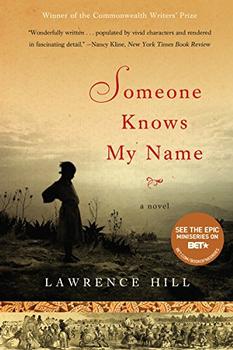
aka: The Book of Negroes
by Lawrence Hill Book Reviewed by:
The weight of one's name and who may
speak it can not, perhaps, be fully understood in
this present era of digital communication and social
informality. But the proper name carried much
significance in eighteenth century Europe: forms of
address and etiquette of the name's use were part of
a careful code of respect and hierarchy. Similarly,
in Bayo, Africa, childhood home of Aminata Diallo,
main character of Someone Knows My Name,
one's name, rank and tribe carried great meaning.
Such distinctions - individual heritage, familial
spiritual beliefs, societal roles - begin to erode,
however, the moment Aminata and several other
villagers are stolen from their homes and families
by slave traders and locked in naked, marching rows
toward the sea. Thus, amidst horrible physical
suffering, Aminata's interior battle begins: a
constant tension between retaining the dignity of
her own name and personhood and adjusting, for
survival's sake, to the whims and mores of other
lands. Through this weaving of opposites, author
Lawrence Hill accomplishes a writing feat of
admirable subtlety: illustrating the homogenizing
influence of mutual suffering inside the theme of
the distinguishing power of a name.
Someone Knows My Name is the story of a girl
who becomes a woman, a wife, a mother, and a leader
– all while under the ownership of white men. It is
a novel that offers its readers not only a mesmeric
heroine and expertly paced plot, but also a
significant survey of the complexities of the pre-
and post-American Revolution African slave trade. In
this tale, the wrongs of human slavery spread across
continents and people groups, perpetuated even by
neighboring African villages and colonists who
question the rightness of the practice. Progress,
whether it be Aminata's or the British
Abolitionists,' often depends on unholy alliances.
As a result, the novel is a literary reminder of the
pain caused by a culture's moral failures and the
precarious fight to correct them.
Turning the pages of Hill's book is effortless in
one sense and very difficult in another. Protagonist
Aminata Diallo's desire for freedom is unquenchable,
her drive inspiring and superhuman. The losses she
experiences, however, are just as potent as her
will. Brief joys of love and family are suffocated
by mourning time and time again. Some scenes
approach the threshold of heartache plausible for
one soul to bear, requiring Hill to find or create a
new purpose for Aminata's fight for life and freedom
to continue. Most often, her rare literacy and gift
for languages is her saving grace, offering a
welcome nod to the power of reading and writing to
change a life – or the direction of an entire
nation.
Someone Knows My Name was originally
published as The Book of Negroes in Canada,
where it received wide praise. The pre and
post-publication media in the USA were in general
agreement, as were BookBrowse's members who voted it
one of the top four books of 2007.
As always, each reader must judge the book's merits.
This is a book that is definitely worth being given
that chance. Despite the book's almost 500 pages,
Hill has crafted a superbly focused narrative and
has successfully blended the unforgettable story of
an indomitable woman with little known, but
important, historical events from Africa, America,
Canada and England.
Read what BookBrowse members have to say about this
book!
 This review was originally published in November 2007, and has been updated for the
November 2008 paperback release.
Click here to go to this issue.
This review was originally published in November 2007, and has been updated for the
November 2008 paperback release.
Click here to go to this issue.
Did you know?
Interesting Links:
Also see:
This review was originally published in November 2007, and has been updated for the
November 2008 paperback release.
Click here to go to this issue.
Your guide toexceptional books
BookBrowse seeks out and recommends the best in contemporary fiction and nonfiction—books that not only engage and entertain but also deepen our understanding of ourselves and the world around us.
