Summary | Excerpt | Reading Guide | Reviews | Readalikes | Genres & Themes | Author Bio
Critics' Opinion:
Readers' Opinion:
First Published:
Jul 2001, 320 pages
Paperback:
Apr 2002, 320 pages

Chapter One
I am in a car park in Leeds when I tell my husband I don't want to be married to him anymore. David isn't even in the car park with me. He's at home, looking after the kids, and I have only called him to remind him that he should write a note for Molly's class teacher. The other bit just sort of . . . slips out. This is a mistake, obviously. Even though I am, apparently, and to my immense surprise, the kind of person who tells her husband that she doesn't want to be married to him anymore, I really didn't think that I was the kind of person to say so in a car park, on a mobile phone. That particular self-assessment will now have to be revised, clearly. I can describe myself as the kind of person who doesn't forget names, for example, because I have remembered names thousands of times and forgotten them only once or twice. But for the majority of people, marriage-ending conversations happen only once, if at all. If you choose to conduct yours on a mobile phone, in a Leeds car park, then you cannot really claim that it is unrepresentative, in the same way that Lee Harvey Oswald couldn't really claim that shooting presidents wasn't like him at all. Sometimes we have to be judged by our one-offs.
Later, in the hotel room, when I can't sleep -- and that is some sort of consolation, because even though I have turned into the woman who ends marriages in a car park, at least I have the decency to toss and turn afterward -- I retrace the conversation in my head, in as much detail as I can manage, trying to work out how we'd got from there (Molly's dental appointment) to here (imminent divorce) in three minutes. Ten, anyway. Which turns into an endless, three-in-the-morning brood about how we'd got from there (meeting at a college dance in 1976) to here (imminent divorce) in twenty-four years.
To tell you the truth, the second part of this self-reflection only takes so long because twenty-four years is a long time, and there are loads of bits that come unbidden into your head, little narrative details, that don't really have much to do with the story. If my thoughts about our marriage had been turned into a film, the critics would say that it was all padding, no plot, and that it could be summarized thus: two people meet, fall in love, have kids, start arguing, get fat and grumpy (him) and bored, desperate and grumpy (her), and split up. I wouldn't argue with the synopsis. We're nothing special.
The phone-call, though . . . I keep missing the link, the point where it turned from a relatively harmonious and genuinely banal chat about minor domestic arrangements into this cataclysmic, end-of-the-world-as-we-know-it moment. I can remember the beginning of it, almost word for word:
Me: "Hiya."
Him: "Hello. How's it going?"
Me: "Yeah, fine. Kids all right?"
Him: "Yeah. Molly's here watching TV, Tom's round at Jamie's."
Me: "I just phoned to say that you've got to write a note for Molly to take in to school tomorrow. About the dentist's."
See? See? It can't be done, you'd think, not from here. But you'd be wrong, because we did it. I'm almost sure that the first leap was made here, at this point; the way I remember it now, there was a pause, an ominous silence, at the other end of the line. And then I said something like, "What?", and he said, "Nothing." And I said "What?" again and he said "Nothing" again, except he clearly -wasn't baffled or amused by my question, just tetchy, which means, does it not, that you have to plow on. So I plowed on.
"Come on."
"No."
"Come on."
"No. What you said."
"What did I say?"
"About just phoning to remind me about Molly's note."
"What's wrong with that?"
Reprinted from How to be Good by Nick Hornby by permission of Riverhead, a member of Penguin Putnam Inc. Copyright 2001 by Nick Hornby. All rights reserved. This excerpt, or any parts thereof, may not be reproduced in any form without permission.

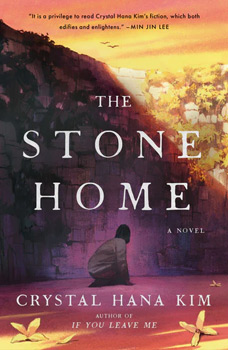
The Stone Home
by Crystal Hana Kim
A moving family drama and coming-of-age story revealing a dark corner of South Korean history.

The House on Biscayne Bay
by Chanel Cleeton
As death stalks a gothic mansion in Miami, the lives of two women intertwine as the past and present collide.

The Funeral Cryer by Wenyan Lu
Debut novelist Wenyan Lu brings us this witty yet profound story about one woman's midlife reawakening in contemporary rural China.
Your guide toexceptional books
BookBrowse seeks out and recommends the best in contemporary fiction and nonfiction—books that not only engage and entertain but also deepen our understanding of ourselves and the world around us.