
-
Your next favorite book
is waiting.
Summary | Excerpt | Reading Guide | Reviews | Beyond the Book | Readalikes | Genres & Themes | Author Bio
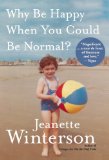
 Book Reviewed by:
1
The Wrong Crib
When my mother was angry with me, which was often, she said, 'The Devil led us to the wrong crib'.
The image of Satan taking time off from the Cold War and McCarthyism to visit Manchester in 1960 - purpose of visit: to deceive Mrs Winterson - has a flamboyant theatricality to it. She was a flamboyant depressive; a woman who kept a revolver in the duster drawer, and the bullets in a tin of Pledge. A woman who stayed up all night baking cakes to avoid sleeping in the same bed as my father. A woman with a prolapse, a thyroid condition, an enlarged heart, an ulcerated leg that never healed, and two sets of false teeth - matt for everyday, and a pearlised set for 'best'.
I do not know why she didn't/couldn't have children. I know that she adopted me because she wanted a friend (she had none), and because I was like a flare sent out into the world - a way of saying that she was here - a kind of X Marks the Spot.
She hated being a nobody, and like all children, adopted or not, I have had to live out some of her unlived life. We do that for our parents - we don't really have any choice.
She was alive when my first novel, Oranges Are Not the Only Fruit, was published in 1985. It is semi-autobiographical, in that it tells the story of a young girl adopted by Pentecostal parents. The girl is supposed to grow up and be a missionary. Instead she falls in love with a woman. Disaster. The girl leaves home, gets herself to Oxford University, returns home to find her mother has built a broadcast radio and is beaming out the Gospel to the heathen. The mother has a handle - she's called 'Kindly Light'.
The novel begins: 'Like most people I lived for a long time with my mother and father. My father liked to watch the wrestling, my mother liked to wrestle.'
For most of my life I've been a bare-knuckle fighter. The one who wins is the one who hits the hardest. I was beaten as a child and I learned early never to cry. If I was locked out overnight I sat on the doorstep till the milkman came, drank both pints, left the empty bottles to enrage my mother, and walked to school.
We always walked. We had no car and no bus money. For me, the average was five miles a day: two miles for the round trip to school; three miles for the round trip to church.
Church was every night except Thursdays.
I wrote about some of these things in Oranges, and when it was published, my mother sent me a furious note in her immaculate copperplate handwriting demanding a phone call.
We hadn't seen each other for several years. I had left Oxford, was scraping together a life, and had written Oranges young - I was twenty-five when it was published.
I went to a phone box - I had no phone. She went to a phone box - she had no phone
I dialled the Accrington code and number as instructed, and there she was - who needs Skype? I could see her through her voice, her form solidifying in front of me as she talked.
She was a big woman, tallish and weighing around twenty stone. Surgical stockings, flat sandals, a Crimplene dress and a nylon headscarf. She would have done her face powder (keep yourself nice), but not lipstick (fast and loose).
She filled the phone box. She was out of scale, larger than life. She was like a fairy story where size is approximate and unstable. She loomed up. She expanded. Only later, much later, too late, did I understand how small she was to herself. The baby nobody picked up. The uncarried child still inside her.
But that day she was borne up on the shoulders of her own outrage. She said, 'It's the first time I've had to order a book in a false name.'
I tried to explain what I had hoped to do. I am an ambitious writer - I don't see the point of being anything; no, not anything at all, if you have no ambition for it. 1985 wasn't the day of the memoir - and in any case, I wasn't writing one. I was trying to get away from the received idea that women always write about 'experience' - the compass of what they know - while men write wide and bold - the big canvas, the experiment with form. Henry James did no good when he said that Jane Austen wrote on four inches of ivory - i e. tiny observant minutiae. Much the same was said of Emily Dickinson and Virginia Woolf. Those things made me angry. In any case, why could there not be experience and experiment? Why could there not be the observed and the imagined? Why should a woman be limited by anything or anybody? Why should a woman not be ambitious for literature? Ambitious for herself?
Mrs Winterson was having none of it. She knew full well that writers were sex-crazed bohemians who broke the rules and didn't go out to work. Books had been forbidden in our house - I'll explain why later - and so for me to have written one, and had it published, and had it win a prize.... and be standing in a phone box giving her a lecture on literature, a polemic on feminism.
The pips - more money in the slot - and I'm thinking, as her voice goes in and out like the sea, 'Why aren't you proud of me?'
The pips - more money in the slot - and I'm locked out and sitting on the doorstep again. It's really cold and I've got a newspaper under my bum and I'm huddled in my duffel coat.
A woman comes by and I know her. She gives me a bag of chips. She knows what my mother is like
Inside our house the light is on. Dad's on the night shift, so she can go to bed, but she won't sleep. She'll read the Bible all night, and when Dad comes home, he'll let me in, and he'll say nothing, and she'll say nothing, and we'll act like it's normal to leave your kid outside all night, and normal never to sleep with your husband. And normal to have two sets of false teeth, and a revolver in the duster drawer.
We're still on the phone in our phone boxes. She tells me that my success is from the Devil, keeper of the wrong crib. She confronts me with the fact that I have used my own name in the novel - if it is a story, why is the main character called Jeanette?
Why?
I can't remember a time when I wasn't setting my story against hers. It was my survival from the very beginning. Adopted children are self-invented because we have to be; there is an absence, a void, a question mark at the very beginning of our lives. A crucial part of our story is gone, and violently, like a bomb in the womb.
The baby explodes into an unknown world that is only knowable through some kind of a story - of course that is how we all live, it's the narrative of our lives, but adoption drops you into the story after it has started. It's like reading a book with the first few pages missing. It's like arriving after curtain up. The feeling that something is missing never, ever leaves you - and it can't, and it shouldn't, because something is missing.
That isn't of its nature negative. The missing part, the missing past, can be an opening, not a void It can be an entry as well as an exit. It is the fossil record, the imprint of another life, and although you can never have that life, your fingers trace the space where it might have been, and your fingers learn a kind of Braille.
There are markings here, raised like welts. Read them. Read the hurt. Rewrite them. Rewrite the hurt.
It's why I am a writer - I don't say 'decided' to be, or 'became'. It was not an act of will or even a conscious choice. To avoid the narrow mesh of Mrs Winterson's story I had to be able to tell my own. Part fact part fiction is what life is. And it is always a cover story. I wrote my way out.
She said, 'But it's not true...'
Truth? This was a woman who explained the flash-dash of mice activity in the kitchen as ectoplasm.
There was a terraced house in Accrington, in Lancashire - we called those houses two-up two-down: two rooms downstairs, two rooms upstairs. Three of us lived together in that house for sixteen years. I told my version - faithful and invented, accurate and misremembered, shuffled in time. I told myself as hero like any shipwreck story. It was a shipwreck, and me thrown on the coastline of humankind, and finding it not altogether human, and rarely kind.
And I suppose that the saddest thing for me, thinking about the cover version that is Oranges, is that I wrote a story I could live with. The other one was too painful. I could not survive it.
I am often asked, in a tick-box kind of way, what is 'true' and what is not 'true' in Oranges. Did I work in a funeral parlour? Did I drive an ice-cream van? Did we have a Gospel Tent? Did Mrs Winterson build her own CB radio? Did she really stun tomcats with a catapult?
I can't answer these questions. I can say that there is a character in Oranges called Testifying Elsie who looks after the little Jeanette and acts as a soft wall against the hurt(ling) force of Mother.
I wrote her in because I couldn't bear to leave her out. I wrote her in because I really wished it had been that way. When you are a solitary child you find an imaginary friend.
There was no Elsie. There was no one like Elsie. Things were much lonelier than that.
I spent most of my school years sitting on the railings outside the school gates in the breaks. I was not a popular or a likeable child; too spiky, too angry, too intense, too odd. The churchgoing didn't encourage school friends, and school situations always pick out the misfit. Embroidering THE SUMMER IS ENDED AND WE ARE NOT YET SAVED on my gym bag made me easy to spot.
But even when I did make friends I made sure it went wrong...
If someone liked me, I waited until she was off guard, and then I told her I didn't want to be her friend any more. I watched the confusion and upset. The tears. Then I ran off, triumphantly in control, and very fast the triumph and the control leaked away, and then I cried and cried, because I had put myself on the outside again, on the doorstep again, where I didn't want to be.
Adoption is outside. You act out what it feels like to be the one who doesn't belong. And you act it out by trying to do to others what has been done to you. It is impossible to believe that anyone loves you for yourself.
I never believed that my parents loved me. I tried to love them but it didn't work. It has taken me a long time to learn how to love - both the giving and the receiving. I have written about love obsessively, forensically, and I know/knew it as the highest value. I loved God of course, in the early days, and God loved me. That was something. And I loved animals and nature. And poetry. People were the problem. How do you love another person? How do you trust another person to love you?
I had no idea.
I thought that love was loss.
Why is the measure of love loss?
That was the opening line of a novel of mine - Written on the Body (1992). I was stalking love, trapping love, losing love, longing for love...
Truth for anyone is a very complex thing. For a writer, what you leave out says as much as those things you include. What lies beyond the margin of the text? The photographer frames the shot; writers frame their world.
Mrs Winterson objected to what I had put in, but it seemed to me that what I had left out was the story's silent twin. There are so many things that we can't say, because they are too painful. We hope that the things we can say will soothe the rest, or appease it in some way. Stories are compensatory. The world is unfair, unjust, unknowable, out of control.
When we tell a story we exercise control, but in such a way as to leave a gap, an opening. It is a version, but never the final one. And perhaps we hope that the silences will be heard by someone else, and the story can continue, can be retold.
When we write we offer the silence as much as the story. Words are the part of silence that can be spoken.
Excerpted from Why Be Happy When You Could Be Normal? © 2011 by Jeanette Winterson; reprinted with the permission of the publisher, Grove/Atlantic, Inc. All rights reserved. No part of this excerpt may be reproduced or reprinted without permission in writing from the publisher.



The most successful people are those who are good at plan B
Click Here to find out who said this, as well as discovering other famous literary quotes!

Can you name the title?
Test your book knowledge with our daily trivia challenge!
Your guide toexceptional books
BookBrowse seeks out and recommends the best in contemporary fiction and nonfiction—books that not only engage and entertain but also deepen our understanding of ourselves and the world around us.
