Summary | Excerpt | Reading Guide | Reviews | Beyond the Book | Readalikes | Genres & Themes | Author Bio

Critics' Opinion:
Readers' Opinion:
First Published:
Mar 2006, 544 pages
Paperback:
Mar 2007, 560 pages
 Book Reviewed by:
BookBrowse Review Team
Buy This Book

Whose
Father Hunts Witches,
Whose
Aunt Seeks Wisdom,
and
Whose Soul Desires
an
Object
It
Cannot Name
May I speak candidly, fleshling,
one rational creature to another, myself a book and you a reader? Even if the
literature of confession leaves you cold, even if you are among those who wish
that Rousseau had never bared his soul and Augustine never mislaid his shame,
you would do well to lend me a fraction of your life. I am Mathematical
Principles of Natural Philosophy, after all—in my native tongue, Philosophiæ
Naturalis Principia Mathematica, the Principia for short—not some
tenth-grade algebra text or guide to improving your golf swing. Attend my
adventures and you may, Dame Fortune willing, begin to look upon the world anew.
Unlike you humans, a book always
remembers its moment of conception. My father, the illustrious Isaac Newton,
having abandoned his studies at Trinity College to escape the great plague of
1665, was spending the summer at his mother’s farm in Woolsthorpe. An orchard
grew beside the house. Staring contemplatively through his bedroom window,
Newton watched an apple drop free of its tree, driven by that strange
arrangement we have agreed to call gravity. In a leap of intuition, he imagined
the apple not simply as falling to the ground but as striving for the very
center of the Earth. This fruit, he divined, bore a relationship to its planet
analogous to that enjoyed by the moon: gravitation, ergo, was universal—the
laws that governed terrestrial acceleration also ruled the heavens. As below, so
above. My father never took a woman to his bed, and yet the rush of pleasure he
experienced on that sweltering July afternoon easily eclipsed the common run of
orgasm.
Twenty-two years later—in
midsummer of 1687—I was born. Being a book, a patchwork thing of leather and
dreams, ink and inspiration, I have always counted scholars among my friends,
poets among my heroes, and glue among my gods. But what am I like in the
particular? How is the Principia Mathematica different from all other books? My
historical import is beyond debate: I am, quite simply, the single greatest work
of science ever written. My practical utility is indisputable. Whatever you may
think of Mars probes, moonlandings, orbiting satellites, steam turbines, power
looms, the Industrial Revolution, or the Massachusetts Institute of Technology,
none of these things is possible without me.But the curious among you also want
to know about my psychic essence. You want to know about my soul.
Take me down from your shelf. If
you’re like most humans, you’ve accorded me a place of prestige, right next
to the Bible, perhaps, or rubbing covers with Homer. Open me. Things start out
innocuously enough, with eight turgid but not indigestible definitions
concerning mass, acceleration, and force, followed by my father’s three famous
laws of motion. Continue turning my pages. Things are getting pretty
rough—aren’t they?—propositions proliferating, scholia colliding, lemmas
breeding like lab rats. “The centripetal forces of bodies, which by equable
motions describe different circles, tend to the centers of the same circles, and
are to each other as the squares of the arcs described in equal times divided
respectively by the radii of the circles.” Lugubrious, I’ll admit. This
isn’t MotherGoose.
But you can’t judge a book by its
contents. Just because my father stuffed me with sines, cosines, tangents, and
worse, that doesn’t make me a dry or dispassionate fellow. I have always
striven to attune myself to the aesthetic side of mathematics. Behold the
diagram that illustrates Proposition XLI. Have you ever beheld a more sensual
set of lines? Study the figure accompanying Proposition XLVIII. Have arcs and
cycloids ever been more beautiful? My father set geometry in motion. He taught
parabolas to pirouette and hyperbolas to gavotte. Don’t let all my
conventional trigonometric discourse fool you, by the way. Determined to keep
his methods a secret, Newton wrote out his discoveries in the mathematics of his
day. What’s really afoot here is that amazing tool he invented for calculating
the rate of change of a rate of change. Abide with me, fleshling, and I shall
teach you to run with the fluxions.
The foregoing is excerpted from The Last Witchfinder by James Morrow. All rights reserved. No part of this book may be used or reproduced without written permission from HarperCollins Publishers, 10 East 53rd Street, New York, NY 10022


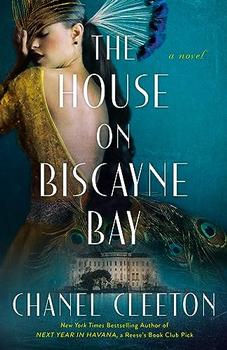
The House on Biscayne Bay
by Chanel Cleeton
As death stalks a gothic mansion in Miami, the lives of two women intertwine as the past and present collide.

The Flower Sisters
by Michelle Collins Anderson
From the new Fannie Flagg of the Ozarks, a richly-woven story of family, forgiveness, and reinvention.

The Funeral Cryer by Wenyan Lu
Debut novelist Wenyan Lu brings us this witty yet profound story about one woman's midlife reawakening in contemporary rural China.
Your guide toexceptional books
BookBrowse seeks out and recommends the best in contemporary fiction and nonfiction—books that not only engage and entertain but also deepen our understanding of ourselves and the world around us.