Summary | Excerpt | Reviews | Readalikes | Genres & Themes | Author Bio
Critics' Opinion:
Readers' Opinion:
First Published:
Jun 1998, 464 pages
Paperback:
Dec 2001, 464 pages

Nash looked up at last and fixed Mackey with an unblinking stare as cool and
dispassionate as that of any bird or snake. "Because," Nash said
slowly in his soft, reasonable southern drawl, as if talking to himself,
"the ideas I had about supernatural beings came to me the same way that my
mathematical ideas did. So I took them seriously."
The young genius from Bluefield, West Virginia -- handsome, arrogant, and highly
eccentric -- burst onto the mathematical scene in 1948. Over the next decade, a
decade as notable for its supreme faith in human rationality as for its dark
anxieties about mankind's survival, Nash proved himself, in the words of the
eminent geometer Mikhail Gromov, "the most remarkable mathematician of the
second half of the century." Games of strategy, economic rivalry, computer
architecture, the shape of the universe, the geometry of imaginary spaces, the
mystery of prime numbers -- all engaged his wide-ranging imagination. His ideas
were of the deep and wholly unanticipated kind that pushes scientific thinking
in new directions.
Geniuses, the mathematician Paul Halmos wrote, "are of two kinds: the
ones who are just like all of us, but very much more so, and the ones who,
apparently, have an extra human spark. We can all run, and some of us can run
the mile in less than 4 minutes; but there is nothing that most of us can do
that compares with the creation of the Great G-minor Fugue." Nash's genius
was of that mysterious variety more often associated with music and art than
with the oldest of all sciences: It wasn't merely that his mind worked faster,
that his memory was more retentive, or that his power of concentration was
greater. The flashes of intuition were nonrational. Like other great
mathematical intuitionists -- Georg Friedrich Bernhard Riemann, Jules Henri
Poincaré, Srinivasa Ramanujan -- Nash saw the vision first; constructing the
laborious proofs long afterward. But even after he'd try to explain some
astonishing result, the actual route he had taken remained a mystery to others
who tried to follow his reasoning. Donald Newman, a mathematician who knew Nash
at MIT in the 1950s, used to say about him that "everyone else would climb
a peak by looking for a path somewhere on the mountain. Nash would climb another
mountain altogether and from that distant peak would shine a searchlight back
onto the first peak."
No one was more obsessed with originality, more disdainful of authority, or
more jealous of his independence. As a young man he was surrounded by the high
priests of twentieth-century science -- Albert Einstein, John von Neumann, and
Norbert Wiener -- but he joined no school, became no one's disciple, got along:
largely without guides or followers. In almost everything he did -- from game
theory to geometry -- he thumbed his nose at the received wisdom, current
fashions, established methods. He almost always worked alone, in his head,
usually walking, often whistling Bach. Nash acquired his knowledge of
mathematics not mainly from studying what other mathematicians had discovered,
but by rediscovering their truths for himself. Eager to astound, he was always
on the lookout for the really big problems. When he focused on some new puzzle,
he saw dimensions that people who really knew the subject (he never did)
initially dismissed as naive or wrong-headed. Even as a student, his
indifference to others' skepticism, doubt, and ridicule was awesome.
Nash's faith in rationality and the power of pure thought was extreme, even
for a very young mathematician and even for the new age of computers, space
travel, and nuclear weapons. Einstein once chided him for wishing to amend
relativity theory without studying physics. His heroes were solitary thinkers
and supermen like Newton and Nietzsche. Computers and science fiction were his
passions. He considered "thinking machines," as he called them,
superior in some ways to human beings. At one point, he became fascinated by the
possibility that drugs could heighten physical and intellectual performance. He
was beguiled by the idea of alien races of hyper-rational beings who had taught
themselves to disregard all emotion, Compulsively rational, he wished to turn
life's decisions -- whether to take the first elevator or wait for the next one,
where to bank his money, what job to accept, whether to marry -- into
calculations of advantage and disadvantage, algorithms or mathematical rules
divorced from emotion, convention, and tradition. Even the small act of saying
an automatic hello to Nash in a hallway could elicit a furious "Why are you
saying hello to me?"
Copyright © 1998 by Sylvia Nasar.

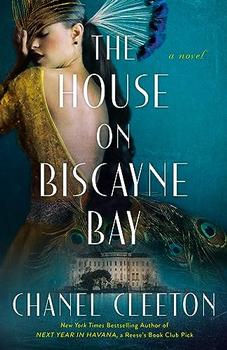
The House on Biscayne Bay
by Chanel Cleeton
As death stalks a gothic mansion in Miami, the lives of two women intertwine as the past and present collide.

The Stone Home
by Crystal Hana Kim
A moving family drama and coming-of-age story revealing a dark corner of South Korean history.

The Funeral Cryer by Wenyan Lu
Debut novelist Wenyan Lu brings us this witty yet profound story about one woman's midlife reawakening in contemporary rural China.
Your guide toexceptional books
BookBrowse seeks out and recommends the best in contemporary fiction and nonfiction—books that not only engage and entertain but also deepen our understanding of ourselves and the world around us.