
-
Your next favorite book
is waiting.
Summary | Excerpt | Reviews | Readalikes | Genres & Themes | Author Bio
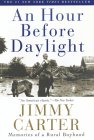
Memories of A Rural Boyhood
by Jimmy Carter
Our house was surrounded by a white-sanded yard, which we had to sweep frequently to remove fowl and animal droppings and leaves from our pecan, magnolia, mulberry, and chinaberry trees. Most of our brush brooms were made of small saplings or limbs of dogwood, which were resilient and long lasting. Several times a year we took a two-mule wagon about three miles to a pit and loaded it with fresh sand, which was scattered on the yard to give it a new white surface. Behind our house and surrounded by fenced fields were a small garage (never used for a car), a smokehouse, a chicken house, and a large woodpile.
Our artificial light came from kerosene lamps, and it was considered almost sinful to leave one burning in an unoccupied room. The only exception was in the front living room, where we had an Aladdin lamp about five feet high whose asbestos wick miraculously provided illumination bright enough for reading in a wide area. We turned this flame way down when we went to eat a meal, both to conserve fuel and to avoid the lamp's tendency to flame up and blacken the fragile wick with thick soot. When this happened -- a mishap for which someone always had to be identified as the culprit -- we had to endure an extended period of careful flame control while we waited in near darkness for the soot to burn off enough for us to read again.
One significant difference between my parents was their reading habits. Daddy mostly limited his reading to the daily and weekly newspapers and farm journals, but he also owned a small library, which I still have, that included Halliburton's Royal Road to Romance, a collection of A. Conan Doyle's Sherlock Holmes stories, and a complete set of Edgar Rice Burroughs's Tarzan books, each carefully signed and numbered by my father to indicate their proper sequence. By contrast, my mother read constantly and encouraged us children to do the same. Since we stayed busy most of the time, Mama and I always had a magazine or book to read while eating our meals, and this became a lifetime habit for my own family and me. The only exception was Sunday dinner, which, for some reason, had too formal an atmosphere for literature at the table. At night, at suppertime, there was no such restraint.
I didn't know of any rural families that had electric lights until the rural-electrification program came along in the late 1930s. We had a large battery-powered radio in the front room that we used sparingly, and only at night, as we all sat around looking at it during "Amos and Andy," "Fibber McGee and Molly," "Jack Benny," or "Little Orphan Annie." When its power failed, we would sometimes bring in the battery from the pickup truck to keep it playing for a special event. I recall some rare baseball games re-created by the announcer from telegraph reports, a few boxing matches, and the late night in 1936 when Alfred Landon was chosen as the Republican nominee for president. The voting went on so long that the battery in our house gave out, and we took the radio outside and set it on the hood of the pickup until the convention made its choice, hours after midnight.
The most memorable radio broadcast was in 1938, the night of the return match between heavyweight boxers Joe Louis and Max Schmeling. The German champion had defeated the black American two years earlier, and the world's attention was focused on the return bout. For our community, this fight had heavy racial overtones, with almost unanimous support at our all-white school for the European over the American. A delegation of our black neighbors came to ask Daddy if they could listen to the broadcast, and we put the radio in the window so the assembled crowd in the yard could hear it. The fight ended abruptly, in the first round, with Louis almost killing Schmeling. There was no sound from outside -- or inside -- the house. We heard a quiet "Thank you, Mr. Earl," and then our visitors walked silently out of the yard, crossed the road and the railroad tracks, entered the tenant house, and closed the door. Then all hell broke loose, and their celebration lasted all night. Daddy was tight-lipped, but all the mores of our segregated society had been honored.
Copyright © 2001 by Jimmy Carter





It is always darkest just before the day dawneth
Click Here to find out who said this, as well as discovering other famous literary quotes!

Can you name the title?
Test your book knowledge with our daily trivia challenge!
Your guide toexceptional books
BookBrowse seeks out and recommends the best in contemporary fiction and nonfiction—books that not only engage and entertain but also deepen our understanding of ourselves and the world around us.


