
-
Your next favorite book
is waiting.
Summary | Excerpt | Reviews | Readalikes | Genres & Themes | Author Bio
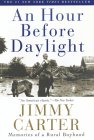
Memories of A Rural Boyhood
by Jimmy Carter
Throughout the South, and particularly in Southwest Georgia, there had long been a growing dependence by landowners on destitute families who owned little other than their clothes and some cooking utensils and who were eager to occupy any vacant shack and to work as day laborers or "on shares" under almost any arrangement. By 1935, families who owned no land worked more than half of Southern farms. As I grew older, I came to understand the personal consequences of this self-destructive scramble for a few small fields on which a family could work as sharecroppers.
Some foreign journalists who toured the South during those years reported that nowhere in Czarist Russia or in Europe under serfdom had families lived in such abject poverty or with so few basic rights as did the tenant families, black and white, of the South. Despite their abominable living conditions, neither my neighbors nor the economic or political powers in America were able to devise a better alternative.
There was a lot of ballyhoo in the Northern press about industrial progress, but not much change had taken place in farming techniques since colonial times. As late as 1942, Fortune magazine honored an outstanding Georgia farmer whose agricultural practices were described as "revolutionary." He did not have a tractor, and relied on five black sharecroppers, two other black tenants who worked by the day, and fifteen mules to work his six hundred acres, and the net annual income of his entire family was $1,500. The most admirable accomplishments mentioned were the diversification of crops and the annual production of $500 worth of food for his family. On the farm I knew as my home, the achievements of my father were much more remarkable, but even when I left home in 1941 to go to college, the absence of mechanized power, the almost total dependence on manual labor, and the basic agricultural techniques employed were relatively unchanged since colonial times. One commentator said that Jesus and even Moses would have felt at home on a farm in the Deep South during the first third of the twentieth century.
Even as a boy, I could see a profound difference between my father's practices and those of other farmers, especially the sharecroppers among whom I lived and worked. A logical option for all farmers was to diversify their agricultural practices, but this choice was available in inverse proportion to the income of the families. It took extra money to expand a rudimentary farming operation. Daddy could afford to take a chance on new ideas; he could buy superior milk cows, brood sows, and beef cattle, and we were able to produce the feed for them. He could also pay the costs of labor, seed, and equipment needed to produce non-cash food crops that would be used for our family's own consumption. This was certainly better than having to pay retail prices for meal, flour, syrup, pork, and other basic commodities. However, such choices were almost impossible for the more destitute and dependent sharecroppers, and particularly when their landowners also had a store or commissary and wanted maximum sales of these items, often at grossly inflated prices and exorbitant credit charges.
Perhaps family incomes are the best indication of living standards in those days. Under average conditions, with cotton selling for about ten cents and peanuts three cents a pound, what income could our farm families expect? Although growers always anticipated much more at planting time, it usually took about three acres of land to produce a bale of cotton ($50) or a ton of peanuts ($60). My father was pleased in a good year when he produced this much on two acres. For most tenant farmers, permanent poverty was inevitable. Even with high yields, a one-horse family with fifteen acres of cotton would have a gross income of $300 to $400 for the year, and after paying the landlord his share for land use and often the rent of mules and equipment, the tenant would be lucky to keep half of this for a year's labor for himself, his wife, and their children. The cash "draw" from the landowner for the eight or nine months from preparing land to harvest would be from $100 to $200, not counting interest. So net indebtedness was almost inevitable for marginal farmers on the poorer land, and the chance for a profitable year was remote. Day laborers didn't have even this rare chance for a good year, but with their weekly wage they could at least pay cash for groceries and clothing and avoid some of the credit and interest charges.
Copyright © 2001 by Jimmy Carter







What really knocks me out is a book that, when you're all done reading, you wish the author that wrote it was a ...
Click Here to find out who said this, as well as discovering other famous literary quotes!

Can you name the title?
Test your book knowledge with our daily trivia challenge!
Your guide toexceptional books
BookBrowse seeks out and recommends the best in contemporary fiction and nonfiction—books that not only engage and entertain but also deepen our understanding of ourselves and the world around us.


