Summary | Excerpt | Reviews | Readalikes | Genres & Themes | Author Bio
Critics' Opinion:
Readers' Opinion:
First Published:
Apr 2000, 520 pages
Paperback:
Apr 2001, 520 pages

In reaction to these limitations, I came to believe that the Darwinian revolution could capture the citadel of human nature only by becoming more of a sexual revolution--by giving more credit to sexual choice as a driving force in the mind's evolution. Evolutionary psychology must become less Puritan and more Dionysian. Where others thought about the survival problems our ancestors faced during the day, I wanted to think about the courtship problems they faced at night. In poetic terms, I wondered whether the mind evolved by moonlight. In scientific terms, sexual selection through mate choice seemed a neglected factor in human mental evolution. Through ten years of researching sexual selection and human evolution, since the beginning of my Ph.D., it became clear to me that sexual selection theory offered valuable intelligence about aspects of human nature that are important to us, and that cry out for evolutionary explanation, but that have been ignored, dismissed, or belittled in the past.
Trying a Different Tool
The human brain and its diverse capacities are so complex, and so costly to grow and maintain, that they must have arisen through direct selection for some important biological function. To date, it has proven very difficult to propose a biological function for human creative intelligence that fits the scientific evidence. We know that the human mind is a collection of astoundingly complex adaptations, but we do not know what biological functions many of them evolved to serve.
Evolutionary biology works by one cardinal rule: to understand an adaptation, one has to understand its evolved function. The analysis of adaptations is more than a collection of just-so stories, because according to evolutionary theory there are only two fundamental kinds of functions that explain adaptations. Adaptations can arise through natural selection for survival advantage, or sexual selection for reproductive advantage. Basically, that's it.
If you have two tools and one doesn't work, why not try the other? Science has spent over a century trying to explain the mind's evolution through natural selection for survival benefits. It has explained many human abilities, such as food preferences and fear of snakes, but it consistently fails to explain other abilities for decorative art, moral virtue, and witty conversation. It seems reasonable to ask whether sexual selection for reproductive benefits might account for these leftovers. This suggestion makes sexual selection sound like an explanation of last resort. It should not be viewed that way, because sexual selection has some special features as an evolutionary process. As we shall see, sexual selection is unusually fast, powerful, intelligent, and unpredictable. This makes it a good candidate for explaining any adaptation that is highly developed in one species but not in other closely related species that share a similar environment.
What Makes Sexual Selection So Special?
In the 1930s, biologists redefined natural selection to include sexual selection, because they did not think sexual selection was very important. Following their precedent, modern biology textbooks define natural selection to include every process that leads some genes to out-compete other genes by virtue of their survival or reproductive benefits. When one biologist says "evolution through natural selection," other biologists hear "evolution for survival or reproductive advantage." But non-biologists, including many other scientists, still hear "survival of the fittest." Many evolutionary psychologists, who should know better, even ask what possible "survival value" could explain some trait under discussion. This causes enormous confusion, and ensures that sexual selection continues to be neglected in discussions of human evolution.
In this book I shall use the terms "natural selection" and "sexual selection" as Darwin did: natural selection arising through competition for survival, and sexual selection arising through competition for reproduction. I am perfectly aware that this is not the way professional biologists currently use these terms. But I think it is more important, especially for non-biologist readers, to appreciate that selection for survival and selection for attracting sexual partners are distinct processes that tend to produce quite different kinds of biological traits. Terms should be the servants of theories, not the masters. By reviving Darwin's distinction between natural selection for survival and sexual selection for reproduction, we can talk more easily about their differences.
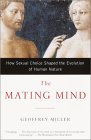
Excerpted from The Mating Mind by Geoffrey Miller Copyright© 2000 by Geoffrey Miller. Excerpted by permission of Doubleday, a division of Random House, Inc. All rights reserved. No part of this excerpt may be reproduced or reprinted without permission in writing from the publisher.


The House on Biscayne Bay
by Chanel Cleeton
As death stalks a gothic mansion in Miami, the lives of two women intertwine as the past and present collide.

The Stone Home
by Crystal Hana Kim
A moving family drama and coming-of-age story revealing a dark corner of South Korean history.

The Funeral Cryer by Wenyan Lu
Debut novelist Wenyan Lu brings us this witty yet profound story about one woman's midlife reawakening in contemporary rural China.
Your guide toexceptional books
BookBrowse seeks out and recommends the best in contemporary fiction and nonfiction—books that not only engage and entertain but also deepen our understanding of ourselves and the world around us.