Summary | Excerpt | Reviews | Readalikes | Genres & Themes | Author Bio
Critics' Opinion:
Readers' Opinion:
First Published:
Oct 1999, 293 pages
Paperback:
Oct 2000, 272 pages

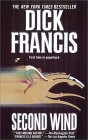
I had met neither man face to face and didn't much want to, but as the day of the lunch approached I kept coming across references to "that gift to racing, Caspar Harvey" or "Caspar Harvey in final dash to honors on the winning owners' list" or "Caspar Harvey pays millions at the Yearling Sales for Derby hopes": and as my knowledge and curiosity grew, so did my understanding of the Quigley jitters.
The week before the Caspar Harvey lunch was one of those times when I gave the top two forecasts, at six-thirty and nine-thirty each evening, daily working out the probable path of air masses and going in front of the cameras at peak times to put my assessments on the line. Many people used to think that all Kris and I and other forecasters did was to read out from someone else's script: there was often surprise when we explained that we were in actual fact forecasters, that it was we who predicted the weather ourselves, using the information gathered from distant weather stations and having discussed it with colleagues. We then went "live" and unscripted-and usually alone-into a very small studio where we ourselves placed the computerized weather symbols on the background screen map of Britain.
There were well over two hundred weather stations covering the British Isles, each reporting local wind speeds and direction and barometric pressure into a large central computer housed in the main Meteorological Office in Bracknell, near Ascot, west of London. Into that computer too came data from all over the world: and one could draw from it everything the world's weather was likely to do in the next forty-eight hours. But nothing was ever certain, and a lurch of high atmosphere pressure could let in a polar gust that would refrigerate our cheerful expectations into unconvincing explanations.
The late September Sunday of Caspar Harvey's lunch, though, dawned fine and clear with a chilly wind from the east, conditions that would remain that way all day while the farmers of East Anglia harvested their late-ripening barley.
"Perfect for flying," Kris said.
Kris's airplane, a low-winged single-engined Piper Cherokee, was approximately thirty years old. He, he frankly acknowledged, was its fourth owner, the third being a flying club that had sometimes put six hours a day on the propeller log (Kris's only gripe) and rubbed old-age patches into the cracked leather seats.
My first reaction to the antique rig a couple of years earlier had been "No thanks, I'll stay on the ground," but Kris had introduced me in his home airfield's echoing hangar to a machinist who understood the relationship between loose screws and sudden death. I'd put my life in Kris's hands on the machinist's assurance that old though the Piper might be, it was airworthy to the last rivet.
Kris, in fact, had turned out to be a surprisingly competent pilot. I'd expected him to be as volatile in the air as in his general behavior but instead he was soberly responsible at the controls and only as high as a radiosonde balloon afterwards.
Many of our colleagues found Kris a difficult companion and asked me in mild exasperation how I dealt with his obvious leaning towards my company. I usually answered truthfully that I enjoyed his slightly weird views on life, and I didn't mention that in his depressive periods he talked familiarly about suicide as if discussing an unimportant life choice like what tie to wear for early breakfast broadcasts.
It was regard for his parents, and for his father in particular, that deterred him from the final jump into the path of a train (his preferred method of exit), and I reckoned that he had less self-hatred and more courageous staying power than many who'd given in to a death wish.
At the time of Caspar Harvey's lunch party, Kris Ironside at thirty-one had outlasted the macabre instincts of a succession of young women who had temporarily found the idea of suicide fascinating, and was beginning to face the possibility that he might yet make it to middle age.
From Second Wind by Dick Francis. Uused by permission of the publisher - Putnam.




The House on Biscayne Bay
by Chanel Cleeton
As death stalks a gothic mansion in Miami, the lives of two women intertwine as the past and present collide.

The Stone Home
by Crystal Hana Kim
A moving family drama and coming-of-age story revealing a dark corner of South Korean history.

The Funeral Cryer by Wenyan Lu
Debut novelist Wenyan Lu brings us this witty yet profound story about one woman's midlife reawakening in contemporary rural China.
Your guide toexceptional books
BookBrowse seeks out and recommends the best in contemporary fiction and nonfiction—books that not only engage and entertain but also deepen our understanding of ourselves and the world around us.