Summary | Excerpt | Reading Guide | Reviews | Beyond the Book | Readalikes | Genres & Themes | Author Bio
Critics' Opinion:
Readers' Opinion:
First Published:
Nov 2012, 256 pages
Paperback:
Nov 2013, 256 pages
 Book Reviewed by:
Stacey Brownlie
Buy This Book

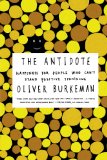
Perhaps you don't need telling that self-help books, the modern-day apotheosis of the quest for happiness, are among the things that fail to make us happy. But, for the record, research strongly suggests that they rarely much help. This is why, among themselves, some self-help publishers refer to the 'eighteen-month rule', which states that the person most likely to purchase any given self-help book is someone who, within the previous eighteen months, purchased a self-help book – one that evidently didn't solve all their problems. When you look at the self-help shelves with a coldly impartial eye, this isn't especially surprising. That we yearn for neat, book-sized solutions to the problem of being human is understandable, but strip away the packaging, and you'll find that the messages of such works are frequently banal. The Seven Habits of Highly Effective People essentially tells you to decide what matters most to you in life, and then do it; How to Win Friends and Influence People advises its readers to be pleasant rather than obnoxious, and to use people's first names a lot. One of the most successful management manuals of the last few years, Fish!, which is intended to help foster happiness and productivity in the workplace, suggests handing out small toy fish to your hardest-working employees.
As we'll see, when the messages get more specific than that, self-help gurus tend to make claims that simply aren't supported by more reputable research. The evidence suggests, for example, that venting your anger doesn't get rid of it, while visualising your goals doesn't seem to make you more likely to achieve them. And whatever you make of the country-by-country surveys of national happiness that are now published with some regularity, it's striking that the 'happiest' countries are never those where self-help books sell the most, nor indeed where professional psychotherapists are most widely consulted. The existence of a thriving 'happiness industry' clearly isn't sufficient to engender national happiness, and it's not unreasonable to suspect that it might make matters worse.
Yet the ineffectiveness of modern strategies for happiness is really just a small part of the problem. There are good reasons to believe that the whole notion of 'seeking happiness' is flawed to begin with. For one thing, who says happiness is a valid goal in the first place? Religions have never placed much explicit emphasis on it, at least as far as this world is concerned; philosophers have certainly not been unanimous in endorsing it, either. And any evolutionary psychologist will tell you that evolution has little interest in your being happy, beyond trying to make sure that you're not so listless or miserable that you lose the will to reproduce.
Even assuming happiness to be a worthy target, though, a worse pitfall awaits, which is that aiming for it seems to reduce your chances of ever attaining it. 'Ask yourself whether you are happy,' observed the philosopher John Stuart Mill, 'and you cease to be so.' At best, it would appear, happiness can only be glimpsed out of the corner of an eye, not stared at directly. (We tend to remember having been happy in the past much more frequently than we are conscious of being happy in the present.) Making matters worse still, what happiness actually is feels impossible to define in words; even supposing you could do so, you'd presumably end up with as many different definitions as there are people on the planet. All of which means it's tempting to conclude that 'How can we be happy?' is simply the wrong question – that we might as well resign ourselves to never finding the answer, and get on with something more productive instead.
But could there be a third possibility, besides the futile effort to pursue solutions that never seem to work, on the one hand, and just giving up, on the other? After several years reporting on the field of psychology as a journalist, I finally realised that there might be. I began to think that something united all those psychologists and philosophers – and even the occasional self-help guru – whose ideas seemed actually to hold water. The startling conclusion at which they had all arrived, in different ways, was this: that the effort to try to feel happy is often precisely the thing that makes us miserable. And that it is our constant efforts to eliminate the negative – insecurity, uncertainty, failure, or sadness – that is what causes us to feel so insecure, anxious, uncertain, or unhappy. They didn't see this conclusion as depressing, though. Instead, they argued that it pointed to an alternative approach, a 'negative path' to happiness, that entailed taking a radically different stance towards those things that most of us spend our lives trying hard to avoid. It involved learning to enjoy uncertainty, embracing insecurity, stopping trying to think positively, becoming familiar with failure, even learning to value death. In short, all these people seemed to agree that in order to be truly happy, we might actually need to be willing to experience more negative emotions – or, at the very least, to learn to stop running quite so hard from them. Which is a bewildering thought, and one that calls into question not just our methods for achieving happiness, but also our assumptions about what 'happiness' really means.
Excerpted from The Antidote by Oliver Burkeman. Copyright © 2012 by Oliver Burkeman. Excerpted by permission of Faber and Faber. All rights reserved. No part of this excerpt may be reproduced or reprinted without permission in writing from the publisher.






The Flower Sisters
by Michelle Collins Anderson
From the new Fannie Flagg of the Ozarks, a richly-woven story of family, forgiveness, and reinvention.

The House on Biscayne Bay
by Chanel Cleeton
As death stalks a gothic mansion in Miami, the lives of two women intertwine as the past and present collide.

The Funeral Cryer by Wenyan Lu
Debut novelist Wenyan Lu brings us this witty yet profound story about one woman's midlife reawakening in contemporary rural China.
Your guide toexceptional books
BookBrowse seeks out and recommends the best in contemporary fiction and nonfiction—books that not only engage and entertain but also deepen our understanding of ourselves and the world around us.