
-
Your next favorite book
is waiting.
Summary | Excerpt | Reviews | Beyond the Book | Readalikes | Genres & Themes | Author Bio
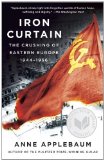
The Crushing of Eastern Europe, 1944-1956
by Anne Applebaum Book Reviewed by:
One regime in particular understood the methods and techniques of totalitarian control so well that it successfully exported them: following the end of the Second World War and the Red Army's march to Berlin, the leadership of the Soviet Union did try very hard to impose a totalitarian system of government on the very different European countries it then occupied, just as they had already tried to impose a totalitarian system on the many different regions of the USSR itself. Their efforts were in lethal earnest. Stalin, his military officers and his secret policemen – known from 1934 to 1946 as the People's Commissariat for Internal Affairs (Narodnyi Komisssariat Vnutrenikh Del or NKVD ) and only later as the KGB – and his local allies were not trying to make a point about Ayn Rand or progressive liberals when they created the totalitarian states of Eastern Europe. To paraphrase Mussolini, they wanted very much to create societies where everything was within the state, nothing was outside the state and nothing was against the state – and they wanted to do it quickly.
True, the eight European countries which the Red Army occupied in 1945, in whole or in part, had vastly different cultures, political traditions and economic structures. The new territories included formerly democratic Czechoslovakia, formerly fascist Germany, as well as monarchies, autocracies and semi-feudal states. The inhabitants of the region were Catholic, Orthodox, Protestant, Jewish and Muslim. They spoke Slavic languages, Romance languages, Finno-Ugric languages and German. They included Russophiles and Russophobes; industrialized Bohemia and rural Albania; cosmopolitan Berlin and tiny wooden villages in the Carpathian mountains. Among them were former subjects of the Austro-Hungarian, Prussian and Ottoman empires, as well as the Russian empire. Nevertheless, Americans and West Europeans in this period came to see the nations of communist-dominated but non-Soviet Europe – Poland, Hungary, Czechoslovakia, eastern Germany, Romania, Bulgaria, Albania and Yugoslavia –as a 'bloc', which eventually became known as 'Eastern Europe'. This is a political and historical term, not a geographic one. It does not include 'eastern' countries such as Greece, which was never a communist country. Neither does it include the Baltic states or Moldova, which although historically and culturally similar to Eastern Europe were in this period actually incorporated into the Soviet Union. There are similarities between the experiences of the Baltic states and those of Poland in particular, but there were also important differences: Sovietization, for the Balts, meant the loss even of nominal sovereignty.
In the years following Stalin's death – since 1989 in particular – the eight nations of Eastern Europe took very different paths, and it has become routine to observe that they never really had much in common in the first place. This is absolutely true: before 1945 , they had never previously been unified in any way, and they have startlingly little in common now, aside from a common historical memory of communism. Yet for a time, between 1945 and 1989 , the eight nations of Eastern Europe did share a great deal. For the sake of simplicity, familiarity and historical accuracy I will therefore use the term 'Eastern Europe' to describe them throughout this book.
Very briefly, between 1945 and 1953 , it did seem as if the USSR would succeed in turning the widely varying nations of Eastern Europe into an ideologically and politically homogeneous region. From Hitler's enemies and Hitler's allies they did, during this period, create a clutch of apparently identical polities. By the early 1950s, all the grey, wardamaged capitals of the 'ancient states' of the region, to use Churchill's phrase, were patrolled by the same kinds of unsmiling policemen, designed by the same socialist realist architects and draped with the same kinds of propaganda posters. The cult of Stalin, whose very name was venerated in the USSR as a 'symbol of the coming victory of communism', was observed across the region, along with very similar cults of local party leaders. Millions of people took part in state-orchestrated parades and celebrations of communist power. At the time, the phrase 'Iron Curtain' seemed much more than a metaphor: walls, fences and barbed wire literally separated Eastern Europe from the West. By 1961 , the year in which the Berlin Wall was built, it seemed as if these barriers could last for ever.
Excerpted from Iron Curtain by Anne Applebaum. Copyright © 2012 by Anne Applebaum. Excerpted by permission of Doubleday. All rights reserved. No part of this excerpt may be reproduced or reprinted without permission in writing from the publisher.





Beliefs are what divide people. Doubt unites them
Click Here to find out who said this, as well as discovering other famous literary quotes!

Can you name the title?
Test your book knowledge with our daily trivia challenge!
Your guide toexceptional books
BookBrowse seeks out and recommends the best in contemporary fiction and nonfiction—books that not only engage and entertain but also deepen our understanding of ourselves and the world around us.


