Summary | Excerpt | Reviews | Readalikes | Genres & Themes | Author Bio

Critics' Opinion:
Readers' Opinion:
First Published:
Nov 1999, 544 pages
Paperback:
Feb 2001, 600 pages

Waves five to ten miles in height were thrown against the continents, surging over shorelines with a destructive power that was awesome in magnitude. Water swept over low coastal plains and swept hundreds of miles inland, destroying everything in its path. Endless quantities of debris and sediment from the ocean floors were spread over low landmasses. Only when the great surge smashed against the base of mountains did it curl under and begin a slow retreat, but not before changing the course of rivers, filling land basins with seas where none existed before and turning large lakes into deserts.
The chain reaction seemed endless.
With a low rumble that grew to the roar of continuous thunder, the mountains began to sway like palm trees under a light breeze as avalanches swept down their sides. Deserts and grassy plains undulated as the onslaught from the oceans reared up and struck inland again. The shock from the comet's impact had caused a sudden and massive displacement in Earth's thin crust. The outer shell, less than forty miles thick, and the mantle that lay over the hot fluid core buckled and twisted, shifting crustal layers like the skin of a grapefruit that had been surgically removed and then neatly replaced so it could move around the core of fruit inside. As if controlled by an unseen hand, the entire crust then moved as a unit.
Entire continents were shoved around to new locations. Hills were thrust up to become mountains. Islands though out the Pacific Ocean vanished, while others emerged for the first time. Antarctica, previously west of Chile, slid over two thousand miles to the south, where it was quickly buried under growing sheets of ice. The vast ice pack that once floated in the Indian Ocean west of Australia now found itself in a temperate zone and rapidly began to melt. The same occurred with the former North Pole, which had spread throughout northern Canada. The new pole soon began to produce a thick ice mass in the middle of what once had been open ocean.
The destruction was relentless. The convulsions and holocaust went on as if they would never stop. The movement of the Earth's thin outer shell piled cataclysm upon cataclysm. The abrupt melting of the former ice packs, combined with glaciers covering the continents that had suddenly shifted into or near tropical zones, caused the seas to rise four hundred feet, drowning the already destroyed land that had been overwhelmed by tidal waves from the comet's impact. In the time span of a single day, Britain, connected to the rest of the European continent by a dry plain, was now an island, while a desert that became known as the Persian Gulf was abruptly inundated. The Nile River, having flowed into a vast fertile valley and then on toward the great ocean to the west, now ended at what had suddenly become the Mediterranean Sea.
The last great ice age had ended in the geological blink of an eye.
The dramatic change in the oceans and their circulation around the world also caused the poles to shift, drastically disturbing the earth's rotational balance. Earth's axis was temporarily thrown off by two degrees, as the North and South Poles were displaced to new geographical locations, altering the centrifugal acceleration around the outer surface of the sphere. Because they were fluid, the seas adapted before the earth made another three revolutions. But the landmass could not react as quickly.
Earthquakes went on for months.
Savage storms with brutal winds swirled around the earth, shredding and disintegrating everything that stood on the ground for the next eighteen years before the poles stopped wobbling and settled into their new rotational axis. In time, sea levels stabilized, permitting new shorelines to form as bizarre climatic conditions continued to moderate. Changes became permanent. The time sequence between night and day changed as the number of days in a year decreased by two. The earth's magnetic field was also affected and moved northwest over a hundred miles.
From Atlantis Found by Clive Cussler. (c) October, 1999

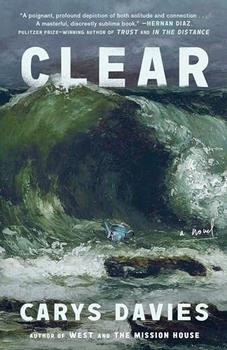




The House on Biscayne Bay
by Chanel Cleeton
As death stalks a gothic mansion in Miami, the lives of two women intertwine as the past and present collide.

The Stone Home
by Crystal Hana Kim
A moving family drama and coming-of-age story revealing a dark corner of South Korean history.

The Funeral Cryer by Wenyan Lu
Debut novelist Wenyan Lu brings us this witty yet profound story about one woman's midlife reawakening in contemporary rural China.
Your guide toexceptional books
BookBrowse seeks out and recommends the best in contemporary fiction and nonfiction—books that not only engage and entertain but also deepen our understanding of ourselves and the world around us.