Summary | Excerpt | Reading Guide | Reviews | Beyond the Book | Readalikes | Genres & Themes | Author Bio
Critics' Opinion:
Readers' Opinion:
First Published:
Jul 2012, 320 pages
Paperback:
Apr 2013, 320 pages
 Book Reviewed by:
Kim Kovacs
Buy This Book

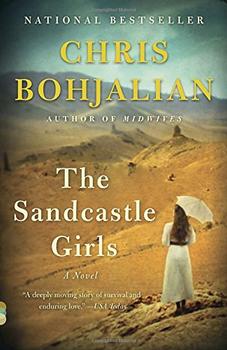
Approaching from down the street is a staggering column of old women, and she is surprised to observe they are African. She stares, transfixed. She thinks of the paintings and drawings she has seen of American slave markets in the South from the 1840s and 1850s, though weren’t those women and men always clothed--if only in rags? These women are completely naked, bare from their feet to the long drapes of matted black hair. And it is the hair, long and straight though filthy and impossibly tangled, that causes her to understand that these women are white--at least they were once--and they are, in fact, not old at all. Many might be her age or even a little younger. All are beyond modesty, beyond caring. Their skin has been seared black by the sun or stained by the soil in which they have slept or, in some cases, by great yawning scabs and wounds that are open and festering and, even at this distance, malodorous. The women look like dying wild animals as they lurch forward, some holding on to the walls of the stone houses to remain erect. She has never in her life seen people so thin and wonders how in the name of God their bony legs can support them. Their breasts are lost to their ribs. The bones of their hips protrude like baskets.
“Elizabeth, you don’t need to watch,” her father is saying, but she does. She does.
Herding the women forward through the town are half a dozen young men, two on horseback who look nearly as weak as the women, and four walking beside the group. All of them have rifles slung over their shoulders. They, too, don’t look any older than Elizabeth, and it crosses her mind that the pair nearest her can’t be more than fifteen or sixteen; their moustaches are wisps, a boy’s attempt to look like a man.
Just before the group reaches them, the gendarmes guide the women down the narrow street that will lead eventually to the square beneath the citadel, where they will be deposited with the deportees who arrived here yesterday. The men are short-tempered and tired. They strike the women when they move slowly or clumsily. They yank them back to their feet by their hair when they collapse. Elizabeth tries to count the women as they turn to the right and disappear into the alley, but reflexively she looks away whenever one of the skeletons meets her eye. Still, she guesses there are at least 125 of them. She verbalizes the number aloud without thinking.
“I assure you, Miss Endicott,” says Ryan, “when that group left Zeitun or Adana or wherever, there were at least a thousand of them.”
“Why did the Turks take their clothes?” she asks him.
He shakes his head. “They don’t usually--unless they’re planning to kill them. Sometimes they take the men’s clothes immediately before executing them; they worry the clothes of the dead are defiled. But I have no idea why they did in this case. Degrade the survivors, maybe. Perhaps increase the chances they’ll die on their own in the sun. But don’t look for reason in any of this.”
“And where are the men?”
He dabs at his forehead with a handkerchief. “It’s safe to assume they’re dead. Either they were--” He doesn’t finish because her father glares at the consul to be silent. To be still. Her father is hoping to introduce her to this world gradually. In increments. They discussed it little on either the ship or the train. Generalities of Ottoman history only.
Later this month, the two doctors in their party will arrive and they will start work. They--along with a returning missionary named Alicia Wells--telegrammed that their ship was going to be delayed leaving Boston, and might then take a more roundabout course to avoid U?boats. But whether the physicians are delayed two weeks or three might make all the difference in the world for some of the survivors who are brought here. These women, she presumes, will be long gone by then, marched back into the desert to one of the resettlement camps to the southeast. So will the group that is already in the square, the women and children who staggered in from the desert yesterday.
Excerpted from The Sandcastle Girls by Chris Bohjalian. Copyright © 2012 by Chris Bohjalian. Excerpted by permission of Doubleday, a division of Random House, Inc. All rights reserved. No part of this excerpt may be reproduced or reprinted without permission in writing from the publisher.






The House on Biscayne Bay
by Chanel Cleeton
As death stalks a gothic mansion in Miami, the lives of two women intertwine as the past and present collide.

The Flower Sisters
by Michelle Collins Anderson
From the new Fannie Flagg of the Ozarks, a richly-woven story of family, forgiveness, and reinvention.

The Funeral Cryer by Wenyan Lu
Debut novelist Wenyan Lu brings us this witty yet profound story about one woman's midlife reawakening in contemporary rural China.
Your guide toexceptional books
BookBrowse seeks out and recommends the best in contemporary fiction and nonfiction—books that not only engage and entertain but also deepen our understanding of ourselves and the world around us.