
-
Your next favorite book
is waiting.
Summary | Excerpt | Reviews | Beyond the Book | Readalikes | Genres & Themes | Author Bio
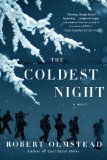
A Novel of Love and War
by Robert Olmstead Book Reviewed by:
The Captain asked Clemmie if she was ever in the city for
he could not recall a time when she was.
"Yes," she said. "One time."
They were stopped to let the horses blow. All about was
the sound of a hollow wind running the land, but it was not
the wind. It was the sound of the thaw, as what grew on the
earth and clutched to the rock gave up the cold in an aching
perceptible gasp.
"No," Clemmie said, reconsidering. "I guess I never was. I
guess I just took that I was."
Her horse scuffed at the cobbled trail. Though noon, it was
now dark again as if early in the morning and would be light
for all but another few hours of the day as the cut where they
stood was so deep and precipitous.
"Wherever you are, you will always think of me," the Captain
said to Henry, his voice seeming to break with regret.
The trail became a road rutted with threadlike rivulets
and late that day they came to the swollen Twelve Mile. They
would have to make a dangerous crossing on a rickety footbridge
and the Captain seemed to hesitate, but then he did
not. Fog enveloped their path and Clemmie commented on
how strange it was, the cold and wet about her legs and ankles,
while her upper body was warming to the light.
The Captain held the reins of the coal black horses as they
unlashed their bundles and shouldered them. First Clemmie
and then Henry embraced the old man and then they turned
and made their crossing over the swaying bridge that would
soon be washed away with the melt.
"Don't look down," she said, as if it were something she'd
heard and now was telling him.
When they reached the other side, Henry looked back. The
Captain was still there, astride a coal black horse, the other
two in hand. He raised his other hand, stretching forward
his arm. Henry made the slightest of gestures, a nod in the
Captain's direction, and the Captain stood in his stirrups, his
old body arched in fierce salute.
They went to live in the city and Clemmie took
a job working at the veterans' hospital where they got their
cast-off towels and bedding and soap. She also saved for
Henry the newspapers and magazines and books that were
left behind.
It was near impossible to imagine not being in the mountains,
but in the city the earth became the land at Henry's
feet. To the west he could see what lay between himself and
the horizon and it was without hollow, valley, defile, ravine,
or stony turret. The mountains were never far away, but the
site of the city was like something made by an originator, the
mountains seemingly split open and pushed back by hand
and then coved and held in place. He'd never walked so far
in a straight flat line and felt turned out and naked.
Clemmie fell from a station in life she'd not known she
occupied. Never before did they have to pay for water, heat,
and a roof. They had a small house with a sun-filled
kitchen
and the hospital had a cafeteria where they often took their
meals. On Saturday mornings Henry would go to the library
with his mother. They'd walk through the back streets where
clothes were hung on the lines to dry. The clothes wore a yellow
hue from the burning of coal and they'd go to the library
so he might pore over maps, atlases, and books of natural
history, as if assuaging the privations of childhood. Then
in the afternoon they'd purchase Italian ice sodas, almond,
orange, or banana with shaved ice in tall, cloudy glasses. In
the evenings Clemmie went to school and in time she became
a nurse.
Sometimes they had visitors, relatives he'd never met before
who'd been shunned by the Captain for having given
themselves over to the life of the wage earner in the coal
mines.
These relatives now lived in the city, or passed through,
returning whenever they could. Uncle Golden came through
when he was flush with money, and Aunt Adelita stayed with
them for a time after her husband and two sons died in the
Bartley No. 1 shaft mine. Ninety-one men and boys died that
day, killed by explosion and fire, and his mother told him
Aunt Adelita had been one of God's wandering souls ever
since.
From The Coldest Night by Robert Olmstead. © 2012 by Robert Olmstead. Excerpted by permission of Algonquin Books of Chapel Hill. All rights reserved.




Experience is not what happens to you; it's what you do with what happens to you
Click Here to find out who said this, as well as discovering other famous literary quotes!

Can you name the title?
Test your book knowledge with our daily trivia challenge!
Your guide toexceptional books
BookBrowse seeks out and recommends the best in contemporary fiction and nonfiction—books that not only engage and entertain but also deepen our understanding of ourselves and the world around us.

&url=https://www.bookbrowse.com/excerpts/index.cfm/book_number/2682/page_number/2/images/touch/apple-touch-icon-114x114.png)


