
-
Your next favorite book
is waiting.
Summary | Excerpt | Reading Guide | Discuss | Reviews | Readalikes | Genres & Themes | Author Bio

Excerpt
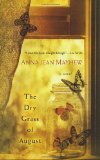
The Dry Grass of August
In August of 1954, we took our first trip without Daddy, and
Stell got to use the driver's license she'd had such a fit about.
It was just a little card saying she was Estelle Annette Watts,
that she was white, with hazel eyes and brown hair. But her
having a license made that trip different from any others, because
if she hadn't had it, we never would have been stuck in
Sally's Motel Park in Claxton, Georgia, where we went to buy
fruitcakes and had a wreck instead. And Mary would still be
with us.
Stell and I carried the last of the suitcases to the driveway.
The sky was a wide far blue above the willow oaks that line
Queens Road West, with no promise of rain to break the heat.
I put Mary's flowered cloth bag in the trunk and Daddy took
it out. "Always start with the biggest piece." He picked up
Mama's Pullman and grunted. "She packed like she's never
coming back." He hefted it into the trunk. "Okay, girls, what's
next?"
Stell tapped her suitcase with the toe of her size six penny
loafer.
"That's the ticket." Daddy put Stell's bag in the trunk beside
Mama's. He looked at the luggage still sitting by the car
and ran his hand through his hair, which was oily with Brylcreem
and sweat. "Ninety-five, and not even ten o'clock." He
wiped his face with his pocket handkerchief and pushed his
wire-rimmed glasses back in place. His hands were tan from
playing golf, thick and square, with blunt fingers. On his right
pinkie he wore a ring that had been his father's - gold, with a
flat red stone.
The cowbell rang as Mary shut the kitchen door behind
her. She came down the back walk, Davie on her hip. Puddin
stumbled along beside them, struggling with the small suitcase
she'd gotten for Christmas.
Daddy said to Mama, "Don't let Mary ride up front."
"I'd never do such a fool thing," Mama said. "Everybody
use the bathroom one last time."
Stell stepped into the shade of the garage. "I don't need
to."
I ran to the breezeway, touching Mary's arm when I passed
her, letting the screen door slap shut behind me. Daddy's bathroom
smelled like cigarettes and poop. I cranked open the
window and sat on his toilet to pee. In the full-length mirror
on the back of the door, I could see the awful welts on my
thighs. I stood and yanked up my pedal pushers.
Daddy was rearranging the luggage, making one more
square inch of room in the trunk. Stell Ann stood by the car,
shiny in her readiness, from her silky hair to her clear lip gloss
to her pale-pink nails. Polished like I could never be.
A horn honked. Aunt Rita's green Coupe deVille skidded
into our driveway, stopping beside the Packard. She rolled down
her window. "I found the picnic basket."
Mama said, "Great!" She asked Daddy, "Can we make room
for it?"
He groaned, looking into the crammed trunk.
Aunt Rita passed the basket out the window to Mama.
"It's packed with dishes, glasses, utensils. The ones in the paper
bag are for Mary." She lowered her voice. "There's talk of the
Klan in Georgia."
Mama handed the basket to Daddy. "We'll be fine."
"I hope so." Aunt Rita waved as she pulled out of the driveway.
Mama jingled her car keys. "Say good-bye to your father."
Daddy hugged Puddin with one arm and reached for Stell
with the other, but she held herself stiffly away from him. He
brushed my forehead with a kiss."Be good, Junebug.You know
you're Daddy's girl, right?"
His head blocked the morning sun and I couldn't see his
face.
Mary stood in the driveway, holding Davie. Daddy poked
Davie's tummy. "Say bye-bye."
Davie waved.
"Take care of my boy for me," Daddy said to Mary.
Excerpted from The Dry Grass of August by Anna Jean Mayhew. Copyright © 2011 by Anna Jean Mayhew. Excerpted by permission of Kensington. All rights reserved. No part of this excerpt may be reproduced or reprinted without permission in writing from the publisher.




A truly good book teaches me better than to read it...
Click Here to find out who said this, as well as discovering other famous literary quotes!

Can you name the title?
Test your book knowledge with our daily trivia challenge!
Your guide toexceptional books
BookBrowse seeks out and recommends the best in contemporary fiction and nonfiction—books that not only engage and entertain but also deepen our understanding of ourselves and the world around us.

