
-
Your next favorite book
is waiting.
Summary | Excerpt | Reviews | Beyond the Book | Readalikes | Genres & Themes | Author Bio
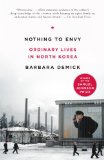
Ordinary Lives in North Korea
by Barbara Demick Book Reviewed by:
The girl would emerge just as soon as she could extricate herself from the family. Stepping outside, she would peer into the darkness, unable to see him at first but sensing with certainty his presence. She wouldn't bother with makeup—no one needs it in the dark. Sometimes she just wore her school uniform: a royal blue skirt cut modestly below the knees, a white blouse and red bow tie, all of it made from a crinkly synthetic material. She was young enough not to fret about her appearance.
At first, they would walk in silence, then their voices would gradually rise to whispers and then to normal conversational levels as they left the village and relaxed into the night. They maintained an arm's-length distance from each other until they were sure they wouldn't be spotted.
Just outside the town, the road headed into a thicket of trees to the grounds of a hot-spring resort. It was once a resort of some renown; its 130-degree waters used to draw busloads of Chinese tourists in search of cures for arthritis and diabetes, but by now it rarely operated. The entrance featured a rectangular reflecting pond rimmed by a stone wall. The paths cutting through the grounds were lined with pine trees, Japanese maples, and the girl's favorites—the ginkgo trees that in autumn shed delicate mustard-yellow leaves in the shape of perfect Oriental fans. On the surrounding hills, the trees had been decimated by people foraging for firewood, but the trees at the hot springs were so beautiful that the locals respected them and left them alone.
Otherwise the grounds were poorly maintained. The trees were untrimmed, stone benches cracked, paving stones missing like rotten teeth. By the mid-1990s, nearly everything in North Korea was worn out, broken, malfunctioning. The country had seen better days. But the imperfections were not so glaring at night. The hot-springs pool, murky and choked with weeds, was luminous with the reflection of the sky above.
The night sky in North Korea is a sight to behold. It might be the most brilliant in Northeast Asia, the only place spared the coal dust, Gobi Desert sand, and carbon monoxide choking the rest of the continent. In the old days, North Korean factories contributed their share to the cloud cover, but no longer. No artificial lighting competes with the intensity of the stars etched into its sky.
The young couple would walk through the night, scattering ginkgo leaves in their wake. What did they talk about? Their families, their classmates, books they had read—whatever the topic, it was endlessly fascinating. Years later, when I asked the girl about the happiest memories of her life, she told me of those nights.
This is not the sort of thing that shows up in satellite photographs. Whether in CIA headquarters in Langley, Virginia, or in the East Asian studies department of a university, people usually analyze North Korea from afar. They don't stop to think that in the middle of this black hole, in this bleak, dark country where millions have died of starvation, there is also love.
By the time I met this girl, she was a woman, thirty-one years old. Mi-ran (as I will call her for the purposes of this book) had defected six years earlier and was living in South Korea. I had requested an interview with her for an article I was writing about North Korean defectors.
In 2004, I was posted in Seoul as bureau chief for the Los Angeles Times. My job was to cover the entire Korean peninsula. South Korea was easy. It was the twelfth-largest economic power, a thriving if sometimes raucous democracy, with one of the most aggressive press corps in Asia. Government officials gave reporters their mobile telephone numbers and didn't mind being called at off-hours. North Korea was at the other extreme. North Korea's communications with the outside world were largely confined to tirades spat out by the Korean Central News Agency, nicknamed the "Great Vituperator" for its ridiculous bombast about the "imperialist Yankee bastards." The United States had fought on South Korea's behalf in the 1950–1953 Korean War, the first great conflagration of the Cold War, and still had forty thousand troops stationed there. For North Korea, it was as though the war had never ended, the animus was so raw and fresh.
Excerpted from Nothing to Envy by Barbara Demick Copyright © 2009 by Barbara Demick. Excerpted by permission of Spiegel & Grau, a division of Random House, Inc. All rights reserved. No part of this excerpt may be reproduced or reprinted without permission in writing from the publisher.







Asking a working writer what he thinks about critics...
Click Here to find out who said this, as well as discovering other famous literary quotes!

Can you name the title?
Test your book knowledge with our daily trivia challenge!
Your guide toexceptional books
BookBrowse seeks out and recommends the best in contemporary fiction and nonfiction—books that not only engage and entertain but also deepen our understanding of ourselves and the world around us.


