
-
Your next favorite book
is waiting.
Summary | Excerpt | Reading Guide | Reviews | Beyond the Book | Readalikes | Genres & Themes | Author Bio
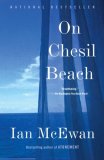
A Novel
by Ian McEwan Book Reviewed by:
To show that he was not troubled by the presence of the waiters, though he longed for them to leave, Edward smiled as he sat back with his wine and called over his shoulder, “Any more of those things?”
“Ain’t none, sir. Sorry sir.”
But the hand that held the wineglass trembled as he struggled to contain his sudden happiness, his exaltation. She appeared to glow before him, and she was lovely—beautiful, sensuous, gifted, good–natured beyond belief.
The boy who had spoken nipped forward to clear away. His colleague was just outside the room, transferring the second course, the roast, to their plates. It was not possible to wheel the trolley into the honeymoon suite for the proper silver service on account of a two–step difference in level between it and the corridor, a consequence of poor planning when the Elizabethan farmhouse was “Georgianized” in the mid–eighteenth century.
The couple were briefly alone, though they heard the scrape of spoons over dishes, and the lads murmuring by the open door. Edward laid his hand over Florence's and said, for the hundredth time that day, in a whisper, “I love you,” and she said it straight back, and she truly meant it.
Edward had a degree, a first in history from University College, London. In three short years he studied wars, rebellions, famines, pestilences, the rise and collapse of empires, revolutions that consumed their children, agricultural hardship, industrial squalor, the cruelty of ruling elites—a colorful pageant of oppression, misery and failed hopes. He understood how constrained and meager lives could be, generation after generation. In the grand view of things, these peaceful, prosperous times England was experiencing now were rare, and within them his and Florence’s joy was exceptional, even unique. In his final year he had made a special study of the “great man” theory of history—was it really outmoded to believe that forceful individuals could shape national destiny? Certainly his tutor thought so: in his view History, properly capitalized, was driven forward by ineluctable forces toward inevitable, necessary ends, and soon the subject would be understood as a science. But the lives Edward examined in detail—Caesar, Charlemagne, Frederick the Second, Catherine the Great, Nelson and Napoleon (Stalin he dropped, at his tutor’s insistence)—rather suggested the contrary. A ruthless personality, naked opportunism and luck, Edward had argued, could divert the fates of millions, a wayward conclusion that earned him a B minus, almost imperiling his first.
Excerpted from On Chesil Beach by Ian McEwan Copyright © 2007 by Ian McEwan. Excerpted by permission of Nan A. Talese, a division of Random House, Inc. All rights reserved. No part of this excerpt may be reproduced or reprinted without permission in writing from the publisher.



In order to become the master, the politician poses as the servant
Click Here to find out who said this, as well as discovering other famous literary quotes!

Can you name the title?
Test your book knowledge with our daily trivia challenge!
Your guide toexceptional books
BookBrowse seeks out and recommends the best in contemporary fiction and nonfiction—books that not only engage and entertain but also deepen our understanding of ourselves and the world around us.

