
-
Your next favorite book
is waiting.
Summary | Excerpt | Reviews | Beyond the Book | Readalikes | Genres & Themes | Author Bio
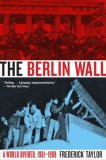
A World Divided, 1961-1989
by Frederick Taylor Book Reviewed by:
Of course, wars, plagues and fires tormented its inhabitants, just as they did other Europeans in the unlucky fourteenth century. The Ascanian dynasty that ruled Brandenburg for centuries eventually died out. Disease, war and famine stalked the land. The Holy Roman Emperor decided to name a new ruler for this neglected area, a scion of a Nuremberg family that had flourished as hereditary castellans of that powerful imperial free city. The family was called Hohenzollern. Its members would rule here through triumph and disaster for 500 years.
Frederick VI Hohenzollern officially became Frederick I of Brandenburg in 1415. Berlin's citizens were delighted. The patrician élite was pleased that this busy man from a distant province left them to rule as they had done for centuries. Berlin kept its privileges, and so did they.
In 1440, the first Hohenzollern ruler died. His successor, Frederick II, unpromisingly known as 'Irontooth', proved the city's nemesis. He played the citizens off against the patricans, then crushed the rebellion that followed. Henceforth the city was ruled by his nominees. The Margrave would deal with Berliners' property and levy taxes on them as he wished.
In 1486, the city became the lords of Brandenburg's official residence. From now until the second decade of the twentieth century, the monarch ruled there, in person and almost entirely absolutely.
In the 1530s, Brandenburg's ruler, Joachim II—now bearing the title of 'Elector', as one of the princes who chose the Holy Roman Emperor adopted Protestantism. In February i he attended the first Lutheran service to be held in Berlin. His subjects followed him—on the whole, willingly—into this new religious direction.
The states of the Holy Roman Empire agreed on a policy of mutual toleration. According to the neat Latin slogan, cuius regio, eius religio (whose region it is, his religion), it would be up to each German prince to determine whether Lutheranism or Catholicism would be the official religion in his particular area. The religious truce and Germany's prosperty lasted until the early 1600s.

The foregoing is excerpted from The Berlin Wall by Frederick Taylor. All rights reserved. No part of this book may be used or reproduced without written permission from HarperCollins Publishers, 10 East 53rd Street, New York, NY 10022




In war there are no unwounded soldiers
Click Here to find out who said this, as well as discovering other famous literary quotes!

Can you name the title?
Test your book knowledge with our daily trivia challenge!
Your guide toexceptional books
BookBrowse seeks out and recommends the best in contemporary fiction and nonfiction—books that not only engage and entertain but also deepen our understanding of ourselves and the world around us.
