
-
Your next favorite book
is waiting.
Summary | Excerpt | Reviews | Beyond the Book | Readalikes | Genres & Themes | Author Bio
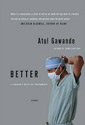
A Surgeon's Notes on Performance
by Atul Gawande Book Reviewed by:
The second challenge is to do right. Medicine is a fundamentally human profession. It is therefore forever troubled by human failings, failings like avarice, arrogance, insecurity, misunderstanding. In this section I consider some of our most uncomfortable questions—such as how much doctors should be paid, and what we owe patients when we make mistakes. I tell the stories of four doctors and a nurse who have gone against medical ethics codes and participated in executions of prisoners. I puzzle over how we know when we should keep fighting for a sick patient and when we should stop.
The third requirement for success is ingenuity—thinking anew. Ingenuity is often misunderstood. It is not a matter of superior intelligence but of character. It demands more than anything a willingness to recognize failure, to not paper over the cracks, and to change. It arises from deliberate, even obsessive, reflection on failure and a constant searching for new solutions. These are difficult traits to foster—but they are far from impossible ones. Here I tell the stories of people in everyday medicine who have, through ingenuity, transformed medical care—for example, the way babies are delivered and the way an incurable disease like cystic fibrosis is fought—and I examine how more of us can do the same.
Betterment is a perpetual labor. The world is chaotic, disorganized, and vexing, and medicine is nowhere spared that reality. To complicate matters, we in medicine are also only humans ourselves. We are distractible, weak, and given to our own concerns. Yet still, to live as a doctor is to live so that one’s life is bound up in others’ and in science and in the messy, complicated connection between the two. It is to live a life of responsibility. The question, then, is not whether one accepts the responsibility. Just by doing this work, one has. The question is, having accepted the responsibility, how one does such work well.
Virginia Magboo lay waiting, anxious and hungry, in a windowless, silent, white-lit holding area for still two hours more. The minutes ticked, ticked, ticked. At times, in medicine, you feel you are inside a colossal and impossibly complex machine whose gears will turn for you only according to their own arbitrary rhythm. The notion that human caring, the effort to do better for people, might make a difference can seem hopelessly naïve. But it isn’t.
Magboo asked me if there was any real prospect of her having her operation that night. The likelihood, I said, had become exceedingly small. But I couldn’t bring myself to send her home, and I asked her to hang on with me. Then, just before eight o’clock, I got a text message on my pager. “We can bring your patient back to room 29,” the display read. Two nurses, it turned out, had seen how backed up the ORs had gotten and, although they could easily have gone home, they volunteered to stay late. “I didn’t really have anything else going on anyway,” one demurred when I spoke to her. When you make an effort, you find sometimes you are not the only one willing to do so.
Eleven minutes after I got the page, Magboo was on the operating table, a sedative going into her arm. Her skin was cleansed. Her body was draped. The breast cancer came out without difficulty. Her lymph nodes proved to be free of metastasis. And she was done. She woke up calmly as we put on the dressing. I saw her gazing upward at the operating light above her.
“The light looks like seashells,” she said.
Copyright © 2007 by Atul Gawande. All rights reserved.







There is no science without fancy and no art without fact
Click Here to find out who said this, as well as discovering other famous literary quotes!

Can you name the title?
Test your book knowledge with our daily trivia challenge!
Your guide toexceptional books
BookBrowse seeks out and recommends the best in contemporary fiction and nonfiction—books that not only engage and entertain but also deepen our understanding of ourselves and the world around us.

