
-
Your next favorite book
is waiting.
Summary | Excerpt | Reviews | Beyond the Book | Readalikes | Genres & Themes | Author Bio
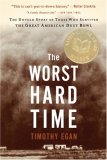
The Untold Story of Those Who Survived the Great American Dust Bowl
by Timothy Egan Book Reviewed by:
"For the sake of a lasting peace," General Sheridan told the Texas
Legislature in 1875, the Anglos should "kill, skin and sell until the buffaloes
are exterminated. Then your prairie can be covered with speckled cattle and the
festive cowboy . . . forerunner of an advanced civilization."
The animals left behind sun-crisped turds, which the nesters used
to heat their dugouts and soddies, until they too ran out.
Empty of bison and Indians, the prairie was a lonely place; it had
taken barely ten years to eliminate them. In victory, the American
government was not sure what to do with the land.
"The High Plains continues to be the most alluring body of
unoccupied land in the United States, and will remain such until the best
means of their utilization have been worked out," the United States
Geological Survey wrote in a report at the dawn of the twentieth century.
At the Texas border, the White family crossed into the XIT ranch — or rather,
what was left of it. Virtually all his life Bam White had heard stories of the
Eden of Texas, the fabled land of waist-high bluestem, of short, resilient
buffalo turf, and the nutrient-rich grama, part of what Coronado had called "an
immensity of grass." Horizon to horizon, buffalo heaven, and a cattleman's
dream, the XIT had been part of the New World's magical endowment —
grasslands covering 21 percent of the United States and Canada, the largest
single ecosystem on the continent outside the boreal forest. In Texas alone,
grasslands covered two thirds of the state, with more than 470 native
species. Virtually all of the Panhandle, nearly twenty million acres, was
grass. In the spring, the carpet flowered amid the green, and as wind blew, it
looked like music on the ground. To see a piece of it in 1926, even in winter
dormancy, could delight a tomorrow man like Bam White, who loved sky and
earth in endless projection.
The temperature warmed just before dusk, and the sky boiled up,
thunderheads coming out of the east. It was too early in the year yet for
clouds to be throwing down lightning and hail, but it happened enough that
people took precautions when warning signs appeared overhead. Bam fretted
about his horses. They looked sad-eyed and road-worn. Like most cowboys
in the High Plains, he preferred darker horses, chocolate-colored or leathery
brown, on a belief that they were less likely to attract lightning. One of his
horses was lighter, not quite beige, just light enough to bring a thunderbolt
down on it. Bam had never actually seen a light-haired horse combust at the
touch of lightning, but he had heard plenty of stories. A friend of his had seen
a cow struck dead by a sky-spark. Bam looked around: there were no rock
overhangs or little arroyos such as they had passed through up north.Well,
hell — what did those XIT cowboys used to do? If those boys could get
through a thunder-boomer without shelter, Bam White could do the same.
Everybody in Texas had a story about the XIT. It was the ranch
that built the state capitol, the granddaddy of them all. Fifteen years after
the
end of the Civil War, Texas wanted the biggest statehouse in the union, a
palace of polished red granite. To pay for the new stone showpiece, the state
offered up three million acres in the distant Panhandle to anybody willing to
construct the building. After the tribes were routed, Charles Goodnight had
moved a herd of 1,600 cattle down from Colorado to Palo Duro Canyon. The
grass then was free; it attracted other nomadic Anglo beef-drivers and
speculators from two continents. In 1882, a company out of Chicago
organized the Capitol Syndicate, and this group of investors took title to three
million acres in return for agreeing to build the capitol. It would cost about
$3.7 million, which meant the land went for $1.23 an acre. The syndicate
drew some big British investors into the deal, among them the Earl of
Aberdeen and several members of Parliament. By then, the Great Plains
cattle market was the talk of many a Tory cocktail hour. Books such as How
to Get Rich on the Plains explained how any investor could double his money
in five years.
Copyright © 2005 by Timothy Egan. Reprinted by permission of Houghton Mifflin Company.




Second hand books are wild books...
Click Here to find out who said this, as well as discovering other famous literary quotes!

Can you name the title?
Test your book knowledge with our daily trivia challenge!
Your guide toexceptional books
BookBrowse seeks out and recommends the best in contemporary fiction and nonfiction—books that not only engage and entertain but also deepen our understanding of ourselves and the world around us.


