
-
Your next favorite book
is waiting.
Summary | Excerpt | Reviews | Beyond the Book | Readalikes | Genres & Themes | Author Bio
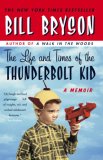
A Memoir
by Bill Bryson Book Reviewed by:
• seafood of any type but especially seafood that looked like large insects;
• soups not blessed by Campbell’s and only a very few of those;
•
anything with dubious regional names like “pone,” or “gumbo” or foods
that had at any time been an esteemed staple of slaves or peasants.
All
other foods of all types — curries, enchiladas, tofu, bagels, sushi,
couscous, yogurt, kale, rocket, Parma ham, any cheese that was not a
vivid bright yellow and shiny enough to see your reflection in — had
either not yet been invented or was yet unknown to us. We really were
radiantly unsophisticated. I remember being surprised to learn at quite
an advanced age that a shrimp cocktail was not, as I had always
imagined, a pre-dinner alcoholic drink with a shrimp in it.
All
our meals consisted of leftovers. My mother had a seemingly
inexhaustible supply of foods that had already been to the table,
sometimes many times. Apart from a few perishable dairy products,
everything in the fridge was older than I was, sometimes by many years.
(Her oldest food possession of all, it more or less goes without
saying, was a fruitcake that was kept in a metal tin and dated from the
colonial period.) I can only assume that my mother did all of her
cooking in the 1940s so that she could spend the rest of her life
surprising herself with what she could find under cover at the back of
the fridge. I never knew her to reject a food. The rule of
thumb seemed to be that if you opened the lid and the stuff inside
didn’t make you actually recoil and take at least one staggered step
backwards, it was deemed OK to eat.
Both of my parents had
grown up in the Great Depression and neither of them ever threw
anything away if they could possibly avoid it. My mother
routinely washed and dried paper plates, and smoothed out for reuse
spare aluminum foil. If you left a pea on your plate, it became part of
future meal. All our sugar came in little packets spirited out of
restaurants in deep coat pockets, as did our jams, jellies, crackers
(oyster and saltine), tartar sauces, some of our ketchup and
butter, all of our napkins, and a very occasional ashtray; anything
that came with a restaurant table really. One of the happiest moments
in my parents’ life was when maple syrup started to be served in small
disposable packets and they could add those to the household hoard.
*In
fact like most other people in America. It is perhaps worth noting that
the leading American food writer of the age, Duncan Hines, author of
the hugely successful Adventures in Eating, declared with pride
that he never ate food with French names if he could possibly help it.
Hines’s other boast was that he did not venture out of America until he
was seventy years old, when he made a trip to Europe. He disliked
nearly everything he found there, especially the food.

Excerpted from The Life and Times of the Thunderbolt Kid by Bill Bryson Copyright © 2006 by Bill Bryson. Excerpted by permission of Broadway, a division of Random House, Inc. All rights reserved. No part of this excerpt may be reproduced or reprinted without permission in writing from the publisher.




The worth of a book is to be measured by what you can carry away from it.
Click Here to find out who said this, as well as discovering other famous literary quotes!

Can you name the title?
Test your book knowledge with our daily trivia challenge!
Your guide toexceptional books
BookBrowse seeks out and recommends the best in contemporary fiction and nonfiction—books that not only engage and entertain but also deepen our understanding of ourselves and the world around us.
