
-
Your next favorite book
is waiting.
Summary | Excerpt | Reviews | Beyond the Book | Readalikes | Genres & Themes | Author Bio
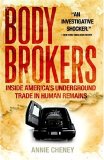
Inside America's Underground Trade in Human Remains
by Annie Cheney Book Reviewed by:
Fourteen months passed. Then, one afternoon, the telephone rang
in Joyce's house.
When she answered it, a woman asked, "Are you the mother of
Jim Farrelly?"
"Yes," Joyce said. "What is this regarding?"
"I'm a victim's advocate."
Joyce wondered if one of her sons was playing a joke. "But my
son is dead," she said.
"Yes, I know," the woman said.
Could it be identity theft? Joyce pressed the phone to her ear
and took a deep breath. "I don't understand," she said. "What is
this about?"
The female caller paused. "I'm calling to tell you that your son
has been the victim of a crime."
"A crime?" Joyce almost laughed.
""Ma'am," the woman's voice was somber. "We have
identified your
son's body parts at a crematorium. His body was dismembered."
Dismembered? But Jim's ashes . . . He'd been buried. He
was fine. Joyce said, "I'm going to have to call you
back."
Later, Joyce would recall that final night in the hospital. In
retrospect, it seemed odd to have left Jim alone. And yet, what
could she have done? No one had invited her to the morgue. Did
the hospital even have one? Joyce had never thought to ask. The
nurses, who had been so solicitous when Jim was alive, said
nothing about his corpse. Joyce had signed some papers at the
funeral home. But she never saw Jim's body. Now, Joyce wondered:
Where had they taken him? Why hadn't she been there for her son?
Corpses lead a perilous existence. Whisked from the arms of
family and friends, they embark on a journey under the care of
strangers. In most cases, those to whom we entrust our dead take
care to ensure that they're laid to rest safely. Most morgue
workers, funeral directors, and crematorium operators keep
careful track of each body. Indeed, many care for them as they
would the dead bodies of their own relatives. Still, body
brokers have been known to haunt this dark landscape, hunting
for body parts, which they can later sell.
At each stage of the journey, there is ample opportunity for
theft. At the hospital, a nurse or an attendant shuttles the
corpse first to the morgue, where it's stored in a steel
refrigerator. If a family requests it, an autopsy may be
performed. As it happens, an autopsy is an ideal situation for
body brokers inclined to theft. Pathologists routinely take
samples of specimens relevant to their investigation–a slice of
kidney, for instance–which get preserved in paraffin blocks and
transferred onto slides. An honest pathologist may remove a
whole brain and keep it fixed in preservative for weeks.
Otherwise, the brain matter will not yield its secrets. This is
perfectly legal as long as the doctor has permission from the
deceased's family.
But consent forms vary in their specificity, and pathologists
often work with unlicensed assistants known as dieners, a
word derived from the German for servant. Dieners do the work
that no one else wants to do: They dissect bodies, cutting
through bone and muscle and removing whole organs so that the
pathologists can weigh and examine them. They are responsible
for cleaning up the morgue and assisting pathologists. A diener
may work with a pathologist, while at the same time harvesting
body parts for tissue banks. Stealing body parts is easy for a
diener, and the money is good. Dieners often become brokers.
Excerpted from Body Brokers by Annie Cheney Copyright © 2006 by Annie Cheney. Excerpted by permission of Broadway, a division of Random House, Inc. All rights reserved. No part of this excerpt may be reproduced or reprinted without permission in writing from the publisher.



To limit the press is to insult a nation; to prohibit reading of certain books is to declare the inhabitants to be ...
Click Here to find out who said this, as well as discovering other famous literary quotes!

Can you name the title?
Test your book knowledge with our daily trivia challenge!
Your guide toexceptional books
BookBrowse seeks out and recommends the best in contemporary fiction and nonfiction—books that not only engage and entertain but also deepen our understanding of ourselves and the world around us.


