Summary | Excerpt | Reviews | Beyond the Book | Readalikes | Genres & Themes | Author Bio

Critics' Opinion:
Readers' Opinion:
First Published:
Feb 2005, 384 pages
Paperback:
Feb 2006, 400 pages

Excerpt
Prince of Fire
THERE HAD BEEN WARNING SIGNS - THE SHABBAT bombing of a Jewish community center in Buenos Aires that left eighty-seven people dead; the bombing of an Istanbul synagogue, precisely one year later, that killed another twenty-eight-but Rome would be his coming-out party, and Rome would be the place where he left his calling card.
Afterward, within the corridors and executive suites of Israel's vaunted intelligence service, there was considerable and sometimes belligerent debate over the time and place of the conspiracy's genesis. Lev Ahroni, the ever-cautious director of the service, would claim that the plot was hatched not long after the Israeli army knocked down Arafat's headquarters in Ramallah and stole his secret files. Ari Shamron, the legendary Israeli master spy, would find this almost laughable, though Shamron often disagreed with Lev simply as a matter of sport. Only Shamron, who had fought with the Palmach during the War of Independence and who tended to view the conflict as a continuum, understood intuitively that the outrage in Rome had been inspired by deeds dating back more than a half century. Eventually, evidence would prove both Lev and Shamron correct. In the meantime, in order to achieve peaceful working conditions, they agreed on a new starting point: the day a certain Monsieur Jean-Luc arrived in the hills of Lazio and settled himself in a rather handsome eighteenth-century villa on the shore of Lake Bracciano.
As for the exact date and time of his arrival, there was no doubt. The owner of the villa, a dubious Belgian aristocrat called Monsieur Laval, said the tenant appeared at two-thirty in the afternoon on the final Friday of March. The courteous but intense young Israeli who called on Monsieur Laval at his home in Brussels wondered how it was possible to recall the date so clearly. The Belgian produced his lavish leather-bound personal calendar and pointed to the date in question. There, penciled on the line designated for 2:30 P.M., were the words: Meet M. Jean-Luc at Bracciano villa.
"Why did you write Bracciano villa instead of just villa?" asked the Israeli visitor, his pen hovering over his open notebook.
"To differentiate it from our St. Tropez villa, our Portuguese villa, and the chalet we own in the Swiss Alps."
"I see," said the Israeli, though the Belgian found that his visitor's tone lacked the humility adopted by most civil servants when confronted by men of great wealth.
And what else did Monsieur Laval remember of the man who rented his villa? That he was punctual, intelligent, and extremely well-mannered. That he was strikingly good-looking, that his scent was noticeable but not obtrusive, that his clothing was expensive but restrained. That he drove a Mercedes car and had two large suitcases with gold buckles and a famous label. That he paid the entire month long lease in advance and in cash, which Monsieur Laval explained was not unusual in that part of Italy. That he was a good listener who didn't need to be told things twice. That he spoke French with the accent of a Parisian from a well-heeled arrondissement. That he seemed like a man who could handle himself well in a fight and who treated his women well. "He was of noble birth," Laval concluded, with the certainty of one who knows of what he speaks. "He comes from a good bloodline. Write that in your little book."
Slowly, additional details would emerge about the man called Jean-Luc, though none conflicted with Monsieur Laval's flattering portrait. He hired no cleaning woman and demanded the gardener arrive punctually at nine o'clock and leave by ten. He shopped in nearby market squares and attended Mass in the medieval lakeside village of Anguillara. He spent much time touring the Roman ruins of Lazio and seemed particularly intrigued by the ancient necropolis at Cerveteri.
From Prince of Fire by Daniel Silva. Copyright notice Daniel Silva 2005, all rights reserved. No part of this book maybe reproduced without written permission from the publisher, Putnam Publishing.






The Flower Sisters
by Michelle Collins Anderson
From the new Fannie Flagg of the Ozarks, a richly-woven story of family, forgiveness, and reinvention.
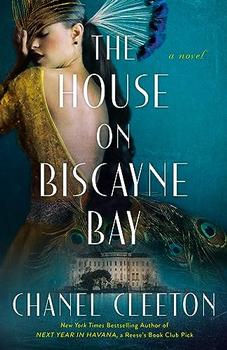
The House on Biscayne Bay
by Chanel Cleeton
As death stalks a gothic mansion in Miami, the lives of two women intertwine as the past and present collide.

The Funeral Cryer by Wenyan Lu
Debut novelist Wenyan Lu brings us this witty yet profound story about one woman's midlife reawakening in contemporary rural China.
Your guide toexceptional books
BookBrowse seeks out and recommends the best in contemporary fiction and nonfiction—books that not only engage and entertain but also deepen our understanding of ourselves and the world around us.